
The Superior Court of Justice (TSJ) of Andalusia has ruled in favor of a worker who wanted to bring his 70-year-old widowed mother to Spain from Morocco. Although at first the Immigration Office rejected the request because it considered that it did not meet the financial requirements and had not sufficiently proven the reasons for that trip, a judge finally upheld the appeal.
The man’s mother, who filed the lawsuit in Jaén, did not have any kind of income, so her son wanted to have her by his side and requested family reunification. The documentation presented and studied by the first administration indicated that the worker was earning an average of 1,148.41 euros per month during the six months prior to submitting the application.
For this reason, since it was a family unit of three members, the administration responded by saying that it was necessary to have a minimum income of 1,200 euros per month. The court considered that the personal and economic circumstances left the door open for this requirement to be made more flexible because the woman was a widow, 70 years old, lacked means and depended on the money her son sent her.
Family reunification denied
The Subdelegation of the Government of Jaén denied authorization in February 2023, pointing out that the applicant did not have the minimum level of income and that it was not sufficiently proven that he took care of his mother. Furthermore, she stated that the fact that she was widowed and that she wanted to live with her son was not enough to justify residence in Spain.
He pointed out that it was not proven that she did not have other relatives in Morocco or that she suffered from any illness that could not be treated there.
The son was not satisfied with the arguments nor with the Immigration Department’s procedure and appealed the decision. Justice, through the Administrative Litigation Court number 1 of Jaén, agreed, pointing out that the denial did not comply with the law and ordered the administration to grant the requested authorization.
The woman received 3,100 euros from her son for a year
One of the elements with which the son managed to get the administration to change the decision was that he demonstrated that he had been sending money to his mother between the months of December 2021 and December 2022, and adding everything he had received, it was 3,100 euros with which to cover basic needs.
For the court, this amount was close to the Gross Domestic Product (GDP) per capita of the Alawite country for 2021, which was 3,324 euros as stated in STSJ AND 8589/2026. The court considered that these payments demonstrated that the woman was in a situation of economic dependence and that it was not a simple promise on the part of the son to support her in the future.
The TSJ of Andalusia, based in Plaza Nueva (Granada) shared that explanation, considering it proven that the woman was in charge of her son because she lacked her own means of living and needed the support that he sent her from Spain.
Get residency
The administration appealed the ruling, pointing out that the reduction in minimum income applies when the person to be reunited is a minor and that in the case of other family members such as ascendants, there must be individualized humanitarian reasons and a favorable report from the General Directorate of Immigration.
The Justice rejected this interpretation for this specific case, pointing out that the mother was 70 years old, was a widow, had no financial means and the money she received was what her son sent her, so, when this had been verified, it was demonstrated that there was a need to authorize her residence in Spain.
The worker received a salary, not social assistance
The resolution reproduces a point of the Immigration Regulation in which reference is made to the Minimum Vital Income (IMV) but the protagonist of the information was not receiving this aid but rather had paid employment accredited by the payroll.
The guaranteed income of the IMV is a reference that is used by the administration to calculate the minimum resources required in certain cases of family reunification, specifically for family units in which one of the reunified persons is a minor.
He wins 109,333 euros in the Christmas Lottery with a tenth that his lover gave him and he has to share the money with his ex-wife because they were still in a relationship.
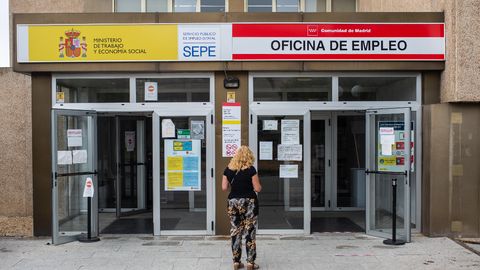
A woman wins from the SEPE after she claimed 4,525 euros for an error when calculating her unemployment: they did not deduct the days she was on sick leave
But in this case it was not like that and the decision was made based on the particular situation of the 70-year-old woman, who did not have sufficient means and depended on the money that her son sent her.