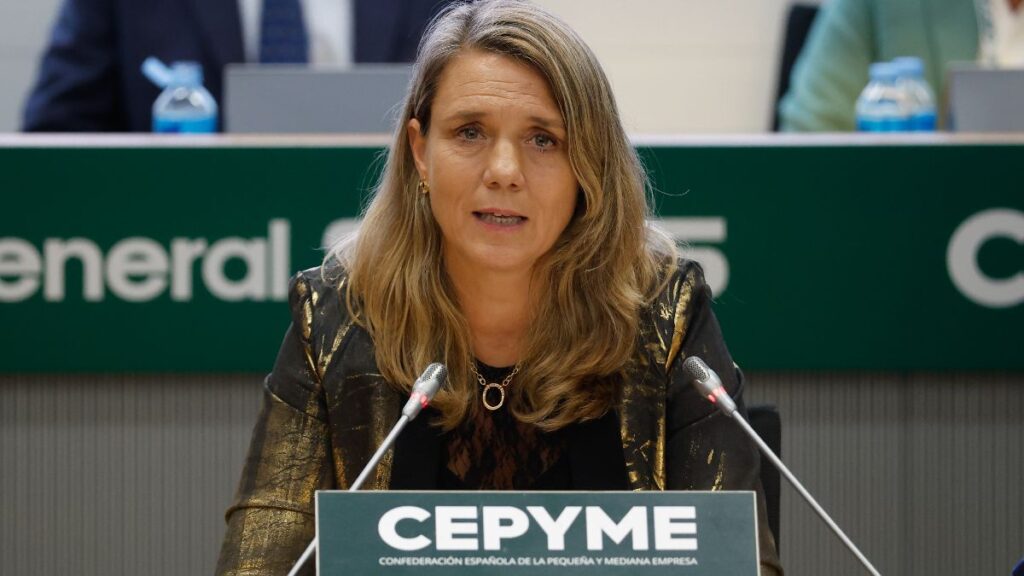
The Spanish Confederation of Small and Medium Enterprises (Cepyme) has warned of the stagnation of the activity of small and medium-sized enterprises, especially microenterprises, in contrast to economic growth in year-on-year terms. The organization has pointed out that this context places smaller companies in a more unfavorable situation to face the upward risks of recent months, derived from the global geopolitical environment.
According to the Cepyme Indicator on the Situation of SMEs, corresponding to the second half of 2025, although the general situation of SMEs has improved slightly in year-on-year terms, recent developments reflect a loss of momentum and an increasingly demanding context, marked mainly by increased costs and economic uncertainty.
Niño Becerra, economist, points out what the economy will change in the coming years: “It will prevent inflation from being a problem”

A company evicts an elderly woman with an old rent after her husband died even though she continued paying: Justice supports it because the law limits subrogations in these contracts
A situation that, as they have expressed in a statement, has worsened even more in the first months of 2026, as a consequence of the war in the Middle East and the increases in the costs of energy, fuel and raw materials, which increase instability and the risks of higher financing costs and a fall in investment and consumption.
The aforementioned indicator analyzes the evolution of costs, sales, financing and solvency of small and medium-sized companies in the reference period. In this case, in the second half of 2025, it stood at 6.1 points, slightly below the two previous quarters and still far from the levels above seven points recorded between 2015 and 2017.
25% cost increase
Cepyme clearly identifies costs as the main problem of SMEs. This block continues to be the “Achilles heel” of the Indicator and registers the lowest scores since 2022. A trend that, they warn, will probably increase in the coming months, as a consequence of the effects of the war conflict in the Middle East.
In this sense, the CEPYME report highlights the accumulated increase in operating costs of 25% since 2019, which is eroding business margins and, especially, the sustained increase in labor costs, which are growing at an average rate of 4.3% annually since 2021, “well above” the period before the pandemic.
From the first quarter of 2021 to the end of 2025, a difference of more than 5 percentage points accumulated between the increase in labor costs in small businesses (28.7%) and microbusinesses (29%) compared to medium-sized businesses (23.4%). In the last five years, labor costs in smaller companies have risen on average one percentage point more each year than in medium-sized companies.
Impact of the minimum wage
Likewise, the organization points out the strong pressure of the minimum wage in this increase in labor costs, with an especially intense impact on smaller companies. Between 2016 and 2026 it has increased by 86%, which is equivalent to an accumulated annual growth rate of 6.4%, which explains why labor costs have risen proportionally more in smaller companies.
The average salary of smaller companies is lower because their productivity is, on average, lower. Hence, the same increase in the minimum wage has a greater impact the smaller the size of the company.