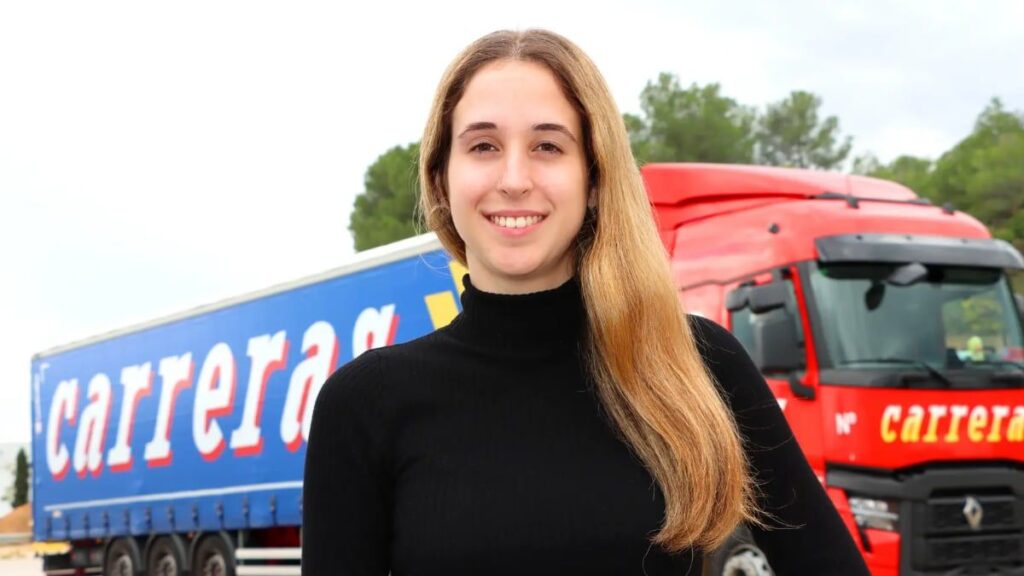
The truck driver’s profession has always been marked by male and age profiles greater than 40 years, but sometimes the new generations come to break those stereotypes. This is the case of Andrea, a young woman who with only 22 years has become the youngest truck in Spain.
This has been told in the YouTube program Success routes Where the young woman tells how her first year has been behind the wheel of a trailer and where she says that “he does not regret” of the bet he did with just 20 years, when he decided to get the necessary cards to drive trucks. “I plan to dedicate myself to it all my life,” he says without hesitation, convinced that he has found a stable, well paid and future job.
You may be interested
Amina Mouthadi, unemployed waitress, responds without hairs on the tongue to Gonzalo Bernardos: “Collection 1,500 euros and paid 750 for a shit and shared apartment. And you come to tell me that we are pijos?”

José Elías, a billionaire, against the educational system: “It teaches you to be poor”
“I like trucks as a child”
Andrea was always clear that his were the engines and while other girls played with dolls, she preferred the strollers and miniature trucks. Years later, her husband, also a truck driver, encouraged her to turn that passion into a professional exit.
With 20 years the process began and the first thing was to get the CAP, then the rigid card and finally the trailer. It was not an easy path. “Between practices, exams and fees, were between 4,000 and 5,000 euros,” he summarizes. Even so, it was not done uphill: “If you really like it and make you want and illusion, it goes well.”
Despite the initial difficulties, just a few months later I was already working. It started in the Mercadona supermarket chain and, after gaining experience, made the leap to the company in which it continues.
Eight hours and “fair” salary
One of the aspects that most attracts the attention of his story is how Andrea disarms the topic of endless roads on the road. “My contract is clear: Monday through Friday, in a fixed afternoon shift, from 2:00 p.m. to 10:00 p.m.,” he explains. And he adds with satisfaction: “They told me eight hours and they are fulfilling it.”
Its day to day develops on regional routes in Catalonia. “I usually move through the Barcelona area,” he says, detailing that he usually covers “between 200 and 250 kilometers a day.” Although it conducts a refrigerator truck, it clarifies that “it almost always transports dry merchandise” and that its activity “is quite stable”, which allows, as it emphasizes, “having time for me, something unusual in this sector.”
The salary is another of the points that break the stereotypes associated with transport. “Round the 2,000 euros per month,” he says. And far from joining the generalized complaint for low wages, Andrea defends it: “For what I do, it seems quite well.”
“A sector that still drags prejudices”
Although Andrea says that in her company “I feel valued and respected,” he acknowledges that he has still lived uncomfortable situations. “Once, in a warehouse, a man asked me with disdain what I was doing there, like insinuating that driving a truck was not a woman’s thing,” he recalls. His answer was immediate: “I am a person like you.”
Nor have the comments about their age have lacked. “They have told me several times: ‘You have no idea what transport is,” he confesses. But it is not dragged by those criticisms. “Yes, it is true that I have been for a short time, but for something you start,” he replies. And it underlines it with conviction: “Because she is a woman and young, she does not mean that she makes the task worse.”
What looks in the future
Andrea is not limited to telling her day to day, she also raises improvement proposals. “If you do 44 minutes of rest, do not tell you only 15. That makes you later get home,” protest, claiming changes in the tachograph.
Another of the issues that worry are public services for drivers. “Women’s bathrooms are often in an unfortunate state,” he denounces. And a possible solution points: “If a small rate were paid, people would take care of them more and be cleaner.”
But, above the criticism, his message is positive and direct to young people: “I would encourage the card to be removed and not be afraid. It is a very important sector and, for me, very beautiful.” Remember that since it was formed “I have not been unemployed for a single day” and that “companies always need drivers.”
Looking ahead, it does not rule out new horizons. “I would like to be a mother and maybe an office post, as a traffic manager, would give me more room to reconcile,” he admits. Even so, it makes it clear that he does not give up what he is passionate about: “What I like most is to drive, listen to music, see the landscape … that freedom does not give it any other work.”