


The voluntary early retirement allows workers with long contribution careers to retire up to 2 years earlier than their ordinary retirement age. Now, it is necessary to meet several requirements, one of which is unknown to many workers. In this sense, Alfonso Muñoz Cuenca, an official at the National Social Security Institute specialized in pensions, explains that “there have been several people I have assisted who have been denied their early retirement pension for a reason they had never heard of.”
Muñoz begins by explaining the difference between voluntary and involuntary early retirement. “In our country there are several types of early retirement, but the most common are involuntary and voluntary.”
You may be interested

Justice confirms that being able to retire early does not extinguish the right to collect unemployment: only the ordinary retirement age does so
Laura Allué (61 years old and 44 contributions): “I was entitled to a pension of about 3,000 euros but they have penalized me 27%, I feel cheated”
Involuntary early retirement is regulated in article 207 of the General Social Security Law, allowing retirement to be brought forward four years with respect to the ordinary age as long as there are causes beyond the control of the worker, such as an objective or collective dismissal, and 33 years of contributions are proven. It also requires being registered as a job seeker for at least six months.
For its part, voluntary early retirement, included in article 208 LGSS, allows you to retire two years earlier with at least 35 years of contributions. And this is where the requirement that is causing problems appears.
The economic requirement that causes the denial
As the official explains, in addition to the years of contributions and age, there is another, less well-known one. “The amount of the resulting pension must be higher than the amount of the minimum pension that would correspond to the interested party based on their family situation at age 65.”
This requirement is reflected on the voluntary Social Security website itself, which says that if after applying the reducing coefficients the pension remains below the minimum pension, Social Security automatically denies it, forcing the worker to wait until the ordinary age.
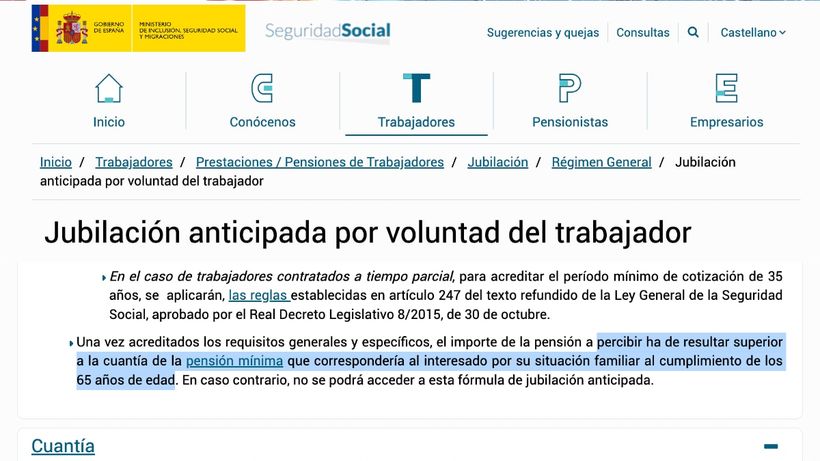
Muñoz emphasizes that “it is precisely this last requirement that is leading to the denial of many voluntary early retirements.”
A real case with 40 years of contributions and denied retirement
To understand it better, Alfonso Muñoz gives a real example in which a 63-year-old worker, with 40 years of contributions, who lives with his wife, without income or pension. According to the resolution, the pension resulting from his early retirement would be only 1,058 euros per month, after applying the reducing coefficients.
The problem arises when comparing this amount with the minimum pension that would correspond to the age of 65, depending on your family situation. For 2025, the minimum amounts are the following:
- Pensioner with dependent spouse: 1,127.60 euros
- Pensioner without spouse: 874.40 euros
- Pensioner with non-dependent spouse: 830 euros
Since there is no income in the family unit and his wife does not receive a pension, it is determined that the spouse is dependent on her. As Muñoz recalls, “a pensioner is considered to have a dependent spouse when he or she does not receive a pension and when the income of any kind of both is less than 10,723 euros per year.”
Therefore, since the threshold of 1,127.60 euros corresponds to him, his early pension of 1,058 euros is well below the minimum required. “And that is precisely the reason for the denial,” he says.
What Social Security says and why this threshold applies
Alfonso Muñoz explains that, although many workers are unaware of it, “the amount of the resulting pension must be higher than the amount of the minimum pension that would correspond to the interested party based on their family situation upon reaching the age of 65.” As he explains, “it is precisely this last requirement that is leading to the denial of many voluntary early retirements.”
The official clarifies that this economic limit is set by applying the minimum regulations because “according to the regulations, a pensioner is considered to have a dependent spouse when he or she does not receive a pension and the income of any kind of the pensioner and his or her spouse is less than 10,723 euros per year.” Social Security interprets the applicant’s family situation to check whether the reduced pension due to early retirement exceeds the threshold that would mark his or her ordinary minimum pension at age 65.
Regarding this Social Security formula, Alfonso asks: “How is it possible that a pensioner who has no income, whose wife does not work, is denied an early retirement pension and that a pensioner who does not have a spouse because his wife is working or has a higher income is granted it?”
The official relates that “there have been several people I have assisted who have been denied their early retirement pension for a reason they had never heard of.” Even workers with long careers and apparently all requirements met may encounter a refusal if the final amount falls below the minimum required.