
To access the retirement pension, in addition to proving a minimum of quotes, it is mandatory to be aware of social security payment. Not fulfilling this requirement can lead to the denial of the benefit, even when 100 % of the regulatory base has been generated. But what happens if the debt is fractional and is being paid according to an approved judicial plan? This is what happened to an autonomous worker, which Social Security denied a pension of 2,439.50 euros per month to maintain a debt of 46,866.88 euros. After resorting, the Superior Court of Justice of Castilla y León has proved him right.
According to the STSJ CL 2656/2025 judgment, everything begins when an autonomous worker decides to request the tax retirement pension to Social Security, after having reached his ordinary retirement age and after gathering the necessary contributions to collect 100% of the pension (so he should have more than 36 years and 6 months quoted according to Law 27/2011). Therefore and after applying the social security calculation method, this would be entitled to collect a pension of 2,439.50 euros per month.
You may be interested
The average retirement age is 65.3 years in Spain, but those who retire at age 61 do so with a pension of 2,134.48 euros

A Mercadona employee achieves a permanent disability after lifting a box and suffering a “shoulder pull” with a pension of 21,731.88 euros
Even so, Social Security decided to deny it a month later. The reason was that this man had a pending debt to the General Treasury of Social Security for the amount of 46,866.88 euros corresponding to unpaid quotas between November 2010 and June 2013. Although the worker had this debt within a payment plan within a bankruptcy procedure (that is, he had fractioned it and was paying it), the administration understood that it was not up to date in its obligations with the social security.
Given this situation and seeing that they did not recognize the pension despite submitting several claims claiming that it was “up to date of payment” decided to file a lawsuit against social security.
The pension cannot be denied if he was paying the debt
In the first instance, the Social Court No. 1 of Segovia gave the reason to Social Security, so this worker could not access the pension until he was aware of payments despite having quoted more than 37 years. But not in accordance with this resolution decided to present an appeal for begging the Superior Court of Justice of Castilla y León, which this time did prove him right.
The Social Chamber analyzed not only the debt situation, but also the existence of a payment plan approved in a bankruptcy procedure. The magistrates explained that, in accordance with article 31 of Royal Decree 1415/2004, on the General Social Security Collection Regulations (which can be consulted in this Official State Gazette), The granting of a postponement “gives rise … to the debtor being considered aware of its obligations with social security in order to recognize benefits.”
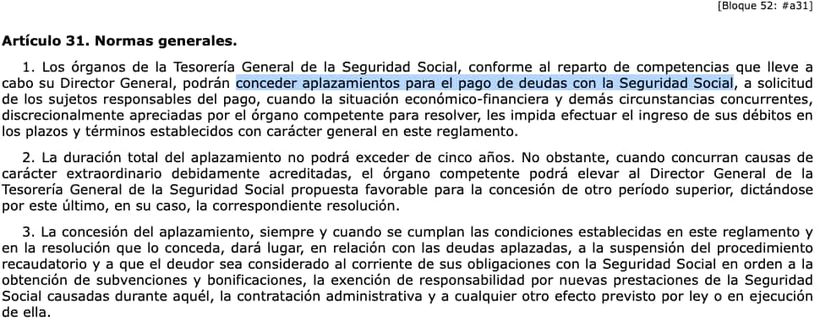
In this way, the sentence is clear, explaining that “the breach of the terms of the postponement determines that from that breach it is no longer aware, but does not imply that, in a retroactive effect that the norm does not authorize, it is stopped being aware when the benefit was caused and when the postponement was governed”.
For this reason, the key in this sentence is that the retirement pension cannot be denied if the autonomous worker, even if he has a pending debt to social security, is paying it through an agreed payment plan. Thus, the TSJ recognizes its right to retirement pension with 100 %, so it will charge 2,439.50 euros per month, and Social Security will have the obligation to pay the amounts not perceived since November 29, 2022.