

The Superior Court of Justice of Galicia has ruled in favor of a woman to receive a widow’s pension whose husband died just three months after getting married. The National Social Security Institute had denied it, alleging that the death was due to a “common illness prior to the marriage”, so it did not meet the requirement of minimum duration of the marriage.
It all begins on July 22, 2022, when Florinda marries Augusto, who died just three months after the marriage, on October 30 of that same year, due to pancreatic cancer. After the death, the woman requested a widow’s pension from Social Security, but it was denied, explaining that she did not meet the requirement of having been married for at least one year before the death, nor did they have common children.
You may be interested

Social Security will deny the widow’s pension in marriages of less than one year if the death was due to a common illness and without children in common or proven previous cohabitation.

Social Security denies a widow’s pension of 2,694 euros to a woman after living together for nine years, having two daughters together and having a date to get married: Justice supports it
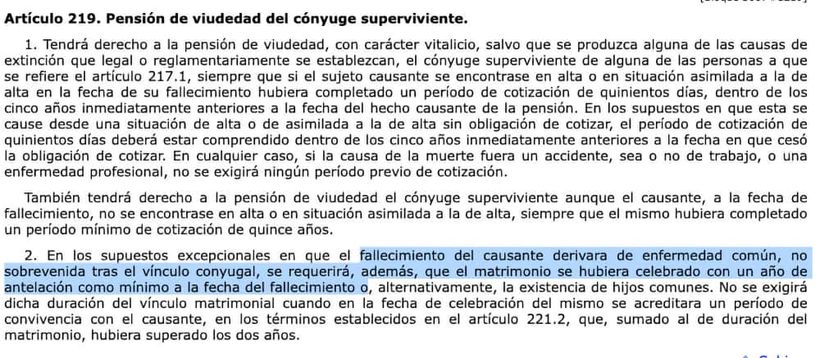
Social Security also alleged that the death was due to a common illness that did not arise from the marital bond, which made its recognition impossible according to article 219.2 of the General Law of Social Security. This article says that, if the marriage lasts less than a year and there are no common children, the widow’s pension can only be recognized if the death does not result from an illness prior to the marriage, or if the couple proves a previous cohabitation of at least two years.
The widow, as she was not satisfied and found this decision unfair, decided to go to court after seeing her appeals rejected.
It was not a marriage of “convenience” to collect the widow’s pension
Both the Social Court of Vigo (under ruling 272/2024) and a subsequent appeal from the Superior Court of Justice of Galicia (TSXG) agreed with the widow, confirming that yes, she had the right to collect the widow’s pension.
It must be said that both Social Security and Beatriz (who was the ex-wife of the deceased and who already received a widow’s pension for gender violence) alleged that the marriage had been “of convenience” and that the illness clearly preceded the marriage.
But the TSJ denied it, confirming the first instance ruling and the reason given was that the medical diagnosis occurred after the marriage and that there was no record or documentary evidence that the illness was prior. As stated in the ruling, it explains that “it cannot be affirmed due to lack of evidence to that effect that it was an illness that did not occur after the marital bond nor that, consequently, the marriage was of convenience or for the sole purpose of obtaining the pension.”
The court also recalled that the unexpected nature or not of a disease “must be analyzed based on its diagnosis, not on hypotheses based on non-specific symptoms”, stressing that fraud of law cannot be presumed without conclusive and objective proof.
A law to prevent fraud
Social Security agreed with this woman based on what article 219.2 of the General Social Security Law says, which we remember is the one that regulates the requirements to access the widow’s pension when the marriage is less than one year. This rule (as explained by the Chamber) is to avoid what Social Security alleged, that is, marriages simulated or celebrated with the sole purpose of generating a benefit, but it cannot be applied automatically when there is no proof of fraud.
In this case, no medical diagnosis prior to the marriage was proven, so the court concluded that the illness did occur after the marriage, so it did meet the requirements.
Thus and for everything explained, the TSJ gave Florinda the right to collect the widow’s pension, dismissing the appeal of the ex-wife and Social Security, and ratifying that a benefit cannot be denied based solely on medical conjectures or on the short duration of the marriage.