It has always been believed that being a carrier or truck driver was a trade in which, in exchange for spending your life on the road, you received good remuneration. Nothing is further from reality. Where many still imagine high salaries, what there are are endless days and salaries that barely have 1,500 euros per month. A hard, demanding and less and less valued profession.
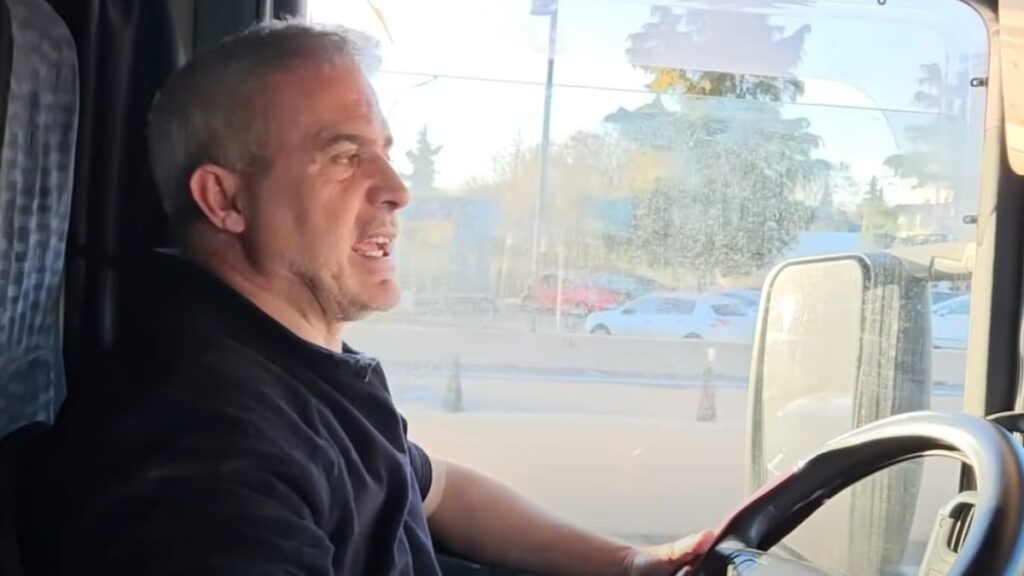
With the aim of giving visibility to this situation, the influencer Jaime Gumiel He has interviewed José Luis, a truck driver with more than 40 years of experience. “Being a truck driver no longer interests,” he explains clearly. The veteran details how the conditions, the risks it assume and how little a job that, in his own words, is “beautiful but slave” have changed today.
You may be interested
To be air controller you only need high school: “In a small private airport, you could collect about 48,000 euros on average”

Anne-Sophie, 47 years, culinary stylist and wins 3,500 euros per month: “We are less than ten in the country who do this work”
“He earned more money 30 years ago”
José Luis begins the day early, as he has been doing for almost four decades. For years he got up at 4 in the morning and drove more than 10 hours in a row, sleeping badly in unsafe parkings and with the fear of robberies always present. “Sleeping six hours was a luxury, normal was three or four,” he recalls.
As for the salary, his complaint is clear: “A driver in Nacional can charge about 1,600 euros, at 1,800 premises if he is lucky, and in international roots the 2,800 or 3,000, but at the expense of not seeing your family in two weeks.” For self -employed, the thing is even worse: “In the end you don’t live, you work only to pay diesel, taxes, insurance and breakdowns.”
“Before you could win more. Today, to get 1,500 euros clean, you leave your life. And if the truck breaks, the ruin is yours,” he says.
A risk profession and little respect
The truck driver’s trade is not just driving. Loads and downloads, endless waiting on the docks and road tensions make the day to day exhausting. José Luis describes it without rodeos: “80% of the companies where you download treat you as dogs.”
The risks are also constant: accidents, extreme tiredness, fuel robberies or even whole trucks with merchandise. “They stole an entire truck, and insurance washed my hands. In the end I took eight months to recover the money,” he says.
The regulations also do not help. With digital tachograph, any minute can be a fine. “If you run out of 1 km from your house, you have to stop and sleep in the truck,” he explains resigned.
Lack of generational relief
One of the biggest transport problems is the lack of young people willing to get on a truck. “There is no one who wants to be a truck driver. Remove the card costs 5,000 or 6,000 euros, salaries are low and endless days. It is easier to study a master’s degree than get into this,” he says.
Consequently, most new drivers are foreigners. “The kids here do not want to work 12 or 15 hours a day for the same thing they can win in other much less sacrificed jobs,” he laments.
A job that does not compensate
José Luis summarizes it bitterly: “I have worked 35 years and I don’t know what is more than 8 days of vacation in a row. If you don’t work, you don’t charge. And an autonomous has no unemployment. You can spend your life at the wheel and end with nothing.”
Even so, he says he likes his trade. “It’s pretty, because everything that comes to the houses have taken it. But it is a slave work. You spend 12 hours on the road, and in the end it is not worth what you earn.”
Its final reflection is a notice: if the conditions of the truckers are not valued, the sector can collapse. “Without transportation, the country stops. But it seems that nobody realizes until something is missing on the shelves.”