
A man has managed to retire at the age of 60 with a pension of 3,126.83 euros per month, despite the fact that social security denied it, because he did not comply with the minimum age or the contribution period. In this sense, the Superior Court of Justice of the Basque Country indicated that since it is a disability derived from the polyomyelitis suffered in childhood and greater than 45%, they had the right to apply the reduction in its entire working life, so it could retire and with 100% of the pension.
This worker was affected by the disease of polyomyelitis (the polio) from the two years of age and when he reached 60 years and with more than 33 years quoted (12,775 days), he decided to request the pension through the early retirement for disability, but social security denied it. The Administration explained that although it had a 45% disability recognized since 2013, the certificate did not indicate that it corresponded to one of the diseases included in Royal Decree 1851/2009, which allows to apply reducing coefficients in the retirement age.
You may be interested
Several retirees older than 80 years speak clearly: “They put me to work with 9 years in a factory, imagine. Since then everything was effort and hard work”

Finance begins to return the personal income tax to retired mutualists: the payment of up to 4,000 euros has begun
At this point, Social Security told him that, not having a recognized disease in said regulations, only the option of retiring voluntarily remains, but it was necessary to have 35 years quoted, a requirement that did not meet, in addition to taking into account that he would suffer a 21% cut in the amount of his pension.
The man filed a claim claiming that the disease suffered from the age of two, although he was recognized in 2013, therefore, he was entitled to reduce his retirement age. But social security discourages this claim, so they decided to go to court.
100% retirement pension
The Social Court number 1 of Donostia-San Sebastián proved the worker, recognizing his right to retire and charging 100% of the regulatory base. Social security as it was not as it decided to resort to the Superior Court of Justice of the Basque Country claiming that the disability of 46% recognized in 2013 included new pathologies (scoliosis and functional limitation of the column) that were not present in 1986, so it understood that it was an aggravation and not of the same ailment.
In spite of this, the TSJ gave the worker again and explained in his ruling that “the actor’s pathology and functional limitations have not experienced changes during his adulthood, being equivalent the disability rating of the year 1986 with the percentage of 33% and the certificate of disability of the year 2013 that recognizes a percentage of 46%”. That is, he ruled out that there was aggravation, so he validated applying the reduction of his ordinary retirement age to access the pension.
What does the law on anticipated disability of 65% say
In this judgment, the key was that polyomyelitis appears as one of the diseases that collects Annex I of Decree 1851/2009 (which has now been modified by Royal Decree 370/2023), which allows anticipating retirement to those who accredit a degree of disability equal to or greater than 45% for at least 15 years of their working life. For this reason, the court understood that it was entitled, since its sequelae had not changed since childhood and had not varied over time.
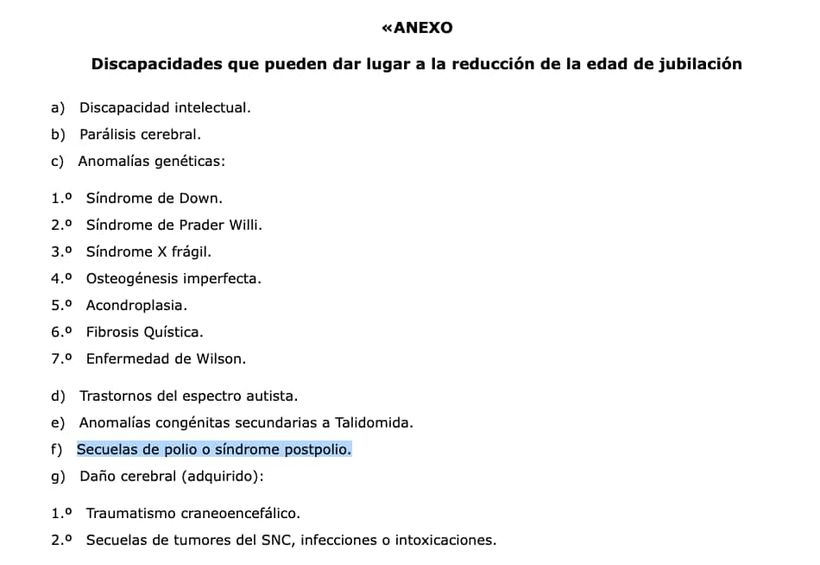
Therefore, the Chamber applied the reducing coefficient from the first application for disability recognition and declared its right to early retirement with a pension equivalent to 100% of its regulatory base, set at 3,126.83 euros per month, with 14 payments per year.