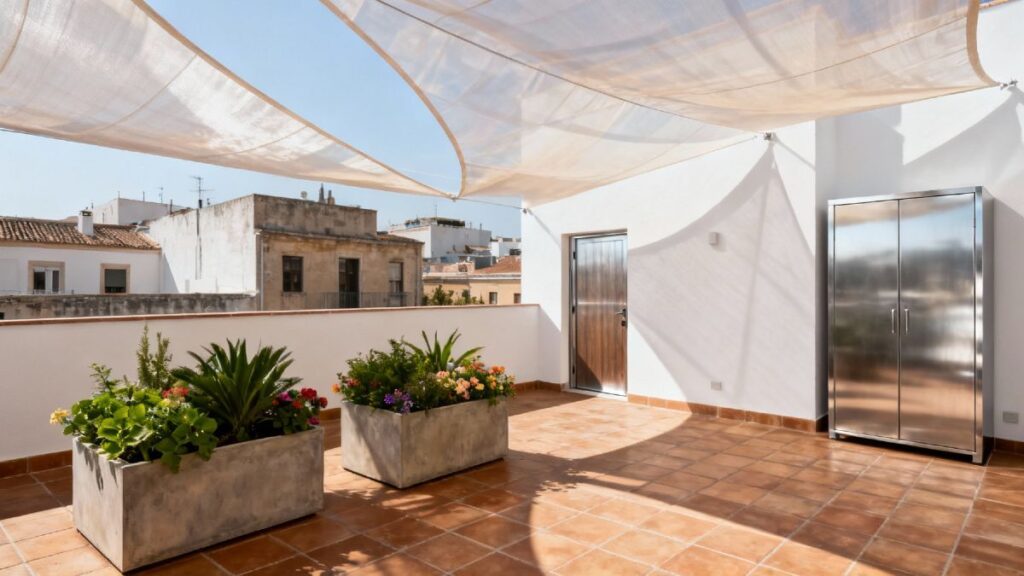
The Provincial Court of the Balearic Islands has condemned the owners of a penthouse to stop using the roof of the building as a private terrace and return it to its original state, despite the fact that it was not proven that they were the ones who carried out the works. Justice understands that the cover is a common element and that the owner must assume the consequences of the illegal works that were carried out there even if he was not the one who carried them out.
According to the ruling of July 15, 2025, the defendants bought the home in 2007 and already had direct access to the roof, where there were various facilities such as a pergolalighting, rest area and a built-in barbecue. There was also direct access to the roof by opening a hole in the floor, without it being proven whether said work was carried out by the current owners or by a previous owner, but the works carried out did not appear in the deed or in the property registry.
Several neighbors sued when they considered that it was an improper occupation of a common element. The Court of First Instance No. 4 of Ibiza partially agreed with them and ordered the cessation of the exclusive use of the roof, although without initially forcing demolish the facilities nor close access, which took the case to the Provincial Court.
The owner is liable even if he did not do the work
The Provincial Court of the Balearic Islands made it clear that the roof terrace constitutes a common element of the building, as established by the Horizontal Property Law, so it cannot be subject to exclusive use or individual appropriation without a valid title authorizing it. The court rejected that the passage of time, the tolerance of the community or non-formalized agreements could legitimize this private use, something claimed by the new owners.
Specifically, the acquisition of the right by usucapion was ruled out, as the requirements of the Civil Code were not met, which requires possession as owner and with fair title. Furthermore, the alleged statutes or agreements invoked to which the owners referred were not formally registered or approved, so they lack legal effectiveness vis-à-vis third parties.
Regarding returning the roof to its original state, the Court considered that it was a real action, that is, an action that falls directly on the property and not on the person who carried out the works. In application of this doctrine, consolidated by the Supreme Court, the current owner is obliged to restore the common element to its original state, even if he was not the material author of the modifications.
In this sense, the court highlighted that the works, such as the opening of direct access from the home to the roof, the enclosures or the installation of a leisure area with a barbecue, did not appear in the property title or in the registry. Therefore, buyers could not rely on good faith or the appearance of legality, since they could verify that said modifications were not legally recognized.
Consequently, the Court concluded that the owners had to demolish the facilities and restore the roof to its original state, guaranteeing its common use by all neighbors, in accordance with the provisions of article 7 of the Horizontal Property Law.
However, the resolution was not final and an appeal could be filed against it before the Supreme Court.