

A retiree will have to return 10,027.66 euros of his pension to the National Social Security Institute after the Superior Court of Justice of Castilla y León confirmed that these were undue charges for having received 100% of the benefit while he was registered with the RETA. The court explains that it is being a pensioner is incompatible with being registered as a self-employed workerexcept in the cases permitted.
According to the ruling, Ezequiel enjoyed a situation of active retirement since May 2019, which allowed him to make 50% of his pension compatible with self-employment. But, the conflict arose when this retiree ended his active retirement to start collecting 100% of his pension, dated January 1, 2020.
You may be interested

Social Security will maintain the retirement age at 65 years for those workers with 38 years and three months of contributions by 2026
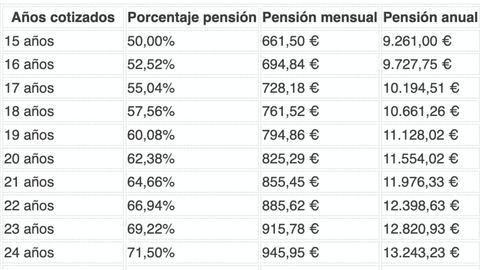
Table with the retirement pension that you will have according to the years of contributions if you receive the Minimum Interprofessional Wage
Social Security became aware of this situation, in which this pensioner was receiving the full pension at the same time as he was registered and paying the self-employment fees, this situation being incompatible. For this reason, Social Security opened a file and requested that it return the amounts collected improperly, that is, 10,027.66 euros, understanding that this administrative situation prevented the total collection of the aid.
The retiree did not want to return it, since he explained that no one had notified him of the cessation of his work activity and that therefore he had the right to a 100% replacement of his pension. For him, the failure was the administration’s, since it was the one who should have removed him from the RETA ex officio and that he did not carry out any effective work during that period.
I was aware of what I was doing
The retiree went through the Social Court and the Superior Court of Justice of Castilla y León, both of which did not agree with him. The Chamber accepts the decision of the Social Security and explains that to collect 100% of the pension it is not enough to communicate the termination but it is essential not to be registered in the self-employed regime, except in the cases provided for in article 213 of the General Law of Social Security.
In this sense, the ruling shows that according to the files of the General Treasury of Social Security, Ezequiel not only remained registered but also paid the RETA contributions within the established legal period throughout the claimed period. The court explains that the voluntary payment of these fees shows that the pensioner was perfectly aware of his situation and accepted it without challenging it at the time.
Paying self-employment fees demonstrates activity
In this ruling we must know that the error was that the pensioner assumed that the communication to the INSS exempted him from processing his withdrawal at the Treasury. Despite its allegations, the Chamber remembers that what is really important is the registration status and the payment of contributions. In the words of the judicial resolution, what is significant is that in addition to having been registered, he paid the contributions in a timely manner, which is incompatible with the full receipt of the retirement.
Therefore, the Court understands that the retiree improperly collected his full pension during the months in which he appeared as an active contributor to the RETA. The court concludes that by maintaining this status of registration and contributions, the necessary requirement for enjoying the pension in its full amount is not met and confirms the obligation to return everything received during that time.