
sick leave or temporary disability It is an issue that worries both Social Security and companies and employers in Spain, since they tend to focus on how much they cost, but less and less on how they are managed, and that is where Sweden makes an important difference. The AIReF has already warned in a report that temporary disability is already the second largest component of Social Security spending, with 16.5 billion euros in 2024. In addition, the incidence of sick leave due to common contingencies has gone from 21.4 to 33.9 cases per 1,000 affiliates between 2017 and 2024, while the average duration has risen from 40 to 45.9 days.
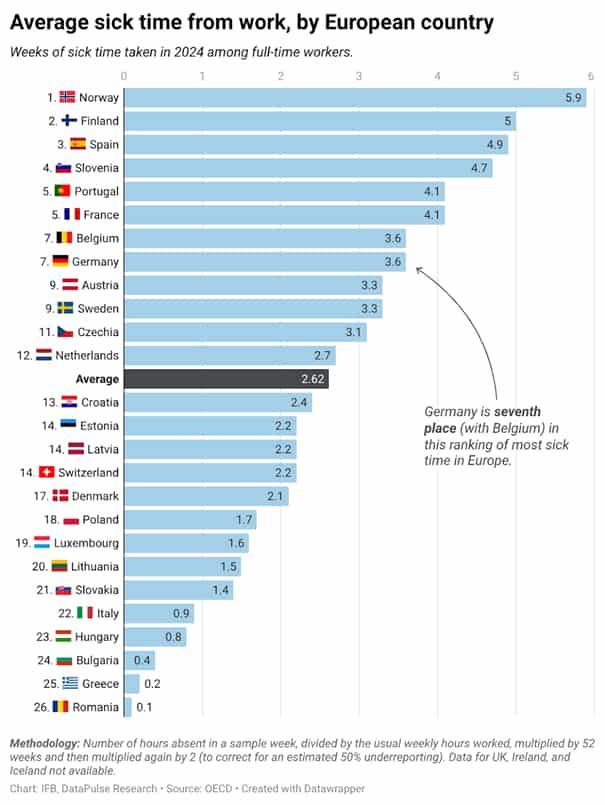
Although Spain has a temporary disability benefit It must be said that its legal system is somewhat strict at the start of the withdrawal, since the first three days nothing is charged and from the 4th to the 20th, 60% of the regulatory base is charged. However, the problem has not stopped growing. And, furthermore, the European comparison suggests that initial financial punishments do not solve absenteeism on their own. The analysis published this month by Betriebsratbased on harmonized OECD data, ends up showing that there is no direct and statistical relationship that unpaid sick leave sustainably reduces sickness absences.
The Swedish lesson arrives before the 30th
Sweden offers the main lesson to Spain for ordering the process earlier. There the employer pays leave for a maximum of 14 days, the worker must present a medical certificate from the 8th and, if the absence is expected to last more than 60 days, the company is obliged to have a return to work plan ready before the 30th. This document must include the necessary measures to facilitate reinstatement.
The Swedish logic hardens with the passage of time and between days 91 and 180 it is analyzed whether the worker can do his usual job or some other temporary task within the company. From day 181, the benefit is only maintained if you cannot perform any work in the ordinary labor market, except in justified exceptions. To understand it, it is not a decline abandoned to inertia, but rather an itinerary reviewed in phases.
This approach connects with an idea that the OECD already highlighted when analyzing the Swedish case and that is, that the system works best when it applies an “approximation of mutual obligations”, that is, when it distributes responsibilities between the worker, the company and the administration to accelerate the return to employment.
Right there AIReF places one of the great Spanish failures. The organization speaks of a structural deficiency due to a lack of integrated information, supervision and coordination between the INSS, health services, mutual insurance companies and companies. That is why it proposes to reinforce early control, improve interoperability and promote gradual reintegration and job adaptation programs.
The lesson that Sweden leaves behind is that, rather than cutting the benefit in the first days, it is preferable to force action earlier, better monitor each case and prepare from the beginning for a return to work. That’s where Spain continues to arrive late.