
The poor attendance at Owners meetings It is a common situation in many neighborhood communities. However, the Horizontal Property Law (LPH) establishes that the lack of participation does not prevent the community from adopting valid agreements, as long as the legal requirements provided for in the regulations are met.
Many neighbors believe that if the majority of the building’s homeowners do not attend a meeting, the agreements cannot be approved. But, the LPH contemplates a specific mechanism to avoid the blockage of community life, which is the second call of the Board of Owners.
The Horizontal Property Law clearly distinguishes between first and second call, and attributes full legal effects to the agreements adopted in both, although the conditions of attendance are different.
The LPH allows the Meeting to be held on second call without a minimum number of attendees
Article 16 of the Horizontal Property Law regulates the system of calls for the Board of Owners. In the first call, the law requires the attendance of the majority of the owners who represent, in turn, the majority of the participation fees.
When this quorum is not reached, which is very common in practice, the Board is not suspended. The law itself establishes that it can be held on a second call, in which a minimum number of attendees is not required, as long as this possibility is stated in the summons made to the owners.
In this way, the Meeting can be held validly, even if only a few neighbors attend, and even if attendance is very small.
The way in which agreements are approved on second call is regulated in article 17 of the Horizontal Property Law. In these cases, it is enough for the majority of the attending owners to vote in favor, as long as they represent more than half of the participation fees of those present.

This implies that the total number of owners of the building is not taken into account, but only those who attended the meeting. If this majority is reached among those attending, the agreement is validly approved and is binding on the entire community, including residents who have not attended the Meeting.
For example, in a community with twenty owners, an agreement can be approved on second call with the attendance of only four neighbors, as long as the majority of them vote in favor and represent more than 50% of the quotas of those present.
Agreements can be challenged, but not for the simple fact of not having attended
Although the agreements adopted in the second call are valid, article 18 of theThe Horizontal Property Law allows its challenge when they are contrary to the law or the statutes, are abusive or cause serious harm to any owner.
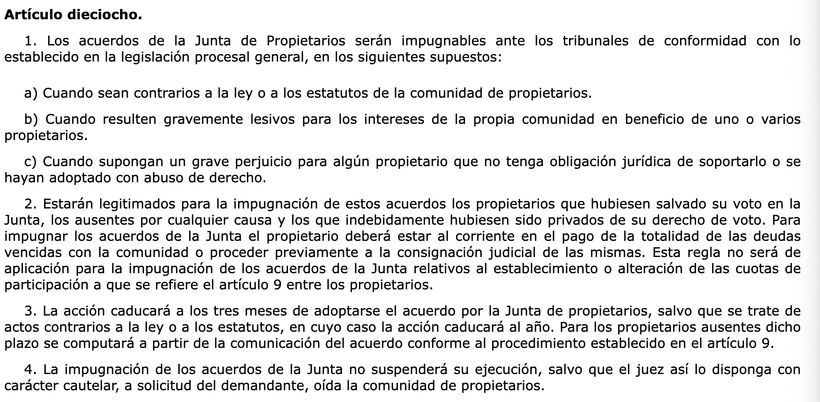
However, mere absence from the Board does not invalidate the agreement in itself. To annul it, it is necessary to go to court and prove one of the causes expressly provided for in the law.
Not all agreements can be approved with a simple majority
It must be taken into account that although the Horizontal Property Law allows many agreements to be adopted on second call, not all matters can be decided in this way. The regulations themselves establish specific cases in which a qualified majority is required, regardless of the number of owners who attend the Meeting.
Article 17 of the Horizontal Property Law includes cases in which a special majority is necessary, as occurs with the modification of the statutes, certain agreements that affect the constitutive title or the implementation or suppression of common services of special relevance.
In these cases, the majority of attendees in the second call are not enough. The law requires reinforced majorities, such as three-fifths of the total owners who, in turn, represent three-fifths of the participation fees, or even unanimity, depending on the nature of the agreement.
This means that, even if the Meeting is validly held with few neighbors, the agreement cannot be approved if the required legal majority of the community as a whole is not reached. In these cases, the lack of assistance can prevent the adoption of the agreement.