Many workers who receive the Minimum Interprofessional Wage wonder what retirement pension they will have when the time comes to retire. In 2026, the SMI has been set at 1,221 euros per month in 14 payments, which is equivalent to 17,094 euros per year. But this figure is not automatically transferred to the pension, since Social Security does not take the gross salary as a reference, but rather the contribution bases and the years contributed throughout one’s working life.
In addition, 2026 will be the first year in which the new dual system for calculating the regulatory retirement base begins to be applied. Even so, during the transitional period, Social Security will automatically compare the previous system and the new one, and will apply the one that is most favorable for the worker, as explained by Social Security official, Alfonso Muñoz.
Regarding the ordinary retirement age, in 2026 it is set at 66 years and 10 months, but with the possibility of retiring at 65 years for those who have contributed for at least 38 years and 3 months. Next year (which will be when the reform of Law 27/2011 is completed) the age will be set at 67 years with the possibility of continuing to retire at 65, but it will be necessary to be at least 38 years and 10 months.
How the regulatory base is calculated if the SMI is collected in 2026
The first thing to be clear about is that the pension is not calculated on the salary that appears on the payroll, but on the contribution bases. In 2026, and until a new Budget Law is approved, the minimum contribution bases are automatically updated with the rise of the SMI increased by one sixth. This leaves the minimum monthly base at 1,424.50 euros for the contribution groups that take the general minimum limit as a reference.
Now, that minimum base is not the pension that is collected. If a person had always contributed for that amount and the classic system was applied, the regulatory base would be the result of dividing the 300 contribution bases of the last 25 years by 350. In that case, the regulatory base would remain at 1,221 euros per month.
From 2026 the new dual system also comes into force. During this year, Social Security will compare this classic calculation with another that takes the 302 contribution bases with the highest amount within the previous 304 months and divides them by 352.33. If all the bases were the same, the result would be practically the same: about 1,221 euros per month.
What percentage of the regulatory base corresponds according to the years contributed
Once the regulatory base has been obtained, the corresponding percentage must be applied according to the years contributed. At 15 years of age, which is the minimum required to access the contributory retirement pension, 50% of the regulatory base is collected.
During 2026, the transitional scale remains in force, that is, for each of the next 49 months, 0.21% is added, and for each of the subsequent 209 months, 0.19% is added, until reaching 100% with 36 years and 6 months of contributions. Starting in 2027 it changes and it will be necessary to have 37 years of contributions to qualify for the full pension, as long as it is accessed at the ordinary age (advancing the age entails cuts).
How much pension is left if the SMI has always been collected in 2026
If it is taken as a hypothesis that a person has always contributed for the minimum base equivalent to the new SMI and neither inflation, nor gaps, nor supplements to minimums are applied, the regulatory reference base would be around 1,221 euros per month. The percentage for years contributed is applied to that figure.
Thus, with 15 years of contributions the pension would be about 610.50 euros per month in 14 payments. With 25 years of contributions, it would be around 900.85 euros per month. At 35 years old, it would amount to about 1,179.24 euros. And with 36 years and 6 months of contributions, 100% would be reached, that is, about 1,221 euros per month or 17,094 euros per year.
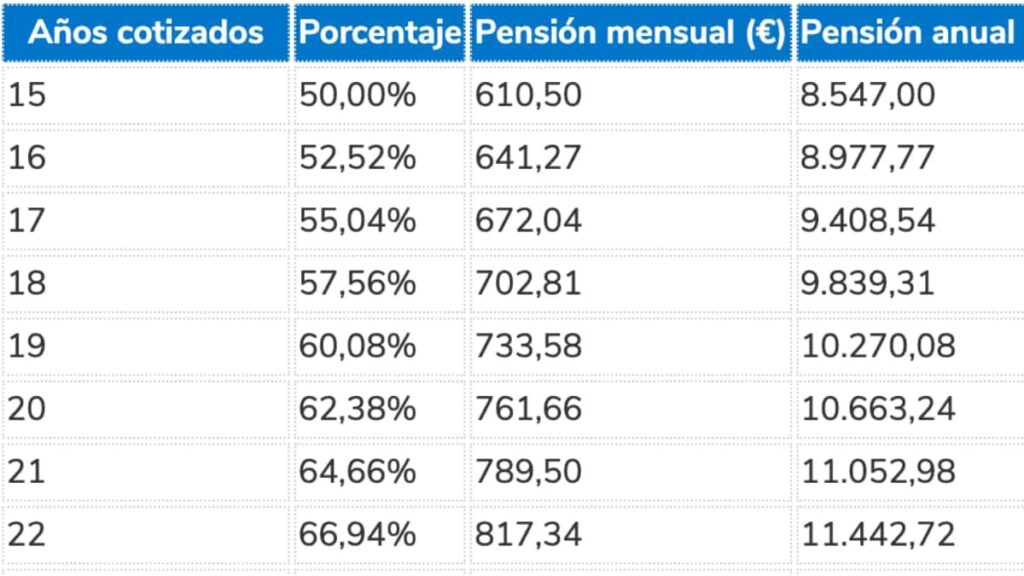
In the following indicative table you can consult the theoretical pension that would remain in 2026 for those who have always contributed for the minimum base linked to the SMI
| Years quoted | Percentage | Monthly pension (€) | Annual pension (€) |
|---|---|---|---|
| 15 | 50.00% | 610.50 | 8,547.00 |
| 16 | 52.52% | 641.27 | 8,977.77 |
| 17 | 55.04% | 672.04 | 9,408.54 |
| 18 | 57.56% | 702.81 | 9,839.31 |
| 19 | 60.08% | 733.58 | 10,270.08 |
| 20 | 62.38% | 761.66 | 10,663.24 |
| 21 | 64.66% | 789.50 | 11,052.98 |
| 22 | 66.94% | 817.34 | 11,442.72 |
| 23 | 69.22% | 845.18 | 11,832.47 |
| 24 | 71.50% | 873.01 | 12,222.21 |
| 25 | 73.78% | 900.85 | 12,611.95 |
| 26 | 76.06% | 928.69 | 13,001.70 |
| 27 | 78.34% | 956.53 | 13,391.44 |
| 28 | 80.62% | 984.37 | 13,781.18 |
| 29 | 82.90% | 1,012.21 | 14,170.93 |
| 30 | 85.18% | 1,040.05 | 14,560.67 |
| 31 | 87.46% | 1,067.89 | 14,950.41 |
| 32 | 89.74% | 1,095.73 | 15,340.16 |
| 33 | 92.02% | 1,123.56 | 15,729.90 |
| 34 | 94.30% | 1,151.40 | 16,119.64 |
| 35 | 96.58% | 1,179.24 | 16,509.39 |
| 36 | 98.86% | 1,207.08 | 16,899.13 |
| 36 years and 6 months | 100.00% | 1,221.00 | 17,094.00 |
This table is indicative and is based on a linear career path, without contribution gaps and without taking into account the minimum supplement. In practice, many pensions of low-paid workers end up being increased through the minimum supplement, as long as the income requirements demanded by Social Security are met.
The conclusion is that, with the 2026 SMI, a full pension of 1,424.50 euros would not be collected, as could be deduced from the original text, but rather a maximum indicative pension of 1,221 euros per month if the minimum base has always been contributed and 100% of the regulatory base is reached. That is the key point that should be corrected in the piece.