
The Consumer Price Index (CPI) remained at 2.3% year-on-year in February, the same figure recorded in January, according to final data published this Friday by the National Institute of Statistics (INE). The stability of inflation is mainly explained by the drop in electricity prices, which has offset the increase in food or restaurant prices.
With this result, inflation stops the downward trend that it had registered in previous months and thus confirms the advance data that already anticipated this containment. Regarding housing, this block is highly influenced by the price of electricity, which reduced its interannual rate to 1.9%, eight tenths less than in January, which has helped contain the general indicator.
On the opposite side, several components of the index put upward pressure on prices. Among them, restaurants and accommodation services stand out, whose annual rate increased to 4.8%, and food and non-alcoholic beverages, which reached 3.2% year-on-year, two tenths more than the previous month.
It should be taken into account that these data are from February, so they are prior to the conflict in the Middle East, whose escalation of war and the rise in fuel prices that it is causing could end up influencing the CPI and therefore slowing down Spanish economic growth, as Garamendi warned.
If we talk about monthly terms, the CPI has marked an increase of 0.4% in February compared to January, driven mainly by the increase in the cost of restaurants and accommodation (0.9%), transportation (0.8%), due to the increase in fuel, and food (0.6%), with increases in fruits, nuts and vegetables.
Core inflation rises to 2.7%
For its part, core inflation (which does not include unprocessed food and energy products, as well as is considered a more stable indicator of price developments) increased by one tenth in February, to 2.7%, its highest level since August 2024.
For its part, the Harmonized Consumer Price Index (IPCA), the reference that allows inflation to be compared between countries in the euro zone, placed its annual rate at 2.5%, one tenth more than the previous month, with a monthly variation also of 0.4%.
Madrid has the highest inflation in Spain
The CPI registered positive annual rates in all the autonomous communities in February, although with territorial differences. The Community of Madrid presented the highest inflation, with 2.9%, while Asturias, Castilla-La Mancha, Catalonia and La Rioja registered the lowest rates, all of them at 2.0%.
Among the intermediate values were Comunitat Valenciana (2.6%), Extremadura (2.5%), the Basque Country, Cantabria and Aragón (2.4%), as well as Andalusia, which was aligned with the national average of 2.3%.
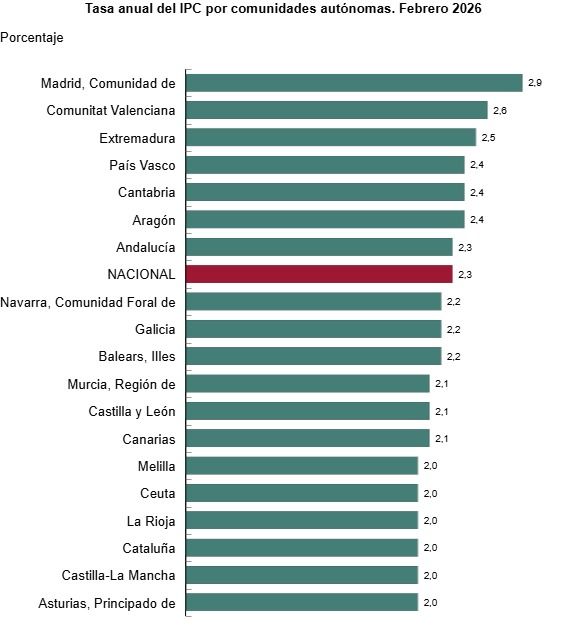
Navarra, Galicia and the Balearic Islands are also below the average (2.2%), while Murcia, Castilla y León and the Canary Islands registered 2.1%, followed by Ceuta and Melilla, with 2.0%.
These data reflect a relatively homogeneous evolution of inflation in the country as a whole, although with slight differences derived from the weight of the different components of the consumption basket in each territory.