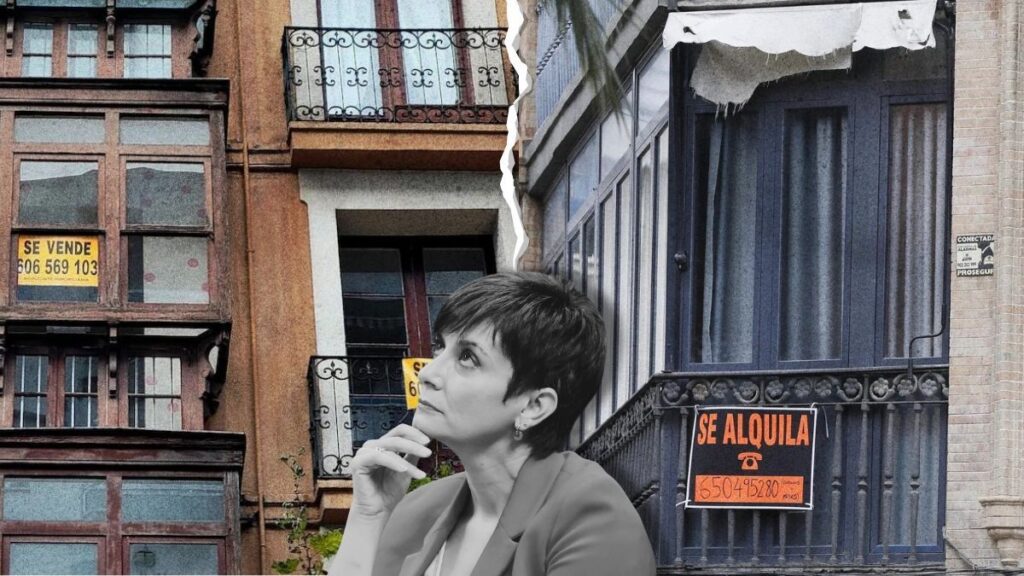
At a time when the rent increase has become one of the main concerns of Spaniards, especially in large cities, the debate has been reopened on whether it is more profitable to buy or rent a home.
The increase in rent prices in recent years and changes in interest rates have generated an increasingly frequent question among those looking for housing: is it more expensive to pay a mortgage or take on rent each month? A study by the Idealista real estate portal tries to answer this question by comparing the average cost of both options in different Spanish capitals.
What is cheaper in Spain
Paying a mortgage in Spain is, on average, 36% cheaper than renting a home, according to Idealista and as reported by ‘Europa Press’. The data indicates that the monthly payment to buy a two-bedroom home is 698 euros, while the rent for a similar property reaches 1,088 euros per month.
The report reflects a paradox in the Spanish residential market, since the monthly cost of buying may be lower than that of renting, but access to the property remains conditional due to the high level of prior savings required by banks. In fact, according to Idealista’s calculation, a family needs to have 64,568 euros on average to cover the down payment on the home, the associated expenses and the part not financed by the bank.
This savings requirement becomes the main filter for access to the purchasing market, especially in cities with higher prices, where the amount needed skyrockets well above the national average.
The cities where the most savings are required to buy a home
Among Spanish cities, Palma heads the list of capitals where a greater initial contribution is required, where a family must have 147,116 euros to qualify for a mortgage.
Following are San Sebastián (137,700 euros), Madrid (117,793 euros) and Barcelona (103,172 euros). They are the only large Spanish cities where the necessary savings exceed 100,000 euros, a figure that considerably limits access to home ownership, especially among younger households.
At the opposite extreme are cities where the economic barrier is lower, such as Zamora, which is the capital where the least savings are required, with 32,996 euros, practically half of the national average. They are followed by Jaén (34,596 euros), Lleida (35,581 euros), Palencia (35,931 euros) and Badajoz (37,862 euros).
Buying is cheaper in almost all capitals
However, Idealista’s analysis indicates that in practically all Spanish capitals the mortgage payment is lower than the rent, once the initial savings barrier is overcome. The only exception is San Sebastián, where paying the mortgage is 10% more expensive than renting.
The largest gap between both costs is registered in Segovia, where the mortgage payment is 54% cheaper than the rent. Ceuta and Lleida also stand out, with differences of 45%, followed by Zamora (-42%), Tarragona (-41%), Zaragoza (-41%), Melilla (-40%) and Córdoba (-40%).
Among the main real estate markets, Valencia and Barcelona present a difference of 38% in favor of purchasing, while in Seville the mortgage payment is 36% lower than the rent. They are followed by Bilbao (-33%), Alicante (-32%) and Madrid (-23%).
The smallest differences, apart from San Sebastián, are found in Palma, where buying is barely 1% less than renting, and in Málaga, where the gap is 16%.