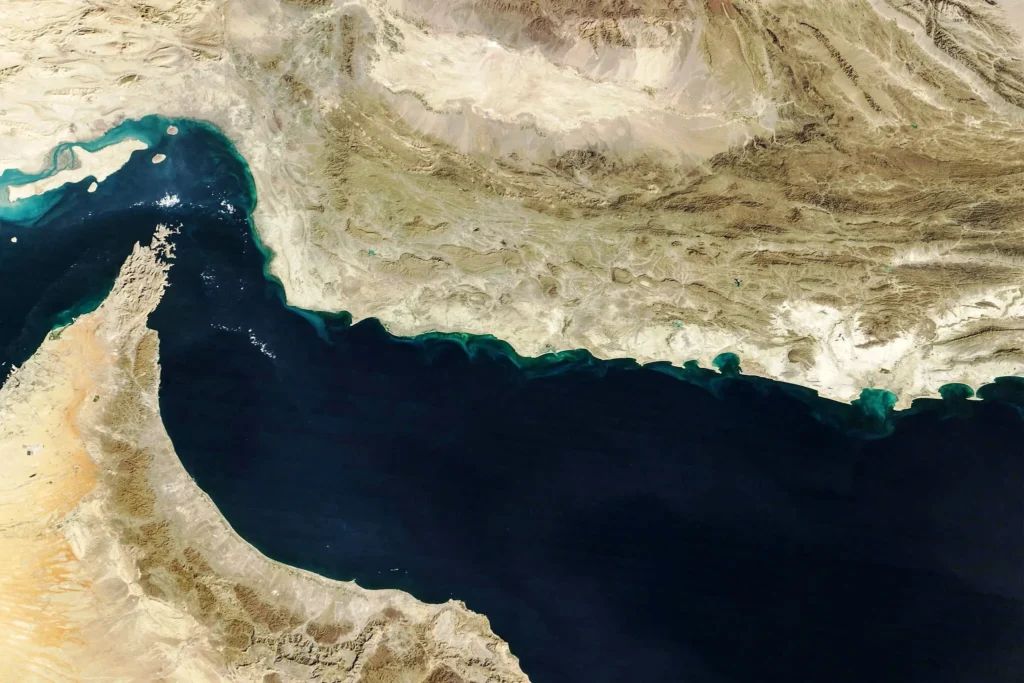
The Strait of Hormuz, one of the most sensitive strategic points in world trade, has once again become the focus of financial markets. Recent geopolitical tensions in the area have revived fears of possible disruptions to maritime traffic, a threat that could have immediate repercussions on the price of oil and global economic stability.
This maritime passage, located between the Persian Gulf and the Gulf of Oman, constitutes a true energy artery of the planet. It is estimated that around a fifth of the oil consumed in the world transits through these waters. Therefore, any alteration in its operation quickly translates into movements in international energy markets.
A global energy bottleneck
The importance of the Strait of Hormuz lies in its role as the main outlet for crude oil produced by some of the world’s largest exporters, including Saudi Arabia, Iraq, Kuwait, the United Arab Emirates and Iran. Every day dozens of oil tankers cross this maritime corridor loaded with millions of barrels of crude oil destined for Asia, Europe and America.
This concentration of energy traffic makes Hormuz one of the main “bottlenecks” of the global energy system. In strategic terms, any threat of blockade or attack in the area has the capacity to generate a domino effect in the markets.
Immediate reaction from investors
When geopolitical risk increases in key energy supply regions, markets react quickly. The price of oil usually rises due to fear of possible interruptions in the flow of crude oil.
At the same time, investors tend to adopt more defensive positions. In these contexts, assets considered safe havens—such as gold—tend to attract part of the capital that temporarily abandons investments more sensitive to the economic cycle.
However, experience shows that the initial reaction of the markets does not always reflect the real impact of events. On many occasions, episodes of geopolitical tension generate short-term volatility spikes that moderate as the days go by.
The inflationary risk
The scenario that most worries analysts would be a significant interruption of oil transit through the strait. If this occurs, the most immediate effect would be a sharp increase in the price of crude oil.
This increase would have direct consequences on global inflation. Energy continues to be one of the most sensitive components of the price index, and a prolonged rise in oil could complicate the process of inflation control that many central banks are trying to consolidate.
In this context, monetary policy could also be conditioned. If the rise in energy prices were passed on to the economy as a whole, the monetary authorities would have less room to relax interest rates.
Surveillance without alarmism
For now, the markets remain attentive to the evolution of the situation in the region, but there has been no effective interruption of energy supply. The transit of oil tankers continues with relative normality, although under reinforced international surveillance.
Analysts agree that, in scenarios of geopolitical uncertainty, the key is to avoid hasty reactions. Recent history shows that many of these crises generate temporary turbulence, but do not always lead to structural changes in financial markets.
Meanwhile, the Strait of Hormuz continues to be one of the most sensitive thermometers of global energy geopolitics. Every movement in its waters is closely watched by governments, investors and energy market operators.