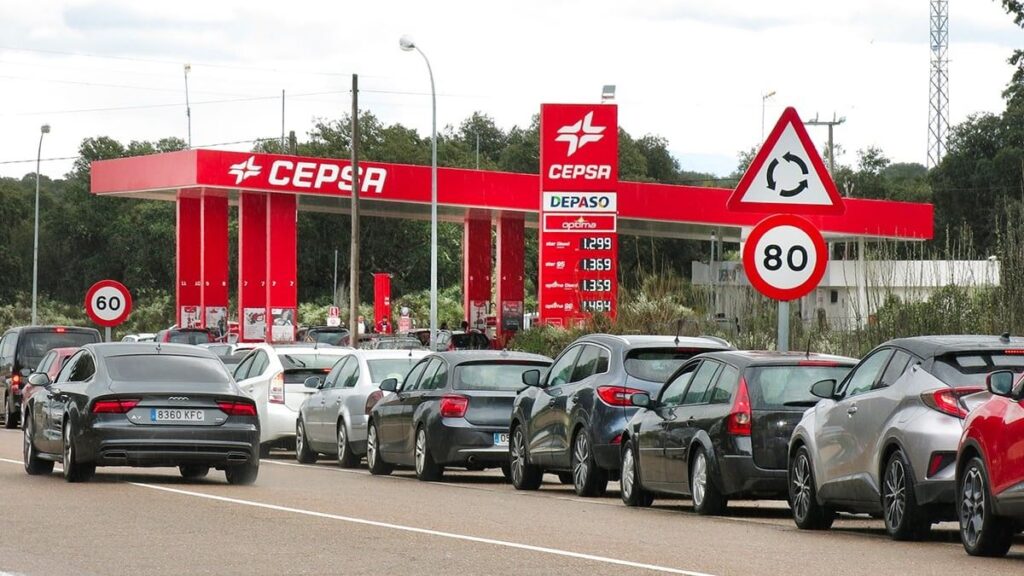
The war in the Middle East is already beginning to be felt in the pockets of Spanish drivers. Just a few days after the attacks by the United States and Israel on Iran, some gas stations have raised their prices to reflect the rise in oil prices in international markets.
The increase is, for now, moderate, around five cents per liter at some stations, but it shows how quickly international conflicts can end up affecting the price paid when refueling. That is why many drivers have begun to fill the tank as a precaution, fearing that the war in the Middle East will cause new increases in the coming days.
For his part, the Minister of Economy, Commerce and Business, Carlos Body, assured this Tuesday that it is still too early to know how far the impact of the crisis will go, but he stressed that the Government “will be on top of prices” to act if necessary and avoid greater damage to families and companies.
“We are perfectly prepared to know what we have to do if necessary, protecting our citizens and companies through that shield,” he said in statements to TVE collected by Europa Press, alluding to the package of measures that the Executive launched after the invasion of Ukraine in 2022.
Body stressed that the Government is closely monitoring the evolution of the markets to measure the scope of the crisis and stressed that everything will depend on how long the conflict lasts. He admitted that, if oil continues to rise in the coming days or weeks, that rise will end up being reflected in the price of fuel.
However, he insisted that for now “we must be cautious” and recalled that only a few days have passed since the beginning of the attacks, so it is still too early to draw definitive conclusions.
Oil soars in international markets
In international markets, the price of oil has reacted strongly. The barrel of Brent, the reference in Europe, rose more than 8% before the opening of the stock markets and stood at around $79. In the United States, West Texas crude oil also advanced by a similar proportion. Some analysts warn that, if the tension continues or escalates, the barrel could approach $100, a common level in previous international crises.
The main concern is in the Strait of Hormuz, a key maritime passage through which about a fifth of the oil consumed in the world circulates. If that strategic point is blocked, global supply would be reduced immediately and prices could skyrocket.
Regarding this, the minister recalled that, although gas closed this Monday above 40 euros, during the crisis caused by the invasion of Ukraine in 2022 it reached more than 340 euros. “This gives us a relative idea that helps us contextualize,” he said, while reiterating the Government’s request to reduce tension and opt for diplomatic channels.
Indirect impact in Spain
Spain does not directly buy oil from Iran, but that does not mean that it is left out of what happens in international markets. Carlos Body explained this Monday that direct dependence is “low” thanks to the fact that the country has diversified suppliers and energy sources. Even so, he acknowledged that the indirect impact through the rise in international prices may end up affecting and must be analyzed in the coming days.
The minister also recalled that when the energy goes up, the effect on the electricity bill is usually almost immediate. He also mentioned the so-called “anti-inflation shield” that the Government put in place after the invasion of Ukraine and once again requested a de-escalation of the current conflict through diplomatic channels.
In concrete figures, today 95 gasoline costs an average of 1,499 euros per liter in Spain, compared to 1,440 euros at the end of last year, which represents an approximate increase of 4.1%. Diesel has gone from 1,387 to 1,457 euros per liter in the same period, an increase of close to 5%.
If taken as a reference last thursdaywhen gasoline stood at 1.471 euros per liter and diesel at 1.423 euros, the increase in just a few days has been around 1.9% in the case of gasoline and 2.4% in that of diesel. These are prices still far from the highs of 2022 and 2023, when two euros per liter were clearly exceeded, but the upward trend once again puts the focus on the impact of energy on inflation.
Experts remember that when oil becomes more expensive, not only gasoline goes up. The costs of transportation, industry and many derived products, such as plastics, also increase. The risk is that this first rise ends up being passed on to other prices in the economy, which is what is known as second round effects, even if oil falls again later.
For now, the increase in prices at gas stations is limited. However, recent experience shows that energy reacts quickly to any international crisis. The evolution of the conflict in the Middle East and, especially, what happens in the Strait of Hormuz will be key to knowing how far prices can go in the coming weeks.