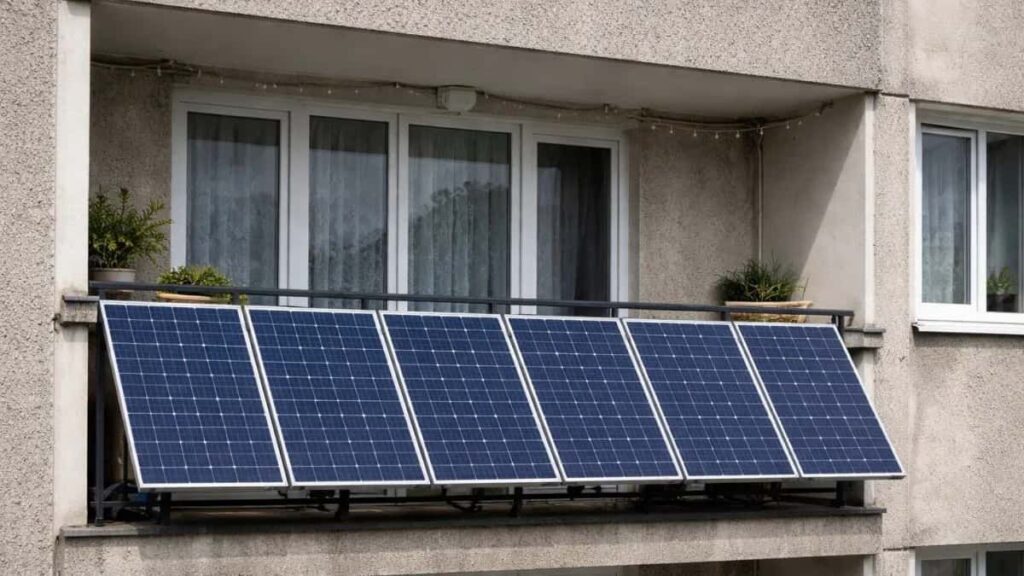
A resident of Gdansk (Poland) decided to make the leap to solar energy with a solution that is increasingly common in European cities, installing solar panels on the balcony to reduce the electricity bill. The initiative worked for him. According to his story, his bill dropped by more than a third. But now the court has ordered him to dismantle the facility because, in the eyes of the court, it was not proven that it had valid approval from the community or, in this case, from the housing cooperative that manages the building.
According to the media Observer, The resolution, issued by the Gdansk-Północ District Court, is of first instance and is not final, which is why the owner has announced that he will appeal. Even so, the case is already circulating as a warning to other residents of multi-family buildings in a context of diffuse regulation on the so-called “balcony photovoltaic”, a small and relatively easy format to set up, but full of problems when a community of neighbors comes into play where there are facades, railings and exterior elements.
Changed the electricity contract to be self-sufficient
This man carried out the installation in March 2023 with a commercial kit designed for balconies. Two panels placed on the railing of a glazed loggia, with their anchors and a microinverter that converts direct current into alternating current for domestic use. The cost, according to information published by Wyborcza.biz, was around 3,500 zlotys (about 820 euros at the exchange rate) for a power of 800 watts.
Months later he added a third panel and reached 1.2 kW. Upon exceeding the threshold of 800 watts, he communicated the change to the distributor Energa-Operator, which replaced the meter with a bidirectional one and granted him the status of prosumer, producer and consumer at the same time.
The conflict did not come because of technology but because of bureaucracy. Before installing the panels, Krzysztof asked for permission and was told that he needed the support of more than half of the residents of the neighborhood community. It gathered signatures from around 60% of the residents with the right to vote and also provided a technical report from a construction expert. The argument was that the panels replaced some heavy planters that were already on the balcony.
After assembly, he requested validation, but the cooperative refused. He questioned the authenticity and traceability of the signatures, claiming that it could not be verified whether they belonged to real members or, for example, tenants or visitors. The matter ended up in court and the judge agreed with the managing entity, considering that there was no way to verify the veracity of support from the neighborhood community. Therefore, I had to dismantle the installation.
The problem goes beyond a balcony
In Poland, as in other countries, the deployment of renewables in urban environments clashes with a basic question: who decides what is seen from the outside. Sector specialists have been warning that the absence of clear rules pushes many communities to paralysis. In other disputes, such as one in Olsztyn over the use of the roof for panels, judges have also stopped collective agreements due to the complaint of a single neighbor.
The economic incentive exists. Experts cited by the Instrat foundation calculate that a balcony installation can mean average annual savings of more than 700 zlotys (approximately 164 euros), with returns in a few years. In Germany, however, it is different and in the first four months of last year alone, more than 100,000 new installations on balconies were recorded.
Krzysztof insists that he was not looking for a conflict but rather to be self-sufficient and reduce the increasingly high electricity bill. “I am willing to redesign it,” he said, while preparing the appeal.