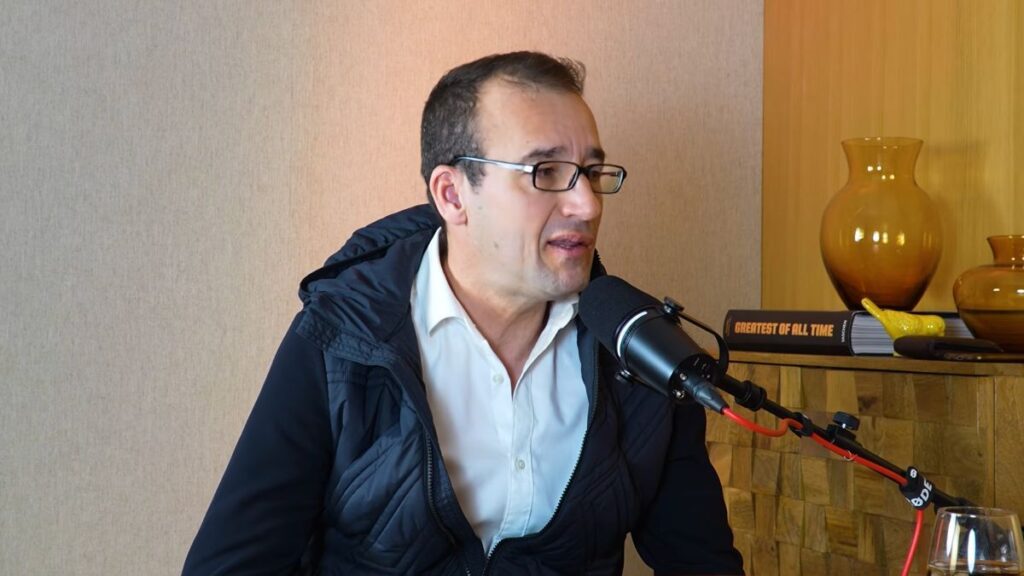
There are people who do not choose the easy way. That, even though they may have their economic livelihood “resolved,” they decide to take a step forward and risk everything for that project they have in mind. Even when the circumstances are not right, the conditions are not the best and logic invites us to stay still. This is the case of Juan Martínez Núñez who went from having the ‘perfect life’ to facing a brain tumor the size of a golf ball.
In an interview for the ‘Breaking the Mold’ podcast, he says that the first time he cried was when a surgeon informed him that he would never be able to practice the sports he loved so much, like skiing. “If we manage to remove the tumor and everything goes well, which we hope will happen, you have to forget about those sports for life,” they told him, stating that that was when he cried, “but not when they diagnosed me with the tumor.”
During his fight against the brain tumor, he survived a first operation that had to be emergency suspended due to a critical brain edema that put his life at risk, subsequently facing severe medical complications. To remove it, the surgeons had to completely empty his left ear, to which was added damage to the optic nerve that caused partial loss of sight and double vision for months.
Likewise, he suffered severe facial paralysis that disfigured his face and caused him to lose his physical identity, requiring complex reconstructive surgery in which doctors grafted a nerve from his tongue to his facial nerve to regain mobility. A medical team that only exemplifies his fighting spirit and for which he was also granted a permanent absolute disability pension. Although he rejected it.
He rejects a lifetime pension to start a business: “I had it in me”
Juan Martínez refused to collect the absolute permanent disability pension, which allows us to collect 100% of our regulatory base. “I had no idea. I’m like, ‘What is that?’ It says, ‘you will receive a pension for life, plus the maximum pension.’ And I said, ‘How?’ He says, ‘Yes, you are no longer fit to work.’ And I stayed like that and said, ‘But how about for life?’ He told me, ‘you are not aware of what situation you are in…’ I told him, but you bury me alive,’” was the conversation he had.
For this entrepreneur, a true example of improvement, it was unthinkable to collect such a pension at 31 years old. So he rejected it and this was his response: “I’m going to dedicate myself to the world of snow, to start a company, because I’ve always wanted to be an entrepreneur. I had it in me.”
Thus, driven by his youth and his desire to work, Juan requested that his case be reviewed and requested a medical discharge. He managed to have his file go through several phases, reducing his status to a total permanent disability and, finally, to a permanent disability for his usual profession, in this case as a construction manager. By making this decision, he gave up the absolute maximum pension (keeping approximately half of the amount) in exchange for regaining the legal right to work in other areas.
Thanks to this, he was able to found his own ski clothing brand, knowing from the beginning that it had to be “next to a powerful resort.” “I hesitated between the Alps, Andorra and Baqueira Beret. And well, the State had spent so much money on me, with the hospitals, I have a construction manager’s pension, and it was a great reason for me to try as much as possible to return what public health, the university, had given me. I went to a public engineering school,” he explains.
For this reason, he says that he wanted to start a business here, in Spain, to try to give back even part of what he had received: “Go, for example, to the Alps and get the brand from France or from Italy, because it was a reason that no, I didn’t see myself. And I went to the Aran Valley.”
That brand is Reforcer, inspired precisely by the improvement of its founder, as indicated on its website: “It was born out of the desire to improve on a personal and sporting level. In life we have many mountains to climb. We also have to prepare to face the storms. The key is not to give up, it is not about resisting but strengthening our capabilities, accepting the inevitable and transforming each challenge into an opportunity to overcome. The value of connecting with the mountain, caring for it and protecting it.”