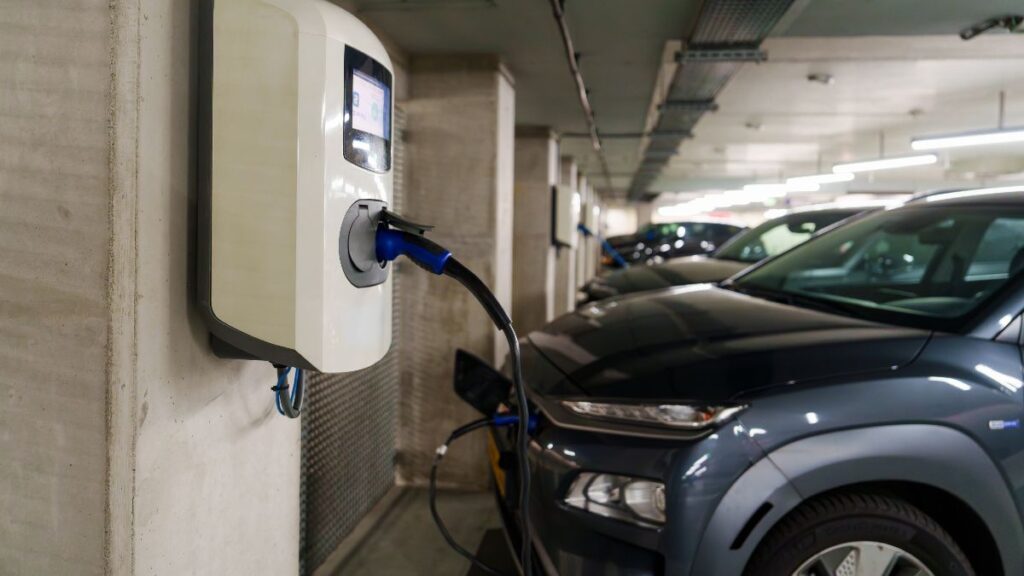
The Supreme Court has once again ruled on the installation of charging points for electric vehicles in garages of communities of owners, reaffirming a doctrine that had already been established in previous resolutions. When the charging point is installed in a parking space for private use, permission from the community is not necessary, prior communication being sufficient.
This is established by STS 240/2026, of January 14, in which the High Court once again clarifies the scope of the article 17.5 of the Horizontal Property Law, the rule that regulates the installation of charging points in community garages and which was introduced to facilitate its implementation and avoid unjustified blockages by the communities.
The ruling analyzes the case of a neighborhood community in which several owners installed charging points for electric cars in their individual parking spaces. A neighbor challenged the works, alleging that the wiring had crossed common elements (such as the floor) without authorization from the board.
Article 17.5 of the LPH allows the installation of the charging point without the need for authorization
The Supreme Court recalls that article 17.5 of the Horizontal Property Law expressly establishes that the installation of a charging point for private use in an individual square only requires prior communication to the community, with the cost being entirely assumed by the interested party.
As the ruling explains, the law does not differentiate whether the installations affect common elements or not, because the legislator was aware that the electrical wiring must necessarily run through common areas in community garages. For this reason, it insists that the mere accessory use of common elements does not make the installation illegal, unless there is an unnecessary or disproportionate impact, a specific detriment to other owners or a risk to the safety of the building.
To do this, although it does not require a specific form, the communication must be sufficient for the community to know the layout and essential details of the work, allowing it to be verified that there are no disproportionate damages.
This interpretation is not new. The Supreme Court expressly relies on its ruling 1745/2015, of December 1, in which it already established doctrine by pointing out that the installation of charging points is outside the general majority regime of the community, precisely to avoid vetoes that frustrate the energy efficiency objectives.
The Supreme Court emphasizes that interpreting article 17.5 in a restrictive manner, requiring additional community authorizations, would empty the rule of content and frustrate its purpose, contravening the interpretation criteria of article 3.1 of the Civil Code, which requires attention to the spirit and purpose of the laws.