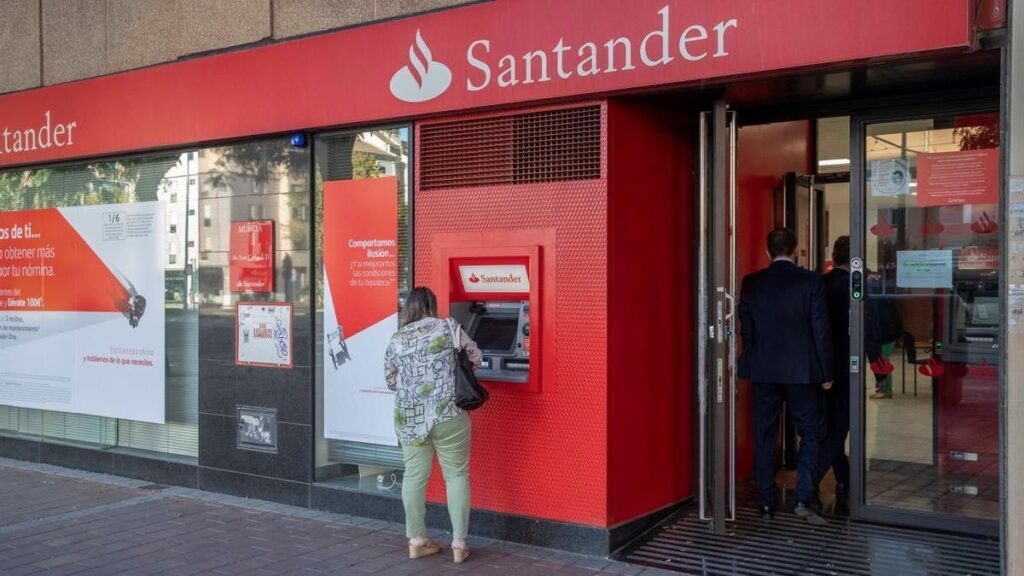
New judicial setback for Banco Santander for the marketing of complex financial products. The Provincial Court of Las Palmas has ruled in favor of a client and her family after their appeal and has condemned Banco Santander to compensate 600,000 euros for the damages derived from the contracting of the so-called ‘Santander Securities’, a complex financial product that has already given headaches to more than one client who contracted them.
This has been resolved by ruling 14/2026, of January 8, provided by Auger Lawyers and to which you have had access NewsWork exclusively, which has revoked the ruling issued in the first instance and condemns the bank to pay 600,000 euros (which is what it invested in 2007).
Specifically, the ruling establishes that the entity must pay “the amount of six hundred thousand (600,000.00 euros) reduced by the amount determined in the execution of the sentence”, corresponding to the value of the shares on the date of the exchange and the returns received up to that moment, plus legal interest from the judicial interpellation.
A product designed to finance the takeover bid for ABN Amro
The ruling recalls that the ‘Santander Securities’ were issued in 2007 in the context of the takeover bid for ABN Amro. These were securities necessarily convertible into bank shares if the operation was completed, as it finally happened.
The client and her husband subscribed to the product on September 20, 2007 for a total amount of 600,000 euros. The mandatory exchange occurred years later, in 2012.
The Court leaves no room for doubt about the origin of the banking product. It expressly points out that ‘Santander Securities’ must be classified as a “complex product”, as the National Securities Market Commission also did, and, in any case, as a “speculative, high-risk product that can cause significant losses for those who acquire it.”
Furthermore, it highlights that its sale required special care to protect non-professional retail investors, since the product included significant risks that could go unnoticed by an uninformed client.
What the Court of First Instance said
In the first instance, the court had completely dismissed the claim, considering that the contracting parties had been informed of the variable nature of the performance and that they had sufficient capacity to understand the product.
However, the Provincial Court reviews this assessment and concludes that the most important thing is not that the client knew that he would receive shares, but that he adequately understood how their value was set and what real risk he assumed.
The real risk was on the valuation date
One of the most relevant aspects of the ruling is the detailed explanation of the risk inherent to the product. The Chamber points out that what is relevant “is not so much that the client knew that after maturity he would receive shares of Banco Santander, since such an investment result is not the ‘risk’ assumed.”
The risk was that the valuation of the shares was not carried out on the date of the exchange, but on the date of issue of the obligations. This could cause, as happened in this case, “a significant deviation in assets between what was initially delivered and what was received in shares after the exchange.”
According to the Court, this circumstance could go unnoticed by an inexperienced customer, which required clear, understandable and detailed information about the operation of the product and its real risks.
The Provincial Court sees that there was financial advice
The Court considers it proven that the contracting took place within the framework of a financial advisory relationship. It expressly states that “there is no doubt that the disputed contract derives from a relationship of advice on financial matters as it is a product offered by the defendant.”
It was not the clients who came requesting a specific product, but rather the decision to hire was the result of the advice received from the entity.
In this sense, the ruling recalls that, even before the entry into force of the MiFID regulations, there was already an obligation to offer “clear, correct, precise, sufficient and delivered on time” information, especially when it came to high-risk financial products.
Insufficient information and standardized clauses
The Court rejects that the simple delivery of an information brochure or the signing of a prearranged clause in which the client declares that they understand the risks is sufficient to prove compliance with the duty of information.
According to the doctrine of the Supreme Court, this type of stereotyped mentions can become formulas “empty of real content” if they are not accompanied by an effective and personalized explanation.
For all these reasons, the Court concludes that “it has not been proven that the appellees had been informed in a clear and understandable manner of the nature, operation and scope of the product, nor that it adjusted to their investment profile.”
How compensation is calculated
Regarding compensable damage, the Court applies the doctrine of the Supreme Court on compensation between losses and returns obtained.
The damage occurred at the time of the exchange of the bonds for shares, when the contracting parties received a lower value than initially invested due to the lower stock market price of the shares on that date.
The compensation will be specified in the difference between the 600,000 euros invested and:
- The amount that could have been received from the sale of the shares at the closing price on the day of the exchange.
- The returns received up to that moment.
Legal interest from the judicial interpellation will be added to the resulting amount. Likewise, the entity has been ordered to pay the procedural costs of the first instance.
With this resolution, the Provincial Court reinforces the jurisprudential line that requires financial entities to take extreme compliance with their information duties when they market complex products to retail clients, especially when financial advice is provided.