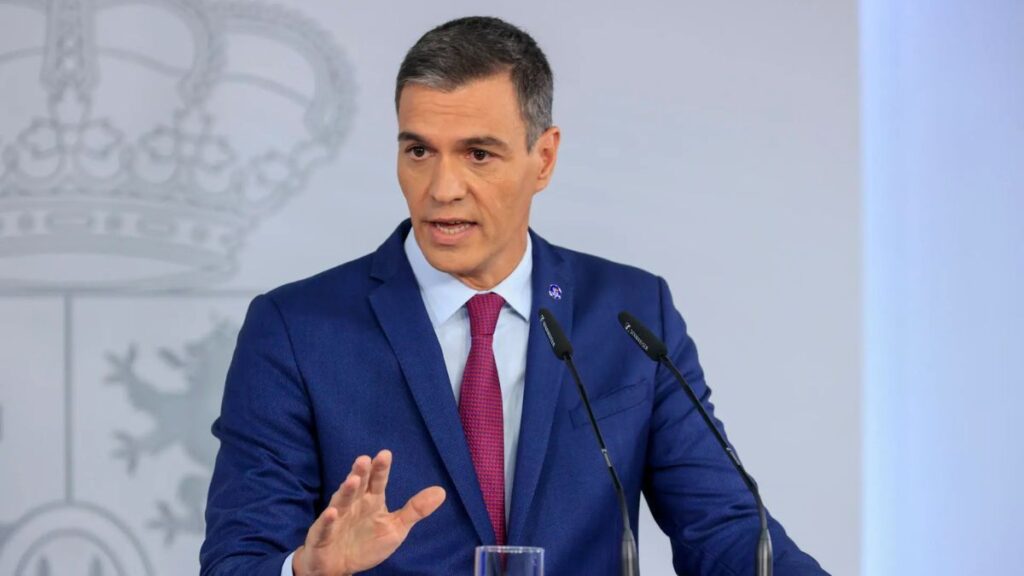
The President of the Government, Pedro Sánchez, has once again encouraged the employers to sit down with the unions at the collective bargaining table to promote wage increases that go beyond the Minimum Interprofessional Wage (SMI), which has increased by 3.1% by 2026 after being approved this week in the Council of Ministers and being published in the BOE .
During the closing of the day ‘Inequality: it’s time to act’held at the Higher Council for Scientific Research (CSIC), according to Europa Press, Sánchez has defended that the distribution of business profits must be equitable.
“When one sees the evolution of business profits, and particularly the stock market prices and performance that some of these large corporations have, obviously I believe that it is also fair to demand from the Government of Spain that this distribution of profits be as fair as possible,” he noted.
Increase wages beyond the minimum wage
The president recalled that the SMI has increased by 66% since 2018 and has stressed that 60% of the workers benefiting from this increase are women, in addition to a significant number of young people.
In this sense, he stated that “the increase in the interprofessional minimum wage is helping precisely to social cohesion, to the reduction of inequalities.”
Sánchez has insisted that the objective must now focus on collective bargaining so that average salaries grow in the coming years and the pay increase is not limited only to the minimum wage.
Weight of wages in growth
During his speech, the president also focused on the evolution of the labor market and highlighted that temporary employment is now “more or less” close to the European average after the labor reform.
Likewise, he has pointed out that the weight of salaries in relation to the Gross Domestic Product (GDP) has increased three points in the last seven years. “To give us an idea of the achievement, we are saying that 60% of our growth goes into the pockets of workers and 40% into capital accounts,” he noted.