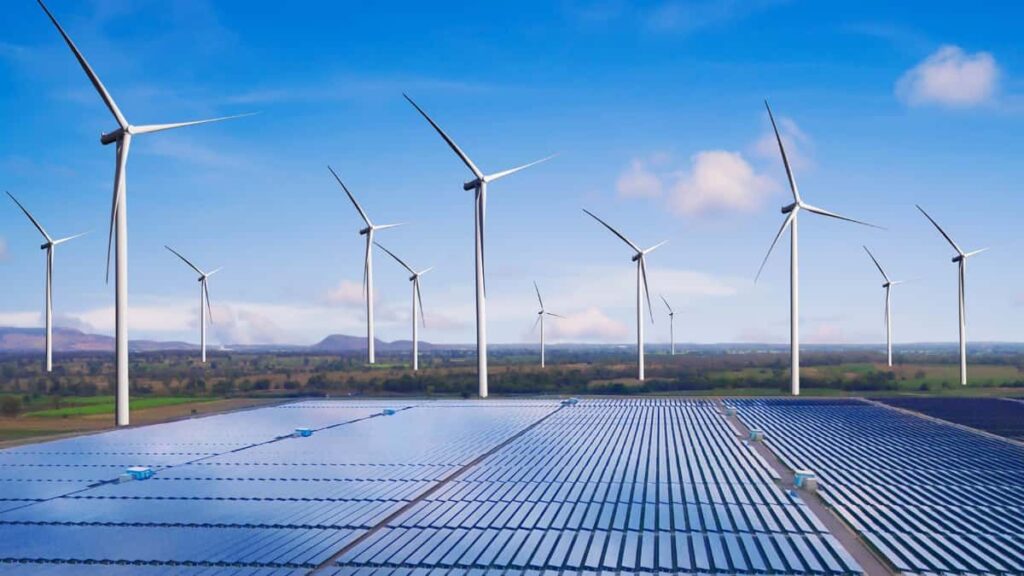
South Australia has shown that betting on sun and wind necessarily translates into more expensive electricity. The data for the last quarter of 2025, collected by the Australian electricity market operator (AEMO), show just the opposite, that is, that the wholesale price of electricity in the State fell “almost a third” compared to the same period of the previous year and was, in addition, the lowest in the country, tied with another region of the national market.
The price of electricity stood at 37 Australian dollars per megawatt hour (MWh) in the fourth quarter, compared to 104 in the previous quarter, according to the state government note based on the AEMO report. In year-on-year terms, this decrease is equivalent to a 30% drop compared to the end of 2024. “The combination of more renewables and less volatility” is the explanation that is repeated in the official diagnosis.
An almost free electricity price with negative values
There is another piece of information that helps to understand why the price plummeted and that is that electricity became free, or even had negative prices, for a very significant part of the time. AEMO places South Australia as the region with the most episodes of negative prices in the national market with 48.4% of the quarter intervals. The mechanism is simple, because when renewable production is very high and demand does not keep up, supply exceeds consumption and the price sinks.
Now, there is a nuance to take into account and that is that the electricity bill is not the same nor does it translate the same with the wholesale market price as the one referred to in this statistic. In Australia, as in Europe and Spain, the final bill includes network, distribution and other charges that do not move at the same pace as the daily market (in Spain we can see this with the OMIE price, which refers to the wholesale market, and that given by Red Eléctrica, which already has taxes applied). Several companies in the sector have explained that this decline may take time to be noticed in homes, precisely because the weight of the networks and term contracts cushions the changes.
Still, the South Australian case is relevant for two reasons. The first is that the reduction in price comes in a context of accelerated transformation of the system: AEMO itself confirms that, in the national market as a whole, renewables (including storage) exceeded 50% of the quarterly mix for the first time in the last quarter of 2025. The second is that the drop in prices coincides with a leap in the technology that acts as a “cushion” when the wind and the sun do not match the demand clock, that is, batteries.
The role of batteries as storage
This role of batteries also appears in the report, since the operator describes how, with a record of distributed solar production, the system faces moments of “minimum load” in which excess generation must be managed to keep the network in a safe state. On several days during the quarter, AEMO explains, large-scale batteries were used to provide operating margin and stability.
Infrastructure is not just storage. South Australia has just added large wind power, such as the Goyder South park, inaugurated by Neoen with 412 megawatts and 75 wind turbines. The company presents it as a decisive push for the State’s goal of reaching 100% “net” renewable electricity in the coming years. According to its statement, the facility will produce around 1.5 terawatt hours per year.
In parallel, change has also crept onto the rooftops. South Australia is one of the territories with the highest penetration of self-consumption in the country: “half of the homes” already have solar panels, according to monitoring of the sector collected by specialized media. It is a less showy detail than a wind farm, but key to understanding the new electrical landscape: each roof that produces during the day, reduces the demand on the network and pushes the price down during solar hours.
On the political level, the State Government has tried to turn the figures into a direct message to its critics. In the note released on January 29, Minister Tom Koutsantonis defended that the report “unequivocally shows” that more renewables and less volatility create “the environment” for lower wholesale prices, and added that he expects the decrease to “be passed on” to invoices.