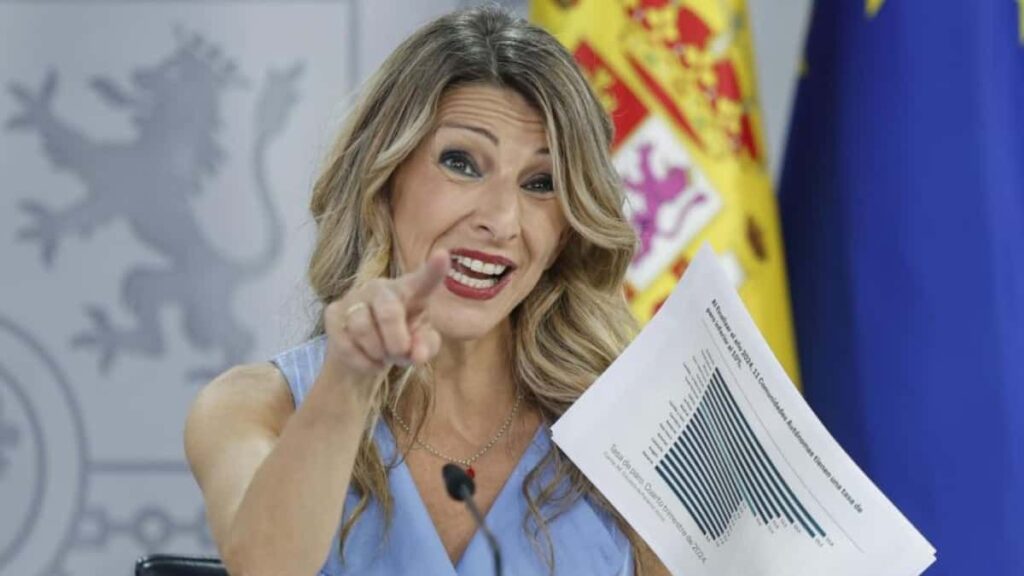
The second vice president and Minister of Labor, Yolanda Díaz, will sign this Monday with the general secretaries of CCOO, Unai Sordo, and of UGT, Pepe Álvarez, the increase in the minimum interprofessional wage (SMI) for 2026. The increase, of 3.1%, will set the new salary floor at 1,221 euros per month for fourteen payments, that is, 17,094 euros per year, and will take effect retroactive from January 1, according to government sources.
The official event will be held at 11:30 a.m. at the Ministry of Labor and will also be attended by the President of the Government, Pedro Sánchez. His attendance has a symbolic value in a procedure usually reserved for the head of Labor and the signatory social agents, since the last time the head of the Executive attended this type of ceremony was in 2020, when the signing took place at the Palacio de La Moncloa.
After the signature, the next step will be the approval of the royal decree in the Council of Ministers, which is expected to be carried out at the meeting on Tuesday, barring last-minute changes. Once published in the BOE, the new amounts will remain fully in force and companies will have to adapt their payrolls. If administrative times allow it, the adjustment will be reflected in February and will include the retroactive payment of what corresponds to the month of January, that is, many workers who collect the SMI will notice an extra on the payroll.
New increase in the Minimum Interprofessional Wage
With the update for 2026, the SMI will stand at 17,094 gross euros per year and 40.70 gross euros per day in general. The increase is equivalent to 37 euros more per month compared to the amount in 2025, established at 1,184 euros per month, and represents an additional 518 euros per year. The Ministry of Labor highlights the impact of the measure on groups with less capacity for salary negotiation and in activities where the minimum wage is a determining reference, such as farming or domestic employment.
The agreement is closed again without the employers. It is the sixth consecutive year in which Labor has agreed alone with CCOO and UGT on the revaluation of the minimum wage, after the social dialogue conversations have ended, once again, with union support and the rejection of business organizations, which question both the pace and the design of the increases.
The new royal decree also includes specific amounts for certain groups. In the case of casual and temporary workers, the minimum wage per legal day will be set at 57.82 euros. For domestic workers, the reference is established at 9.55 euros per hour actually worked.
Review of contracts
The update does not alter, in principle, the structure or the amount of salaries that already exceed the SMI in annual calculation. But it does require a review of private contracts or agreements whose amounts, added up throughout the year, fall below the new legal minimum. In these cases, companies must adjust the amounts to guarantee the threshold set for 2026, in accordance with the current absorption and compensation rules.
Precisely that point anticipates a new regulatory front. Labor and unions have been demanding changes for some time to prevent the increase in the SMI from being diluted through compensation with salary supplements, such as bonuses or incentives. The Ministry promised to clarify these rules, but this reform will not be incorporated in the royal decree of the increase. According to department sources, it will be processed in a different standard linked to the transposition of the European directive on adequate minimum wages, a debate that explains part of the clash with the employers in this year’s negotiation.