The Superior Court of Justice of Andalusia has given the reason to Social Security to deny the widowhood pension to a woman who despite living with her partner 26 years were not registered as a de facto couple in an official registry or having a public document to accredit said union. Although the woman contributed Padrón, invoices, supplies and witnesses contracts, the court decided to dismiss her appeal by not complying with the required requirements.
As the sentence recounts, everything begins when this woman requests, in March 2021, the widow’s pension to Social Security after the death of her partner and with which she lived for more than 26 years. Although they had a stable relationship and accredited it by means of a certificate of registration, invoices, supplies and witness statements, it had not registered their union as a de facto couple in an official registry or formalized the relationship in a public document, the pension was denied.
You may be interested
Susana (79 years): “I charge a pension of 800 euros and 600 rental payment, what is left for light, water and gas … is impossible”
A woman charges 165,058.69 euros of the widow’s pension of her deceased mother for almost 30 years; Social security claims, but dies, they are asked to their heirs and justice acquit them
Social Security explained in its letter of resolution that the widow did not meet the requirement required in article 221 of the General Social Security Law, which requires the registration or public document with a minimum in advance of two years to the death to recognize the widowhood pension to the de facto couples. That is, in spite of being living 26 years, it is necessary that this relationship is “formalized.”
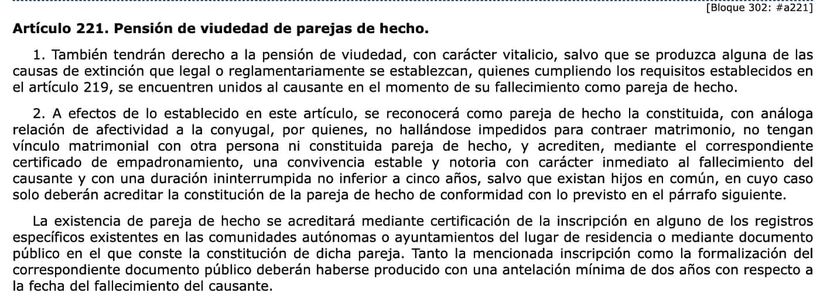
Therefore and as the resolution points out, the “mere coexistence, however prolonged, is not enough to generate the right if the formal existence of the couple is not credited,” he explains. For this reason and despite the relations, which were all dismissed, the widow decided to go to the courts with the aim of giving him reason, understanding that coexistence and union was more than justified.
Coexistence is not enough to generate the right to pension
Both in the first instance before the Social Court number 5 of Granada, and later before the Superior Court of Justice of Andalusia (TSJA) they proved the social security, that is, that the widow did not have the right to collect the widowhood pension. Both courts agreed that although the coexistence with the deceased for 26 years was fully accredited, the formal registration requirement as a de facto pair was not met in a specific registry or the formalization in a public document with a minimum in advance of two years to the death.
In the case of the TSJ of Andalusia, he also explained that according to the jurisprudence of the social order of the Supreme Court to access the widowhood pension in the case of de facto couples, two simultaneous requirements that are, the stable and uninterrupted coexistence for at least five years and the formal existence of the in fact in fact must be met, being this last essential and accreditable only by registration or public document.
It is not always necessary to prove the de facto couple
In this judgment, the key is that the widow did not comply with the requirement required in article 221 of the General Social Security Law, which is to prove the formal existence of the de facto couple. Now, it is not always the case, since, according to another sentence, this woman was recognized by the widow’s pension without accrediting such a requirement, because in that case she had a daughter in common.
As the court explained, “the fact of having a daughter in common, born in 2005, was more than enough to prove a family union that went beyond mere coexistence.” Therefore, although the General Social Security Law is clear in this regard, sometimes this requirement can be interpreted more flexible.