
The Superior Court of Justice of the Canary Islands has confirmed the obligation of a widow to return 6,877.20 euros to social security for the improper collection of the minimum vital income (IMV), although she herself warned the administration of the change in her economic situation after beginning to perceive the widow’s pension. The National Institute of Social Security (INSS) maintained the payment of the benefit almost a year after the interested party communicated the new income, but finally claimed the full return of what has received more.
The case begins when the widow requests the IMV, they approve it and start charging it. After the death of her husband, she begins to collect a widow’s pension and her income exceeds the allowed threshold. According to the sentence, the widow “presented written to the Social Security Care and Information Center, the CAISS, indicating that they had changed their economic conditions … In case they had to stop paying the minimum vital income.” But Social Security did not act until December 2021, when he declared the right extinguished and claimed the return of the unduly charged in 2021.
You may be interested
Social Security will raise the widow’s pension to 60% of the regulatory base to all pensioners over 65 who do not have other income or pensions

A woman loses the widow’s pension and must return 2,355.62 euros because she did not communicate to justice that she had reconciled with her husband after divorce
The affected resorted to the decision, defending that he had acted “in good faith, and from the moment in which he had knowledge of the perception of widowhood benefits, he made it known to the INSS”, so he considered it unfair to have to return the money received while the body itself did not react in time. Even so, the Administration claimed the amounts, hosting article 55.3 of the LGSS, which establishes the “obligation to reimburse the benefits perceived unduly, regardless of the cause that originated its perception.”
Good faith recognized, but obligation to return money
In the first instance, the Social Court number 10 of Las Palmas dismissed its claim and confirmed the obligation to return. The affected resorted to the TSJ of the Canary Islands, claiming that, as the European doctrine and several sentences of the Supreme Court, the errors attributable to the administration should not be charged when they have acted in a diligent and transparent way. That is, if the error is of the administration, the citizen should not be charged and especially when I notify it.
However, the Chamber, although it recognizes the good faith and the diligence of happiness by notifying the change of income, concludes that the case cannot be considered an error of the administration in the initial concession of the IMV, but a delay in declaring undue perception after the notice. Therefore, as a pure administrative error has not occurred, but an “undue perception” communicated but not detained in time, the law forces to return the benefits, even if the ruling has been of the administration and the citizen has acted correctly.
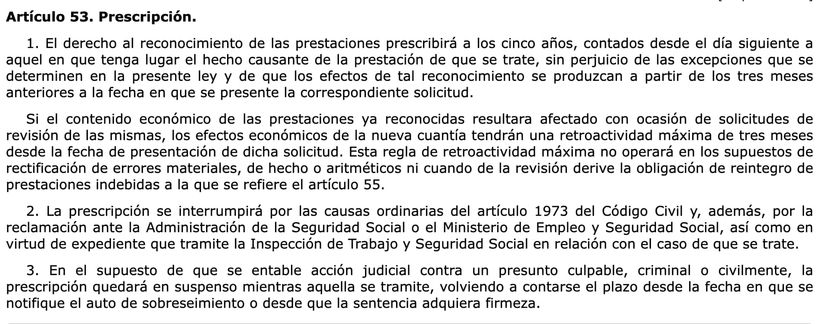
The Superior Court of Justice of the Canary Islands explains that article 55.3 of the General Law of Social Security imposes the reimbursement of unduly perceived benefits, and that the claim was filed within the legal period of prescription. Despite the reference to the European jurisprudence and at the beginning of legitimate trust, the Chamber recalls that this criterion only operates when the error is exclusively attributable to the administration, and not when the beneficiary himself recognizes that he has stopped meeting the requirements and communicates it.
For all these reasons, the TSJ confirms the initial sentence and condemns this widow to return 6,877.20 euros claimed, even if it is the Social Security itself who took almost a year to react to its communication