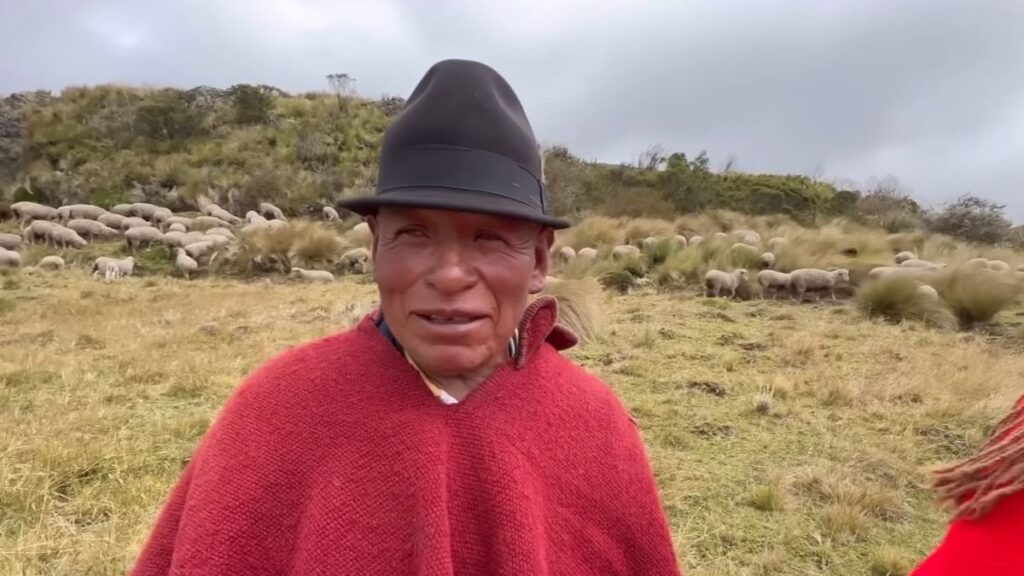
While many workers count the hours until the end of their day, Juanito, 71, practically organizes his entire day around his animals. He lives at about 4,000 meters above sea level in the Ecuadorian moors and continues to dedicate himself to herding about 150 sheep, a profession that he learned from his family and that he continues to carry out with his children and grandchildren. For him, age does not seem to be a limit, since he admits that he continues to feel good enough to work all the hours necessary.
His story has been disseminated by the popularizers Josué and Elie, from the YouTube channel ‘Ecuador and its official landscapes’, who spent several days living with Juanito and his family.
Juanito was born there and it seems like he doesn’t want to leave for anything in the world. “For me it is happy here. I was born here in the moor,” he explains, remembering that his parents also lived in the same place and that practically his entire life has passed among those mountains. He assures that in that environment he has a quiet life and that “illnesses don’t even come,” so nothing invites him to leave.
“All day long you have to be taking care of the sheep”
The work begins by taking the herd out and walking about 40 minutes to the pasture areas. Then you have to stay there for hours watching the animals and preventing them from dispersing too much.
“The little sheep are grouped together, there are 150,” explains Juanito. “Every day you have to go out to graze. All day you have to be there taking care of the sheep until you take them to the corral again.”
The task is divided between him and his daughters. While accompanying the sheep he usually also carries an Andean flute that he plays during his walks along the hills, an instrument that, he jokes, accompanies him even more than his own wife.
Their daily life is also very different from that of a city. They cook with firewood, sleep on straw mattresses and need three or four blankets to combat the cold of the night. Part of the food comes from their crops and animals and the water is taken directly from mountain sources.
“We are from the wilderness, but we live in tranquility”
Juanito has six children and six grandchildren and part of the family continues to live nearby. For him, precisely that coexistence and tranquility compensate for the hard work and the few comforts. “We live happily here. Since we don’t live in a town, in the countryside we live more peacefully,” he says.
He also remembers some anecdotes of discrimination that he experienced when he went to other places to sell. According to him, they even insulted him because of his indigenous origin. His response, however, reflects quite well how he understands his life: “We are Indians, but we are from the moor and we live in peace and health.”
At 71 years old he is not talking about retiring. He continues to go out with the flock, planting potatoes, using firewood for cooking and helping to maintain a way of life that has been passed down from father to son.
They sell a 3-bedroom rural house with a fireplace, garden and a 6,250-meter farm in the Sierra de Madrid

The Junta de Castilla y León has aid of up to 900 euros for young people who want to get a driving license
And when it rains or freezes there are not many alternatives either. The sheep have to continue eating and someone has to take care of them. For Juanito, after a lifetime there, it is simply part of the job.