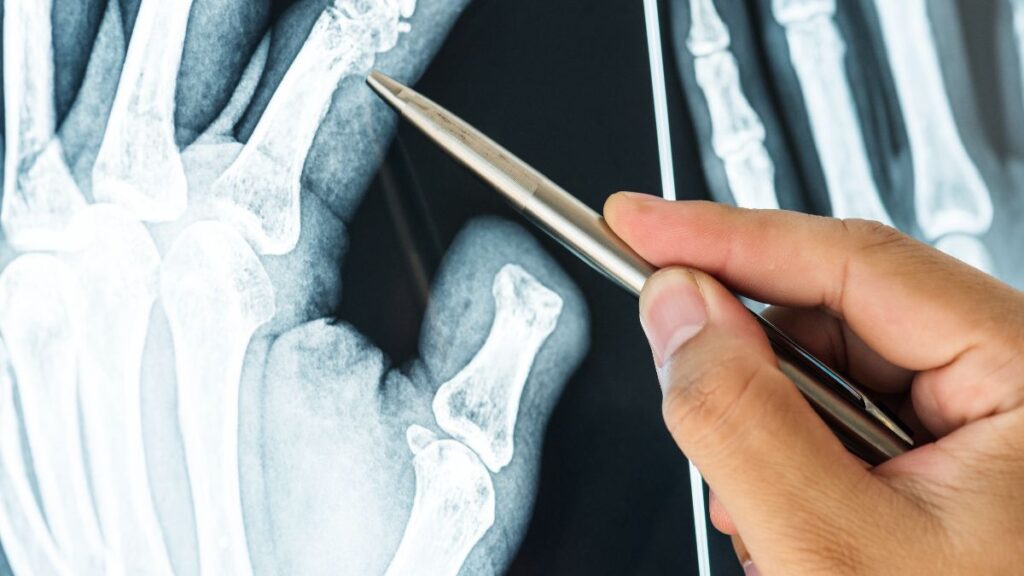
The Superior Court of Justice of Castilla-La Mancha has recognized the permanent partial disability to a seamstress with rhizarthrosis (osteoarthritis at the base of the thumb), for which she will receive a single payment of 25,146.24 euros. In this way, the court refuses to grant him a life pension, because, despite the pain he caused, his injury is not enough to grant him a life pension, since he continued to retain mobility.
The worker was on sick leave until she exhausted maximum duration of temporary disabilitythat is, the 545 days (365 days plus the extension of 180 days). Although he requested permanent disability, this was denied by Social Security, because the medical report stated that there were no “current limitations that justify IP for his profession.” That is, they did not give him any degree of disability.
Despite the fact that the Social Court number 3 of Ciudad Real gave her permanent partial disability, both parties appealed, since the Social Security claimed that she was not entitled to any degree of disability and the worker wanted to achieve the full degree (the one that disqualifies her from the usual profession and with which a pension equivalent to 55% of the regulatory base is collected).
To understand it a little, clarify that the partial degree is the lowest degree within the disability. It is granted to those people who lose at least 33% of their performance at work, but still maintain the possibility of continuing to work. Instead of collecting a monthly pension, you receive a lump-sum compensation (at once) equivalent to 24 monthly payments, so if your regulatory base was 1,047.76 euros, you would collect 25,146.24 euros with the possibility of continuing to maintain your job.
Performing less in sewing gives the partial and not the total
The Superior Court of Justice of Castilla-La Mancha rejects the Social Security appeal, since, according to the organization’s own professional guide, sewing requires precision work with the hands for more than 60% of the day. He remembers that the disability depends on “its real work impact and not from a merely clinical perspective,” as well as that the operation they offered him did not give guarantees that he would be able to do the clamp again.
Nor does it give the worker the reason to give her the total, since, although the total does not require an “absolute impossibility”, she can continue doing the fundamental tasks of her profession. The problem is that, according to the facts contained in the sentence (available in the Judiciary), she retains her mobility and doing the clamp hurts her and makes her slower, without indicating “a true professional disqualification.”
For all things, the Chamber gives him the right to receive partial permanent disability, but not total disability, so he will be able to continue working in his profession, although the Chamber itself admits that repeating the clamp “increases pain and significantly decreases performance.”

A forklift operator who underwent surgery for a hernia achieves absolute permanent disability with a pension of 1,558.02 euros after Social Security denied it
Justice denies permanent disability to a 63-year-old family doctor who underwent surgery for pancreatic cancer with metastasis because he can do sedentary work
The difference is that, if he had been given the full degree, with his regulatory base of 796.37 euros, he would have been left with a pension of 438 euros per month (55% of the regulatory base). Now, since it is below the minimum, you could collect the minimum pension of total permanent disability for common illness, which in 2026 is 684.30 euros per month in 14 payments (9,580.20 euros per year).