
For this Sunday, May 10, 2026, the average price of electricity in Spain is 20.84 euros per megawatt hour (MWh) in the wholesale market, according to data published by the Iberian Energy Market Operator (OMIE). This represents a drop of 38.34% if we compare it with the rate registered this Saturday, which was located at 33.80 euros/MWh.
The wholesale market price is the one paid by marketers to buy the electricity that they then sell to their customers, so it is not the figure that the consumer sees directly reflected on their bill. The rate that does affect the pockets of households is the Voluntary Price for Small Consumers (PVPC), which incorporates taxes, tolls and system charges, and is published by Red Eléctrica based on market data.
The price of electricity today, Saturday, May 9, 2026 in the PVPC plummets, although there are 8 sections above 100 euros
The price of electricity for Saturday, May 9, 2026 in the wholesale market: the cheapest and most expensive hours
When is electricity cheaper this Sunday?
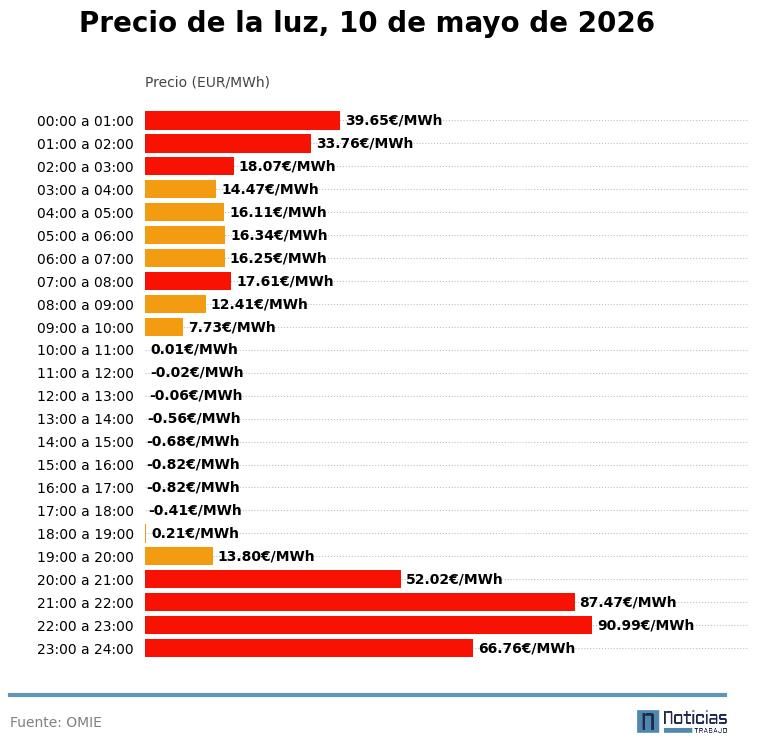
The cheapest hour of electricity will occur in two consecutive sections, from 3:00 p.m. to 4:00 p.m. and from 4:00 p.m. to 5:00 p.m., both with a price of -0.82 euros/MWh. The most economical stretches of electricity will start at mid-morning and will continue continuously until the end of the afternoon. Ten of them will have a value below 10 euros, and even eight will be trading in the negative.
When is electricity most expensive this Sunday?
The maximum price of electricity will occur from 10:00 p.m. to 11:00 p.m., when 90.99 euros/MWh will be reached. The most expensive hours of electricity will be concentrated mainly in the late afternoon and evening, with an additional spike in the early hours of the morning. Despite the strong contrast with the midday sections, no section will exceed 100 euros.
Price of electricity by hour, Sunday, May 10
To take advantage of the drop in electricity, it is best to optimize consumption according to its evolution. This will be the price of electricity hour by hour on Sunday, May 10, 2026 in the wholesale market:
| Hour | Price (euros/MWh) |
|---|---|
| 00:00 – 01:00 | 39.65 |
| 01:00 – 02:00 | 33.76 |
| 02:00 – 03:00 | 18.07 |
| 03:00 – 04:00 | 14.47 |
| 04:00 – 05:00 | 16.11 |
| 05:00 – 06:00 | 16.34 |
| 06:00 – 07:00 | 16.25 |
| 07:00 – 08:00 | 17.61 |
| 08:00 – 09:00 | 12.41 |
| 09:00 – 10:00 | 7.73 |
| 10:00 – 11:00 | 0.01 |
| 11:00 – 12:00 | -0.02 |
| 12:00 – 13:00 | -0.06 |
| 13:00 – 14:00 | -0.56 |
| 14:00 – 15:00 | -0.68 |
| 15:00 – 16:00 | -0.82 |
| 16:00 – 17:00 | -0.82 |
| 17:00 – 18:00 | -0.41 |
| 18:00 – 19:00 | 0.21 |
| 19:00 – 20:00 | 13.80 |
| 20:00 – 21:00 | 52.02 |
| 21:00 – 22:00 | 87.47 |
| 22:00 – 23:00 | 90.99 |
| 23:00 – 24:00 | 66.76 |
Evolution of the price of electricity in the first 9 days of May
The average price during these first 10 days of May has stood at 56.79 euros/MWh, which means that electricity is now 43.23 euros more expensive than a year ago, when the average price was €13.56/MWh.
If today’s day is compared to just a year ago, there is an increase of 129.52%. This is because on May 10, 2025 the price of electricity stood at €9.08/MWh, while the price today stands at €20.84/MWh, which represents an increase of €11.76 compared to the same date last year.
| Date | 2025 | 2026 | Difference in euros/MWh |
|---|---|---|---|
| May 1 | 13.29 | 57.87 | 44.58 |
| May 2 | 10.94 | 43.64 | 32.70 |
| May 3 | 16,17 | 48.13 | 31.96 |
| May 4 | 11 | 69.71 | 58.71 |
| May 5 | 10.89 | 64.34 | 53.45 |
| May 6 | 10.24 | 78.02 | 67.96 |
| May 7 | 19.01 | 86.90 | 67.89 |
| May 8 | 16.76 | 64.69 | 47.92 |
| May 9 | 18.24 | 33.80 | 15.56 |
| May 10 | 9.08 | 20.84 | 11.76 |
The Government reiterates the creation of a temporary tax on energy companies
The pressure to tax the extraordinary profits that large electricity and oil companies are registering in the heat of the conflict in the Middle East moves on two fronts at the same time. One European and one national, which at the moment are advancing in parallel without quite fitting together.
The first step started at the beginning of April from five capitals. The First Vice President and Minister of Economy, Carlos Body, together with his counterparts from Germany, Italy, Austria and Portugal, sent a letter to the European Commission requesting the creation of a temporary solidarity contribution for the energy sector. The idea was to replicate the scheme that was already applied in 2022 after the Russian invasion of Ukraine, when part of the extra profits from the sector were diverted to alleviate the bills of homes and companies.
Brussels, however, responded in the opposite direction and in just a few weeks. On April 22, the European Commission presented the AccelerateEU package, focused on lowering taxation on electricity and giving Member States room to abolish the electricity tax for vulnerable consumers and industry. There is no trace of the tax on energy companies that Spain demanded: the community proposal avoids for now any tax on the sector’s profits.
Despite this initial coldness, the PSOE has decided to continue pushing. On May 6, the Socialist Group registered a non-legal proposal in the Congress of Deputies so that the Executive keeps this request alive before the European Union and continues negotiating a coordinated tax on extraordinary profits.
In the registered text, the socialists defend that the extra cost of the crisis should not fall solely on consumers and the public treasury, and argue that if large energy companies are obtaining extraordinary profits thanks to the rise in fossil fuels, they must also contribute in an extraordinary way to alleviate its effects. The path they demand is the same one that was opened three years ago with the war in Ukraine: a temporary and exceptional contribution, in force as long as the situation that has skyrocketed prices lasts.