Construction is one of those sectors that almost everyone needs at some point, but that finds it increasingly difficult to attract workers. Behind a renovation, a home or a simple raised wall there is an aging profession that cannot find relief among young people. In fact, according to data collected by the sector, of the more than 1.5 million people employed in construction, only 10.8% are under 30 years old, while 22% are over 55 years old and could retire during the next decade.
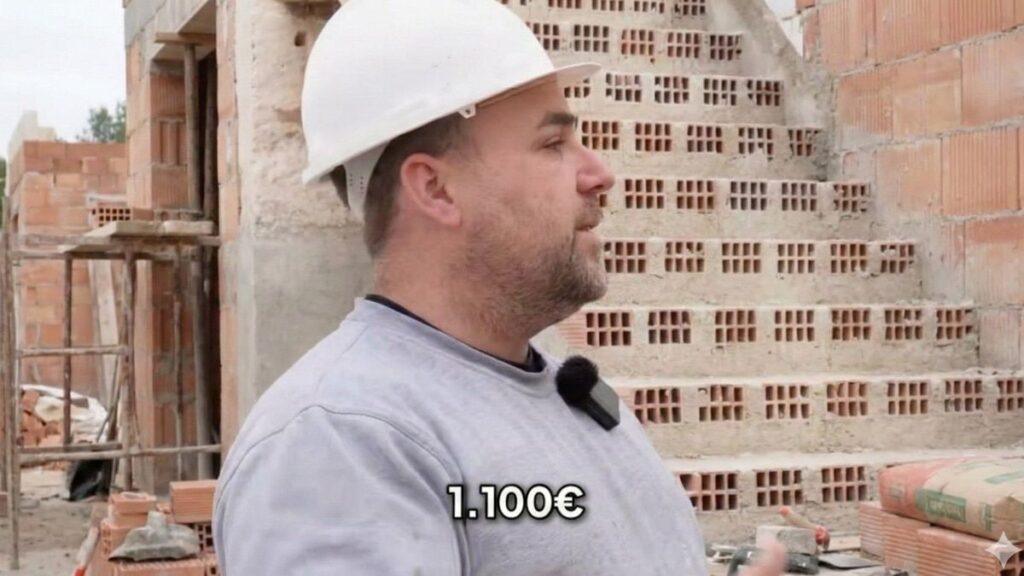
In this sense, content creator Adrián G. Martín shows this reality in one of his videos, where he interviews several workers on a construction site to learn what the bricklayer’s trade is really like. Among them are Pascual and Matías, who explain bluntly what it means to dedicate yourself to construction and why it is increasingly difficult to find young people willing to learn the trade.
“You’re cold, you’re hot, your back hurts,” summarizes one of the workers when talking about day-to-day life at the construction site. The effort is not only in laying bricks or preparing cement, but in repeating movements for hours that end up taking their toll. At one point in the video, Adrián asks how many bags they can move in one day. The answer is clear: “50, 100 bags.” Each one weighs “25 kilos”.
Matías remembers that before the bags were even heavier. “Before they weighed 50 kg,” he explains, adding that they limited themselves because “you would burst your back with a bag.” Although safety has improved and some materials have been adapted, the work is still physical and demanding. “You bend over all day lifting weights,” he says. When you get home, what hurts the most are “your knees and your back.”
Salaries that do not compensate for physical wear and tear
One of the key points of the interview is salary. Matías details how categories work in construction. You start as a laborer, move on to a specialized laborer, then a second-class officer, a first-class officer and, with experience, a construction manager. However, current salaries are far from those of years ago.
“A laborer can be between 900 and 1,000 euros. A second-class officer, between 1,200 and 1,300, and a first-class officer, with luck, between 1,500 and 1,600 euros. A manager can reach 1,800,” he points out. For him, these figures do not fully reflect the effort or risks of the job. “We are not well paid,” he says.
The comparison with other jobs is inevitable. “A mechanic charges you 34 or 40 euros an hour,” he explains, while a bricklayer “doesn’t work for more than twenty-odd euros an hour.” That is why he believes that the job should be paid better, especially given the level of risk assumed by those who work on a construction site.
He also remembers that before there were workers who could earn much more, although not always for better conditions, but for long hours and jobs paid for performance. “People maybe worked 10 or 12 hours,” he says. In those years, some tilers or plasterers could earn very high amounts if they did a lot of work in a short time, but the physical strain was also greater. “All the plasterers at the end, everyone in the back knackered,” he summarizes.
A job that no longer attracts many young people
The lack of generational change is another of the big problems. “Young Spaniards don’t want to be bricklayers,” explains Matías during the interview. According to him, many prefer other jobs where they can earn something similar without enduring the same physical wear and tear. “They say they have other jobs that can earn the same or more and they don’t get half as tired.”
For him, construction needs people willing to learn, because it is not enough to show up at a construction site. It takes skill, patience and time to learn from those who already know. Matías remembers that he started from the bottom, as a laborer, observing the officers and practicing when he could. “When I started working, I was a laborer,” he says.
The problem, he maintains, is that this way of entering the profession has been lost. “Before, people came to learn the trade,” he laments. Now, training someone new takes time and also money for companies. “It costs you maybe 700 euros for each person’s insurance and you don’t get the performance of a person like that,” he explains.
“It is a dangerous job if you don’t take precautions”
The work also has risks. When Adrián asks if it is a dangerous job, Matías does not hesitate: “Yes, quite dangerous, if you don’t know what you are doing and if you don’t take the appropriate precautions.”
Among the main dangers, he mentions working at height, scaffolding, railings, radial machines, compressors or poorly protected spaces. “You have to know the environment in which you move,” he explains. A mistake with a tool or a fall can have serious consequences.
That is why he insists that it is not a job that anyone without experience can do. “You can pick up a radial and have a disc break and the disc fire and hit someone,” he warns. These are details that, seen from the outside, may go unnoticed, but are part of the daily routine on a construction site.