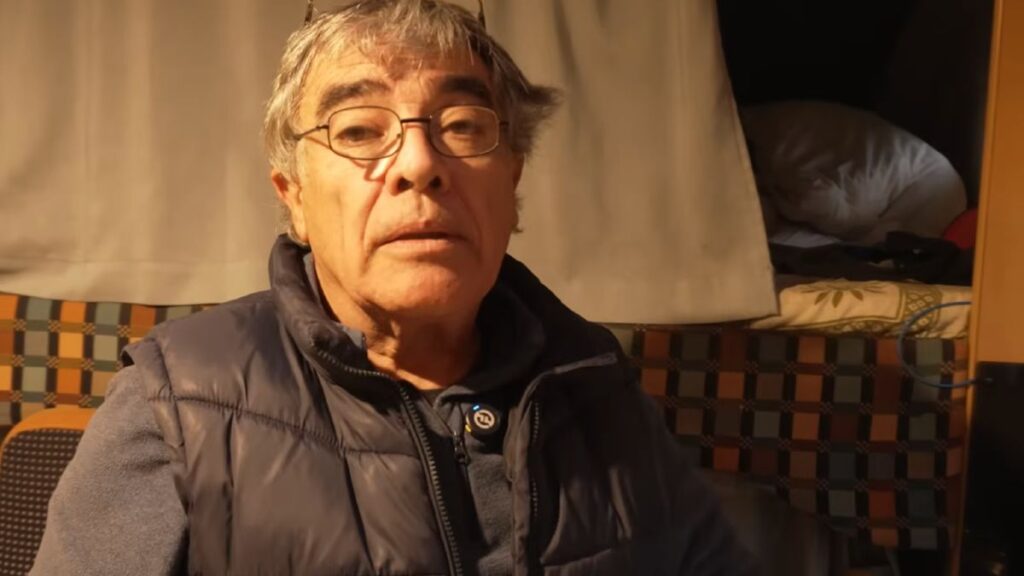
What was once an active working life behind the wheel of a truck has today been reduced to a five-square-metre cabin. Javier, a 67-year-old pensioner, was forced to leave his rental home in Palma de Mallorca after suffering a stroke and seeing his income dwindle drastically.
Now, with a pension that barely exceeds 500 euros, he has been living in a caravan for four years, facing loneliness and bureaucratic pressure from the local administration every day.
“When I wanted to retire, I had a stroke”
Despite having worked for years as a transporter, with times in which his income fluctuated enormously, health and lack of sufficient contributions cut short his retirement.
“I didn’t get the years together and, when I wanted to retire, I also had a stroke, half my body was paralyzed,” explains Javier to the YouTube channel. Diego Revuelta. The inability to move the left side of his body prevented him from continuing to work.
The ultimate turning point came when checking his bank balance. “When you look at the bank account and you see that there is zero. You can’t pay, always zero, and with that amount of money you can’t do much,” he says. With a rent that years ago already cost him between 670 and 680 euros per month, maintaining a traditional roof became a chimera compared to his pension of “500 and something and a plus.”
Faced with the imminence of being left homeless, he collected money borrowed from acquaintances and sold off his belongings to buy the caravan, his “last chance.”
“I wish I had a house”
Javier’s daily life takes place in an extremely small space, just five or six square meters. Despite the precariousness, he maintains an organized routine: he cooks daily, although for health reasons he has stopped eating dinner and only makes simple meals, and he is responsible for going shopping.
However, the biggest challenge comes in the afternoon, when there is no sun. In winter, temperatures drop drastically and the vehicle lacks a safe heating system. “I wish I had a house here. It’s already cold at night,” he laments.
“The motorhome is not a pigsty”
To combat low temperatures, your only alternative is to sleep “more dressed and dressed.” He does not want to use stoves or heaters at night because of the extreme risk they pose: “And if it goes off, what do we do? We go to the other neighborhood,” says the man.
There is also no television for entertainment. Although he would like to have one, the device he had stopped working after a system change and purchasing a new one would mean an unaffordable outlay of more than 300 euros.
Despite everything, Javier assures that they do not steal electricity or water from public roads. The vehicle has a fresh water tank for cleaning and showering, and bathroom waste is managed using a chemical cassette that is rigorously emptied at the green point. “This is a house, it is not a pigsty, it has everything of a house,” he claims.
“Here you realize the reality of life”
Without family to support him, isolation has deeply marked this former truck driver’s worldview. The vulnerability of his situation became painfully evident during his hospital admissions due to the stroke and other operations. “When you fall into a hospital and you are there and no one visits you (…) you realize the reality of life,” he confesses.
This loneliness has led him to lose any kind of hope or ambition. Nowadays it is managed only “with concrete things”, living strictly day to day. “I don’t think about a year from now, I think about a week from now. A month is a long time for me,” says Javier, adding that his only current wish is “that no one bothers me, that they leave me alone.”
Furthermore, he feels that society has turned its back on the elderly. “In the past, older people were respected (…) because they had experience in life, and today younger people who end up leaving a university pretend to know more than us,” he reflects.
At 67 years old, he is convinced that he will never live in a house again. However, their biggest concern is the future of the housing market. Given the government’s inaction, he warns that the problem will fully affect the youngest: “I think that in the future grandparents are going to be the ones who provide habitation for their grandchildren (…) Their children are going to end up either in a caravan, or they are going to end up living with their parents, or they are going to end up living with their grandparents,” the man finally says.