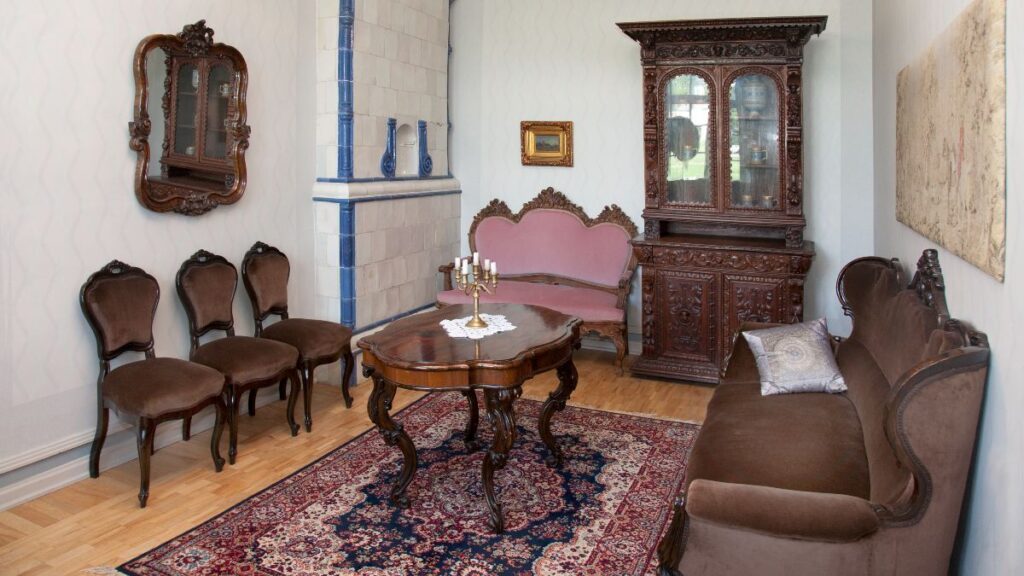
The Superior Court of Justice of Madrid has ruled in favor of the Community of Madrid against a taxpayer who claimed the annulment of a liquidation of the Inheritance Tax for a value of 61,284.24 euros, considering that the household trousseau included in the legacy should not be attributed to him. Justice supports the Administration’s actions by understanding that, since a home has been expressly bequeathed “with all the furniture and belongings inside”, the inclusion of said value in the tax base of the tax is appropriate.
Following the death of a woman who had no direct descendants or ancestors, this taxpayer was designated as a legatee in her will. Among the assets he received was a home in Madrid, expressly described as a legacy with all the furniture and belongings that were inside, as well as a family pantheon, a niche and a canine grave. Thus, the total value of the entire inheritance amounted to 189,716 euros.
When this woman presented the self-assessment of the Inheritance Tax before the Community of Madrid, she calculated a provisional settlement by applying 3% on the value of the apartment received, as household goods, as established in article 15 of Law 29/1987 on the Tax on Inheritance and Donations (LISD). That amount, 5,676.48 euros, was added to the declared value of the inheritance, which raised the tax base to 195,392.48 euros. As a result, the amount to be paid for the tax was 61,284.24 euros. The total inheritance had initially been valued at 189,716 euros, with the apartment being the most valuable asset.
The trousseau as taxation in an inheritance
The taxpayer decided to challenge the assessment, understanding that the household goods should not be included in her case, since she was the legatee of specific assets. To do this, it relied on article 23.2 of the Inheritance and Gift Tax Regulations, which excludes this tax burden when the testator leaves specific assets. He also defended that the furniture and belongings were part of the legacy itself, and that they should not be valued as an addition to the price of the apartment.
Despite their allegations, both the General Directorate of Taxes and the Regional Economic-Administrative Court (TEAR) of Madrid rejected their claims. Both organizations considered that the settlement was correct and in accordance with the regulations.
Already in court, the Superior Court of Justice of Madrid reviewed the arguments of both parties. The taxpayer’s defense insisted that the Administration confused the contents of the apartment with the concept of domestic trousseau, when in fact the furniture was expressly included in the will. For its part, the Community of Madrid maintained that the inclusion of the trousseau was valid because the legacy referred to the home “with all the furniture and belongings”, which justified applying the additional 3%.
The court recalled that, according to the jurisprudence of the Supreme Court, domestic trousseau only covers movable property that can be considered for personal or domestic use by the deceased. But despite this, in this case, he understood that the express mention in the will justified its valuation within the legacy. Therefore, the application of the percentage of 3% on the value of the apartment was considered legal.
The court agrees with the Administration
Finally, the TSJ of Madrid rejected the contentious-administrative appeal and confirmed the validity of the liquidation carried out by the Administration. In addition, it imposed the costs of the process on the plaintiff, with a limit of 1,000 euros for each of the defendants.
With this ruling, the court puts an end to and supports the criteria applied by the Administration regarding the treatment of household goods in inheritances that include specific legacies, although, if the parties so wish, they can file an appeal before the Supreme Court for the unification of doctrine.