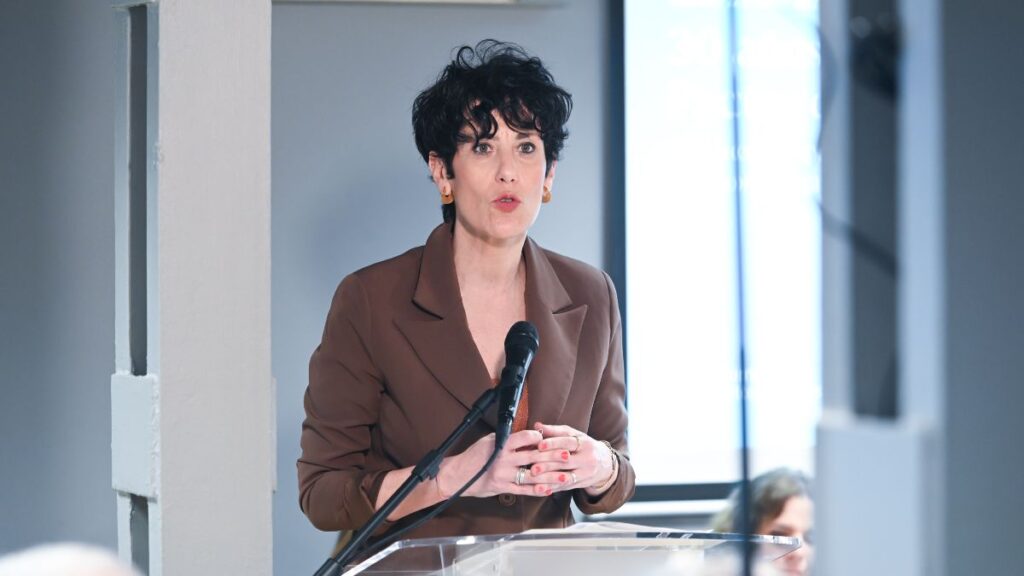
The Minister of Inclusion, Social Security and Migration, Elma Saiz, has called on right-wing parties not to use the Spanish pension system as a “partisan weapon” in pursuit of their interests, right now when there is most debate about whether the current system is sustainable or not over time. The Government spokesperson has also defended the role of the Toledo Pact, which she considers “the best example” of State policy in Spain.
During a conference organized by the Alternativas Foundation on the occasion of the 30th anniversary of the parliamentary agreement, Saiz claimed the Toledo Pact as a guarantee of stability for the public pension system in Spain. The minister believes that political parties should not take the pension system as a “political battlefield.”
Saiz was especially critical of the Popular Party and its position in the latest debates on pensions. “Pensions cannot be used as a partisan weapon when what is at stake is the security of millions of people,” he stated, while questioning that the party votes against norms that develop recommendations that it previously supported within the Pact itself.
Support from Brussels and structural challenges
In his speech, Saiz also stressed that the European Commission has ended up endorsing the reforms of the Spanish pension system, despite the initial reluctance of some technicians. This community support, he maintained, reinforces the credibility of the Spanish model and allows us to face the future “with optimism”, in line with the commitments acquired with Brussels in terms of financial sustainability.
Likewise, the Minister of Social Security recognized that the system faces significant challenges. Among them, he cited the imminent retirement of the ‘baby boom’ generation, the aging of the population, changes in the labor market or the need to advance gender equality. He also mentioned the increase in temporary disability and the need to improve its management as elements that strain the system.
To face these challenges, the Executive relies on new analysis tools such as Integrass, a platform that allows us to anticipate scenarios and plan public pension policies with greater precision.
The budgetary weight and the debate on its sustainability
In the same forum, the Secretary of Public Policies and Social Protection of CCOO, Carlos Bravo, recalled that the pension system absorbs approximately a third of public spending, around 200,000 million euros annually. A magnitude that illustrates both its relevance and the need to constantly evaluate its operation and efficiency.
Together with the union representatives and academics present at the meeting, a catalog of additional challenges was put on the table: from the improvement of benefits such as those for permanent disability or widowhood, to the need to strengthen the protection of the self-employed or move towards a universal child-rearing benefit.
Three decades after its creation, the Toledo Pact thus returns to the center of the political and economic debate. The Government’s insistence on preserving consensus contrasts with a more fragmented parliamentary scenario, where pension system reforms continue to be one of the main areas of confrontation.