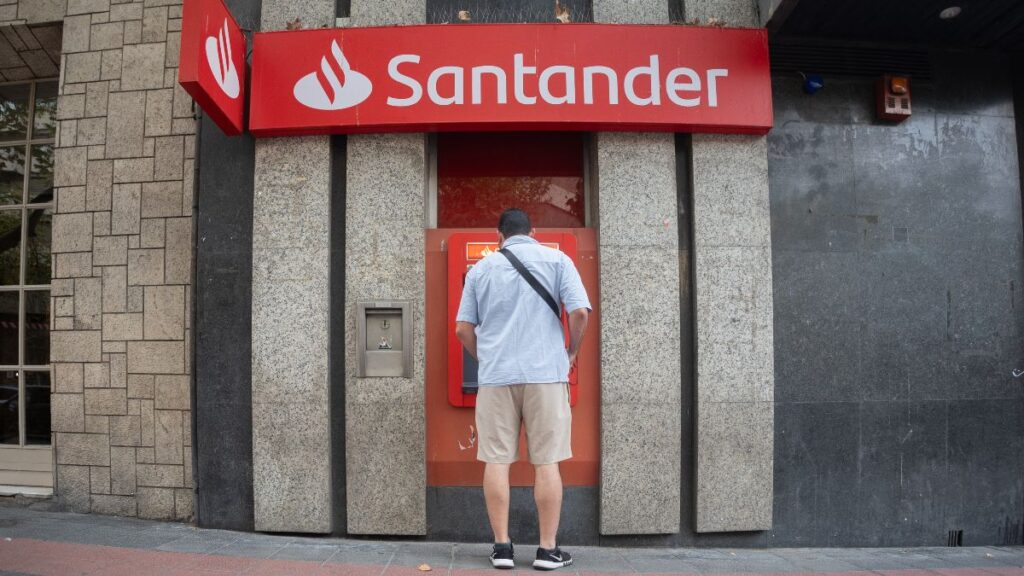
Justice once again turns its back on Banco Santander for once again trading in complex financial products. The Provincial Court of Barcelona has condemned the entity to compensate a client with 222,393.82 euros for the losses suffered after investing in the well-known ‘Valores Santander’, considering that it did not receive clear, sufficient and understandable information about the risks of the product. It is not the first time that the banking entity faces a judicial process derived from the marketing of this financial product that, of course, did not go well for the entity or for those who invested in it.
This is reflected in ruling no. 12/2026, of January 29 (which can be consulted at this link from the Judiciary), issued by Section 16 of the Provincial Court of Barcelona, which partially upholds the bank’s appeal but maintains responsibility for failure to comply with its information duties.
‘Santander Securities’ were a hybrid financial product issued in 2007 that was mass marketed among retail clients. They functioned as debentures that were necessarily convertible into bank shares, which meant that, when the moment of exchange came, the investor received shares instead of recovering the capital, often with significant losses if the price had fallen.
It all started in October 2007, when the client acquired this product through bank financing, investing a large amount through several mortgage loans. As time went by, the value of the product deteriorated until, in 2012, it was exchanged for shares with a much lower value than initially invested, generating a significant capital loss.
A complex product with a high speculative component
The ruling leaves no room for doubt about the nature of the product. The Provincial Court recalls that ‘Santander Securities’ are complex financial instruments whose value depends on the stock market performance of the bank’s own shares.
In this sense, he emphasizes that it is a product with an “important speculative component”, in which the investor could lose part or even all of his investment, especially if he did not understand how the value of the shares was set at the time of the exchange.
Furthermore, the ruling insists that these types of products require a special level of information when they are marketed to retail customers, as was the case, since they do not have the necessary knowledge to correctly assess the risks.
What the Court of First Instance said
In the first instance, the Court of First Instance No. 30 of Barcelona partially upheld the client’s claim and ordered Banco Santander to compensate him with 275,688 euros for the damages suffered.
The court considered it proven that the entity had failed to comply with its information obligations in the marketing of the product, which generated direct economic damage to the investor. However, it rejected other claims, such as the obligation to renew the financing under the same conditions.
The Provincial Court confirms the breach but reduces the compensation
The Provincial Court of Barcelona confirms the core of the ruling: the bank did not comply with its duty to adequately inform the client.
Specifically, the Court concludes that the entity did not prove that it had provided “accessible, clear and understandable” information about the risks of the product, either before or during the contract. Nor is it considered sufficient to sign standard documents or generic clauses in which the client declares that they are aware of the risks, as these are pre-arranged formulas without real content.
Furthermore, the court highlights that the contracting occurred in a context of financial advice, since it was the bank itself that recommended the product to the client based on his profile, which further increased its information obligations.
However, the Court introduces an important nuance. It considers that a second investment made by the client in the secondary market demonstrates that it was already aware of the risks of the product at that time, so it excludes that part of the compensation calculation.
For this reason, it partially upholds Banco Santander’s appeal and reduces the final compensation to 222,393.82 euros, maintaining the rest of the rulings of the lower court ruling.
With this resolution, the Provincial Court reinforces the doctrine of the Supreme Court on the marketing of complex financial products: entities must guarantee that the client truly understands the risks assumed, especially when it comes to retail investors and there is prior financial advice.