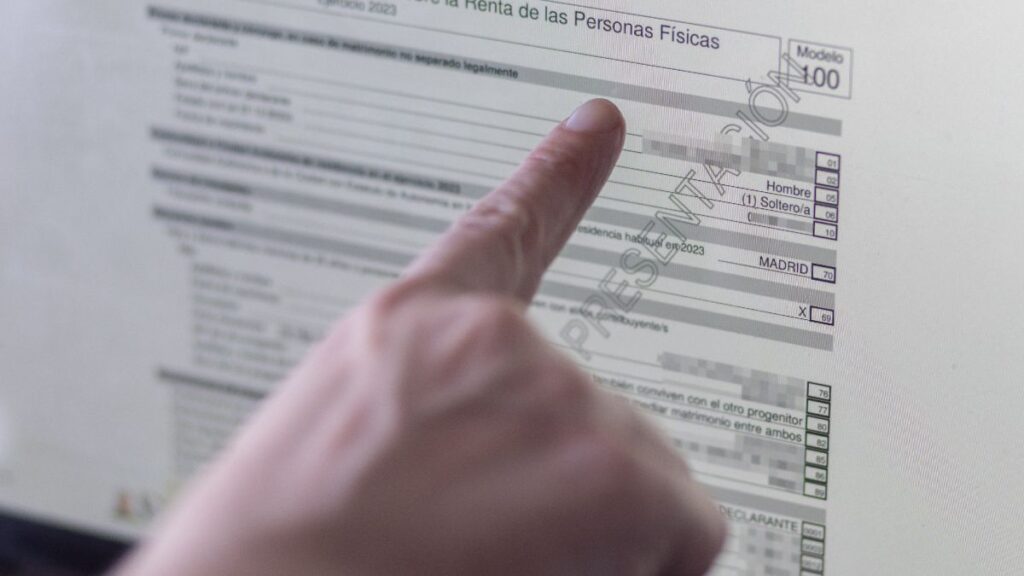
The 2025-2026 income campaign once again raises the same question for the three and a half million self-employed workers who work in Spain, regarding what can be deducted and what cannot. The Tax Agency accepts the deduction of the expenses incurred by the self-employed to develop their economic activity, but subjects them to strict justification conditions. A deductible expense that is not accompanied by an invoice, that is not recorded in the books or that the Treasury considers unrelated to the activity can become a penalty.
The majority of the self-employed are taxed under simplified direct estimation, the regime applicable to those who invoice less than 600,000 euros annually. Within this regime, deductible expenses are grouped into two large blocks: those that are deducted 100% and those that have specific limits or percentages.
Expenses that the self-employed can deduct 100%
The first block includes the expenses that the regulations fully admit, as long as there is an invoice and connection with the activity:
- Self-employed quota to the RETA: the monthly contribution to Social Security is deducted in its entirety. It is the most common expense and the first one that should be recorded.
- Rental of premises or office: if the self-employed person works in a space rented exclusively for their activity, the full amount of the rent is deductible.
- Salaries and labor costs: the salaries of hired employees, overtime payments and social contributions of these workers are fully deductible.
- Office supplies and work tools: from a computer to a saw, if the good is necessary for the activity and is amortized according to the official tables, the expense is deductible.
- Software, licenses and professional subscriptions: digital tools necessary for work, web hosting, design platforms or accounting management applications are 100% deducted.
- Advertising and marketing: Social media ads, logo design, card printing, or Google Ads campaign expenses are fully deductible expenses.
- Management, advice and legal services: the fees of the manager or lawyer who advise the self-employed person in their professional activity are fully deducted.
- Training related to the activity: an accounting course for an electrician or a master’s degree in web design for a freelance designer are deductible expenses if there is a direct relationship with the declared activity.
- Professional insurance: civil liability insurance and business-related insurance have a full deduction.
- Interest on professional loans: the interest on a loan intended to finance the activity is deductible. Not so the return of capital.
Expenses with limit or percentage
The second block includes expenses that the self-employed can also deduct but with limits that the regulations expressly establish.
Mixed-use mobile phone. When the same terminal is used for personal and professional calls, the Tax Agency allows a deduction of 50% of the invoice. It does not require justifying the proportion: half is the recognized limit unless the self-employed person certifies a higher percentage of professional use.
Household supplies for those who work from home. The self-employed person who carries out his activity in his habitual residence can deduct the expenses of electricity, water, gas and internet, but not in their entirety. The official formula is 30% of the invoice amount, multiplied by the percentage of square meters that correspond to the space affected by the activity over the total of the home. If the office occupies 20% of the total area and the electricity bill is 100 euros, the maximum deduction is 6 euros. Housing rent, however, is not deductible.
Diet and maintenance. Food expenses on professional trips are deductible within these limits, as long as payment is made by card or electronic means (not cash) and there is a ticket or invoice:
- In Spain, without overnight stay: 26.67 euros per day
- In Spain, with overnight stay: 53.34 euros per day
- Abroad, without overnight stay: 48.08 euros per day
- Abroad, with overnight stay: 91.35 euros per day
Health insurance. The self-employed person can deduct private health insurance premiums of up to 500 euros per person (the self-employed person, the spouse and children under 25 years of age who live with them). If the self-employed person has a recognized disability, the limit rises to 1,500 euros per person.
Deduct vehicle expenses
The vehicle is the expense that generates the most friction with the Tax Agency. Personal income tax regulations require that tourism be exclusively linked to the activity to allow 100% deduction. That is, it is not enough to use it regularly for work if it is also used for personal trips. In practice, the Treasury rejects the deduction of passenger cars with mixed use in personal income tax.
VAT for passenger cars applies a legal presumption of 50%, which allows deduction of half of the VAT incurred on the purchase and on maintenance and fuel costs, without the need to justify the percentage of professional use.
What the Treasury does admit without discussion are tolls and parking linked to professional trips, with a 100% deduction in personal income tax and VAT.
Expenses that are difficult to justify and that almost no one applies
The simplified direct estimate includes an item that many self-employed people are unaware of or do not apply, these being expenses that are difficult to justify. The law allows 5% of the previous net income of the activity to be deducted, with a maximum limit of 2,000 euros per year, without the need to provide invoices proving them.
This percentage is designed to cover small unavoidable expenses that are difficult to document, such as minor work materials, specific trips or various consumables. It cannot be accumulated with the deduction for work in normal direct estimation. And it does not apply in the objective estimation regime (modules).
The three requirements that the Treasury requires in every deduction
An expense can be perfectly legitimate and still not be accepted by the Treasury if it does not meet the three formal requirements established by the regulations:
- Link with the activity. The expense must be necessary to obtain the declared income. A physical therapist can deduct a stretcher; a programmer, hardly.
- Complete invoice. The cash receipt is not enough. The invoice must include the name or company name of the self-employed person, their NIF and the VAT breakdown. Minor expenses have more margin, but the invoice is still the guarantee against an inspection.
- Accounting record. The expense must appear in the expenses and investments book. If it is not recorded in the corresponding year, the Treasury may reject the deduction even if the invoice exists.
Self-employed people with doubts about the deductibility of a specific expense can consult the Tax Agency’s electronic headquarters or request an appointment at its Treasury branch. When faced with an inspection, orderly documentation and updated accounting books are the best defense.