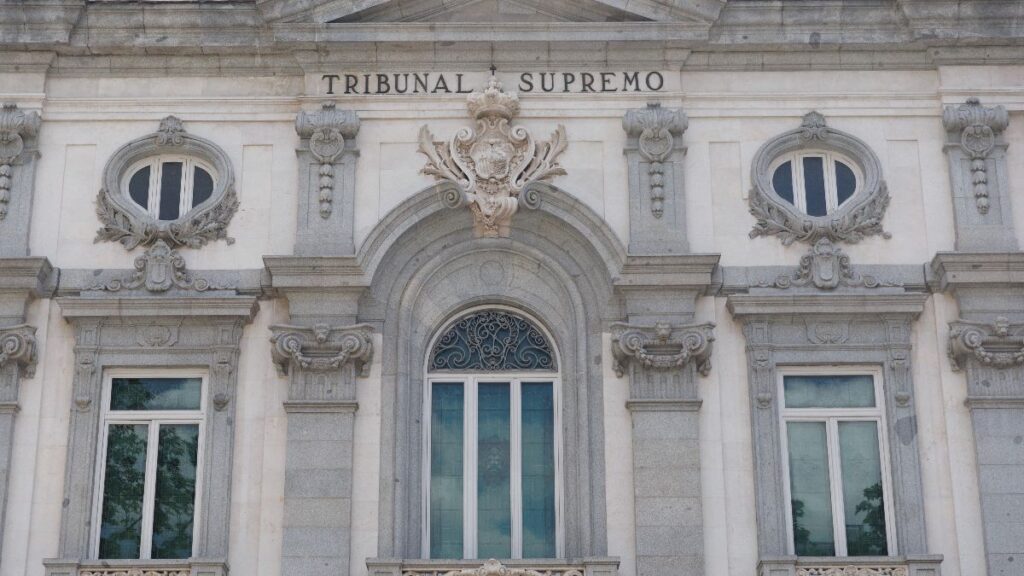
The Supreme Court has stated that for the purposes of collation of assets in inheritances, Donations that were made during life do have to be valued at the time the inheritance is distributed and not on the date on which they were made. According to the High Court, this fact is key for the distribution among the heirs to be equitable and therefore directly affects the calculation of the legitimate interest, especially when it comes to rights such as usufruct.
This is established in its ruling of March 5, 2026, in which it analyzes a conflict between several heirs over the valuation of a usufruct lifetime of shares donated decades earlier. The point of discussion was whether to value them it was necessary to take into account the age of the beneficiaries at the time of the donation or at the time the inheritance is distributed.
The Supreme Court considers that using the historical value of the donation can generate imbalances between heirs, since it does not reflect the economic reality of the right at the time of distribution. Therefore, it establishes that the current value of the asset and the circumstances existing at the time of partition must be taken into account, although maintaining the asset in the state in which it was donated.
Valuation must be done at the time of partition
In its ruling, the Supreme Court recalls that article 1045 of the Civil Code establishes that what must be brought into consideration is not the donated asset itself, but its value at the time the hereditary assets are evaluated.
In the case of life usufruct, this rule takes on special importance, since its value depends directly on the age of the usufructuary. The Supreme Court explains that the right is maintained in the state in which it was donated, but must be valued according to current criteria, which implies taking into account the age of the beneficiary at the time of distribution. Otherwise, the loss of value of the usufruct over time would be ignored, attributing a value higher than the real value and altering the balance between heirs.
The High Court also clarifies that, according to the interpretation of article 1045 of the Civil Code and its jurisprudential doctrine, variations in value must be analyzed according to their origin. Thus, when the increase or decrease in value does not derive from physical changes in the property or from the actions of the donee, but from external factors such as the passage of time or the evolution of the market, this variation must be taken into account in the collation. On the contrary, if the change in value responds to the actions of the donee himself, it should not be transferred to the rest of the inheritance.
In this particular case, the passage of time reduces the value of the usufruct and, at the same time, increases the value of the bare property, so it is consistent to value both rights at the same moment, that of the partition. However, the court rejects that this update extends beyond that moment, since this would break the coherence of the system and generate inequalities with respect to the rest of hereditary assets. For this reason, it establishes as a criterion that donations must be computed at their current value at the time of distribution, thus guaranteeing a fair distribution among the heirs.