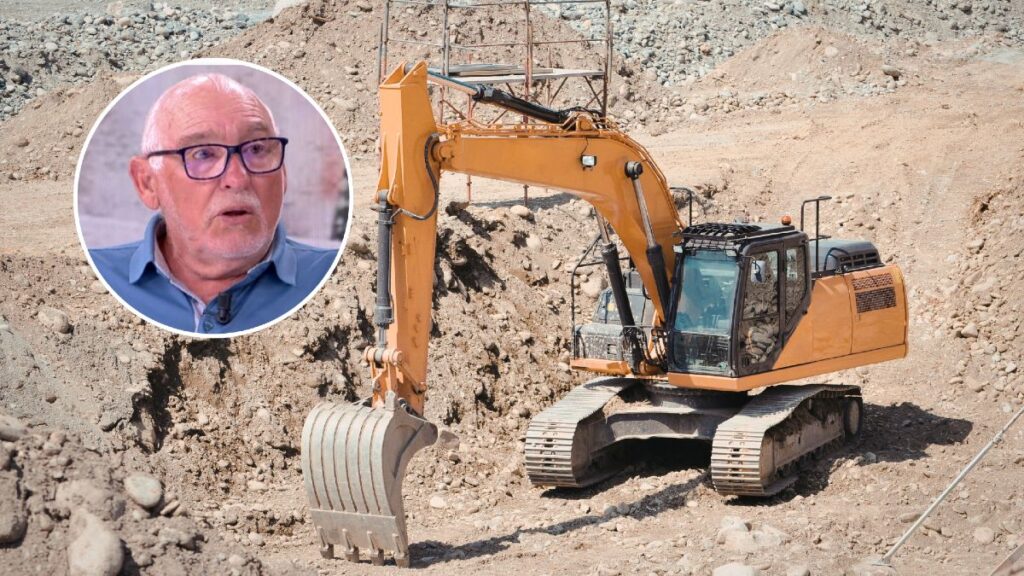
Ángel did not want to be an entrepreneur at 73 years old, he was not looking for business success or to appear on television. What Ángel was looking for was simply to pay the rent. After a lifetime working as an electrician, the 2008 crisis destroyed his company and his expectations of a peaceful retirement. Finally, he was forced into early retirement with a benefit of just 850 euros.
Between the rent of 840 euros he paid, electricity and water, the pension was exhausted before reaching the supermarket. “It was impossible to live,” he admits. Faced with this critical situation, he made the decision to ask for a loan, went into debt of 50,000 euros and bought a backhoe that now, at 77 years old, allows him to earn between 3,000 and 3,500 euros per month to complete his income.
Getting started in old age to make ends meet
A worker since he was 16 as an electrician, the financial collapse of 2008 forced him to stop working. Not finding alternatives in the labor market due to, according to him, his age, he was forced to take early retirement with one for a minimum benefit. “At my age, no one gives you a job anymore, so you have to do something else to be able to live,” he explained in statements to Telemadrid and the program And now Sonsoles. Years later, unable to make ends meet, he decided to buy the excavator.
The most striking thing about Ángel’s story is not only the investment at an age when many are looking for retirement, but that he took the step without even knowing how to operate the machine that was going to become his livelihood. “No one taught me. I bought it, got on and started working.” His only basis was the memory of his childhood in Talavera, where he helped his rancher father and became familiar with the rural environment.
Four years after that decision, he bills between 3,000 and 3,500 euros per month thanks to the machine. However, as a self-employed person receiving active retirement, he only receives 50% of his pension, about 450 euros, and a good part of his income is used to cover the costs of the business such as financing the excavator, which was between 50,000 and 60,000 euros and which he is still paying, in addition to fuel, maintenance, insurance and taxes.
In practice, he has gone from not being able to make ends meet to living with a little more peace of mind, although at the cost of many hours of work and with his wife in charge of controlling expenses.
Active retirement allows you to work while collecting part of your pension
His case, although it is extreme due to the risk and physical effort involved, is part of an increasingly common reality in Spain such as active retirement. This modality, regulated by the General Social Security Law, makes it possible to make the collection of a part of the pension compatible with employment or self-employment. Since April 2025, the regulations encourage the delay of definitive withdrawal.
The compatible pension percentage scales from 45% with a one-year delay to 100% after five or more years of activity after the ordinary retirement agewhich currently stands at 66 years and 10 months, or 65 years for those who can prove contributions for more than 38 years and three months. In Ángel’s case, his benefit is reduced by half precisely for maintaining this professional activity.
The story has generated a debate about the sustainability of the system and social justice. While some television collaborators praise his “enterprising spirit” and propose him as an example for youth, others criticize that a “just” society should not allow a man of almost 80 years to be forced to do heavy physical work in order to eat.
“I had to take this job because I had no other job to survive on,” says Ángel. For him, the excavator is not a retired hobby, but the only way to support himself and pay his basic expenses.