
The bulk of the effort with the public sector is concentrated in the central stage of life. According to a report published by Fedea, the group of adults between 30 and 54 years old is the one that “pays the bulk of the taxes” and that is why it presents a “strong deficit” in its net balance with the State. This aggregate imbalance amounts to about 165,000 million euros, while young people up to 29 years of age show a surplus of 46,000 million and the senior population aged 55 or over one of almost 100,000 million.
The document, prepared by economists such as Ángel de la Fuente and Julio López Laborda, explains this dynamic through the logic of the life cycle. While the consumption of goods and services remains relatively stable from youth to old age, the generation of income (and with it the payment of most taxes and social contributions) is concentrated intensively in the central section of life, that is, between 30 and 55 years of age. This asymmetry forces consumption of non-productive ages to be sustained through transfers that come “from the public sector and the family.”
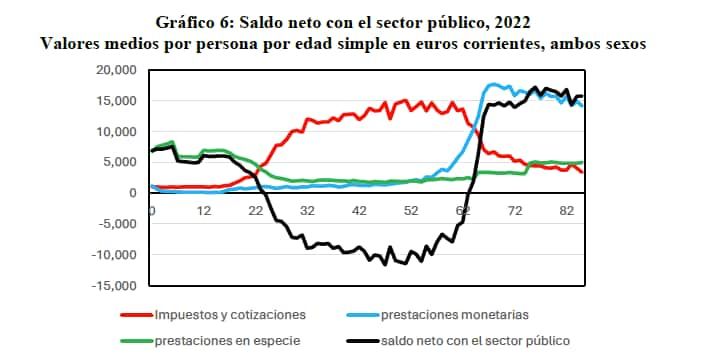
Balance with the State according to age
The report defines the net balance with the public sector as the difference between monetary benefits such as pensions, unemployment and aid and benefits in kind such as education and health, compared to taxes and social contributions. With this methodology, the profiles are neatly ordered. Young people and the elderly are net recipients, with a positive balance associated above all with education and health at an early age and pensions after retirement. On the other hand, active age concentrates the contribution because it is where personal income tax payments, contributions and other taxes accumulate.
The report adds a second graph that focuses on homes. These are internal intra-household transfers, which go “from adults to children and young people” to finance their consumption “until they have sufficient income to finance themselves.”
In aggregate terms, the volume is high. The document estimates these transfers at 130,000 million euros per year, of which 103,000 million come from the central age group and 27,000 million from those over 55 years of age.
In the age profile, these transfers are clearly positive in childhood and adolescence, with amounts that exceed 10,000 euros per year in minors, and become negative in middle age, with values close to 8,000 euros between 40 and 50 years of age, which is where family financing is concentrated.