Australia has had one of the strongest mining industries in the world for decades. It is a sector that constantly needs labor and pays much higher salaries than those usual in Europe for similar jobs. That’s why, many young foreigners With temporary visas they go to Australian mines to save or earn money to travel.
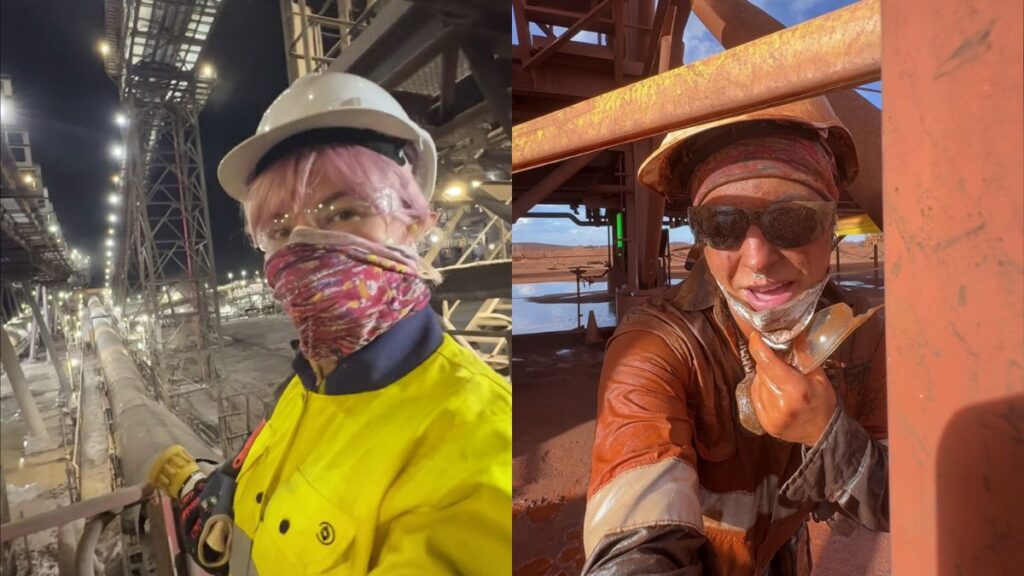
This is the case of Virginia Sanz, an Andalusian who has shared on social media how much she currently earns and what the conditions of her new position are in a mining camp located in the heart of the Australian desert. There he works as hose technician (hose technique), a function that consists of using high-pressure water within the mining operation.
“Charging 2,500 euros a week, does that seem like a little to you? Because I’m hallucinating,” he says in one of his videos, after some users assured that it’s not that much money. Sanz explains that he works seven days in a row with 12-hour days, although he clarifies that not all of that time is effective work. “Actually we work 10 hours and have two hours off, but in this position they pay me for 12,” he details.
As he explains, not all days are equally demanding. “I haven’t done practically anything for two nights. The first I only worked for two hours with the hose and the rest of the time I was in the tanker truck accompanying the driver,” he says. For this reason, he clarifies that the workload depends a lot on the specific position and the shift it is on.
Salary also depends on those factors. Working at night, he earns about 2,500 euros a week and if he were on the day shift, he estimates he would earn around 2,000. In service sector jobs within the mine, such as cooking or cleaning, the salary is around 1,500 euros per week, he explains. “I don’t think it’s poorly paid at all,” he says.
Intensive work with covered expenses and long periods of rest
The workers reside in camps set up by the mining companies, located in remote areas far from urban centers and, as he explains, one of the factors that allows him to save is that he barely has any expenses there because “everything is covered.” “I have free accommodation, they give me food, a gym, a swimming pool… I don’t have to worry about anything. It’s all for my pocket,” he says.
Furthermore, the shift system, known as swing either roster allows different combinations. Sanz has done periods of two weeks of work followed by two weeks off, time he dedicated to traveling. “Last year my goal was to travel. I took money from the mine and spent it traveling,” he explains. Now, however, he assures that his priority is to save and gain stability in the new agency for which he works.
Other workers choose different combinations, such as eight days in the mine in a row and six days off, or two weeks on and two weeks off continuously. For some Australians, he explains, this system becomes a way of life for years. “It’s complicated when you have a family,” he acknowledges. Even so, it stands out that in some cases they spend half the month at home, which allows them to concentrate work in intensive periods and then enjoy several days off in a row.
In short, mining in Australia offers high salaries, but it also involves working in isolated places and with very demanding shifts. In the case of Virginia Sanz, her decision to be there is based on assessing whether the effort is financially worthwhile. “It depends on what your objectives are,” he summarizes. Right now, he is clear: “Charging 2,500 euros a week doesn’t seem like much to me.”