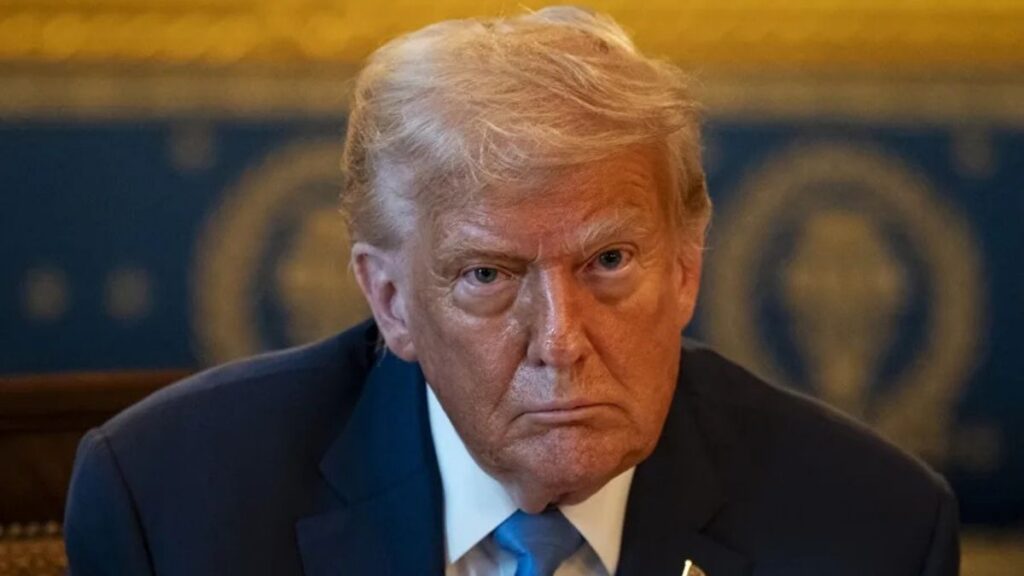
Donald Trump has harshly criticized Spain for being a “terrible” ally and assures that he has ordered “cutting all trade” with the country after the Government of Pedro Sánchez refused to authorize the use of the Rota and Morón bases for an offensive against Iran. The US president has questioned Spain’s commitment to both Washington and NATO, also due to Spain’s refusal to increase defense spending last summer.
The statements, made from the Oval Office after meeting with the German Chancellor, Friedrich Merz, represent one of the greatest diplomatic tensions between both countries in recent years. Trump reproached the Spanish Executive for its refusal to provide US military installations on Spanish soil for an operation in the Middle East.
“Spain is being terrible, I have asked to cut all agreements with Spain,” said the president. Trump called the government’s position “unfriendly” and added: “We are going to cut off all trade.” He even went so far as to assure that his Administration “does not want to have anything with Spain” and that it has “the right to cease tomorrow, or today, everything that has to do with Spain.”
Defense spending was the beginning of tensions
The American president also linked the disagreement to Spanish defense policy. “It does not have great leadership, it is the only NATO ally that did not agree to reach 5% and in fact they do not even pay 2%,” he said, referring to military spending commitments. In the same appearance, Chancellor Merz insisted that the allies are trying to “convince” Spain to increase its investment in defense to 3% or 3.5% of GDP, in line with the agreements reached within the Atlantic Alliance. Although this collides with the defense spending ceiling agreed between Pedro Sánchez and NATO, of 2.1% of GDP.
Trump’s words open several fronts. First of all, the strictly military one. The Rota (Cádiz) and Morón (Seville) bases operate under bilateral defense cooperation agreements between Spain and the United States. Although they host US contingents and assets, they are under Spanish sovereignty, which explains the Executive’s refusal to authorize their use for a specific action.
Trump threatens to “make embargoes” on Spain
Secondly, the economic. The United States is one of Spain’s main trading partners outside the European Union. An eventual rupture or imposition of embargoes, as Trump suggested when stating that he could “impose embargoes on everything that has to do with Spain”, would have relevant consequences for sectors such as agri-food, automotive or capital goods. However, the US president did not detail what specific measures he has ordered or in what time frames they could be applied.
It remains to be known the formal response of the Spanish Government and whether the threat will be translated into executive decisions or into a strategy of political pressure within the framework of NATO. It also remains to be seen the real room for maneuver of the White House to adopt unilateral trade retaliation against a member state of the European Union, which would foreseeably imply a coordinated response from Brussels.
Beyond the specific clash, the episode is part of a context of growing tension in the Atlantic Alliance regarding the distribution of defense effort and positioning in the face of escalation in the Middle East. Spain’s refusal to get involved in the operation against Iran, and Washington’s forceful reaction, show the extent to which security policy has become a central factor in the transatlantic diplomatic and economic agenda.