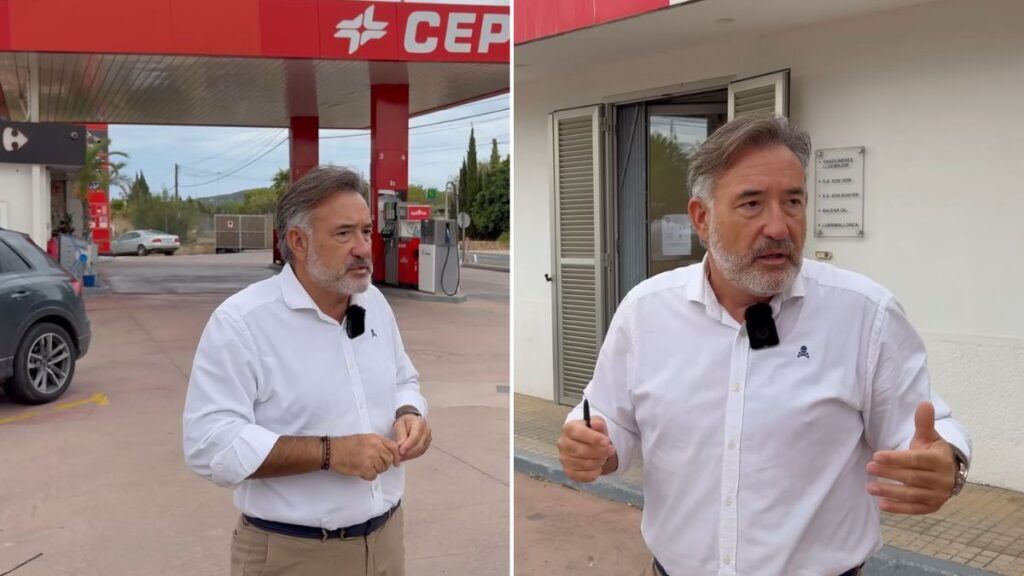
It has always been thought that having a gas station is riding on the dollar because its high turnover is associated with large profits, but that is not really the case. This is what Tomeu Clar, owner of up to 7 service stations under the Cepsa flag in Mallorca, has tried to explain, who has shown how this sector truly works, which is more complex than it seems and can have margins adjusted to the cent, as well as a tax pressure in which the State wins.
In an interview with YouTuber Adrián G. Martín, Clar offers a complete vision of a family business group that was founded in 1962 by his grandfather, Bartolomé Pou. “He had the vision when there were barely any cars to maintain a station,” he recalls. Today, four generations later, they manage a business volume close to 20 million euros annually, although the real profitability is between 5% and 10% of the total turnover.
“A raw liter of gasoline can leave you between 10 and 25 cents in profit,” explains Clar, who highlights that staff salaries, maintenance and supplies must be removed from that margin. “55% of the price you see on the monolith are taxes; the vast majority goes to the State.”
“Four generations and 60 years without failing to pay a payroll”
The expansion of the Clar family has not been easy. Managing 7 stations entails knowing how to deal with a staff of around 60 people, which also represents a large monthly cost in payroll and Social Security. “Since 1962 we have not failed to pay a single payroll,” he says proudly, also highlighting that today opening a new station is an administrative obstacle course that can take 4 or 5 years.
In addition to bureaucracy, the sector faces competition from stations low cost. Clar defends its model based on quality and additives: “The more additives and the better, the more expensive the gasoline is in the monolith. Low-cost gas stations have simple facilities and fewer staff, which allows them to lower the price, but we are committed to added value.”
The relationship with the oil company has also evolved. Although they own four of their seven stations, they operate under flag contracts that, by law, are renewed annually. “You receive an email with the purchase prices every morning, you buy the product and from then on the gasoline is yours and you set the margin according to the competition,” he clarifies.
“The gas station store is no longer more expensive”
One of the pillars of the survival of this business is diversification. For Tomeu Clar, the concept of “gas station” has died to make way for the “service station.” His group has integrated Carrefour Express supermarkets into its facilities, breaking one of the great myths of on-road consumption.
“That myth that gas stations are more expensive has been broken. A bag of ice or a food product costs the same here as in any Carrefour. If the customer is confident in the quality and price, the business works.”
Currently, store sales represent approximately 6.5% of total turnover, but they are essential to attract traffic. In addition, the group is exploring new avenues of income such as laundries, pizza dispensers and coffee corners, seeking to ensure that customers take advantage of their stay.
Hydrogen and AdBlue: the future beyond “diesel”
Regarding the future of mobility, Clar is more optimistic than other actors in the sector regarding new energies, although he makes a necessary technical correction: “Diesel does not come from oil, diesel comes from it. Diesel was the engineer who invented the engine.”
The businessman fully trusts in green hydrogen as the real alternative to fossil fuels in the long term. “In the next 10 or 15 years we are going to cohabit: classic gasoline with very low emissions thanks to AdBlue, efficient electric charging and, I hope, hydrogen pumps,” he predicts.
For Clar, the key to success in the next decade will be the ability to adapt: ”Success is having all the necessary products so that the customer is satisfied and being supported by a great company that gives you a product guarantee.”