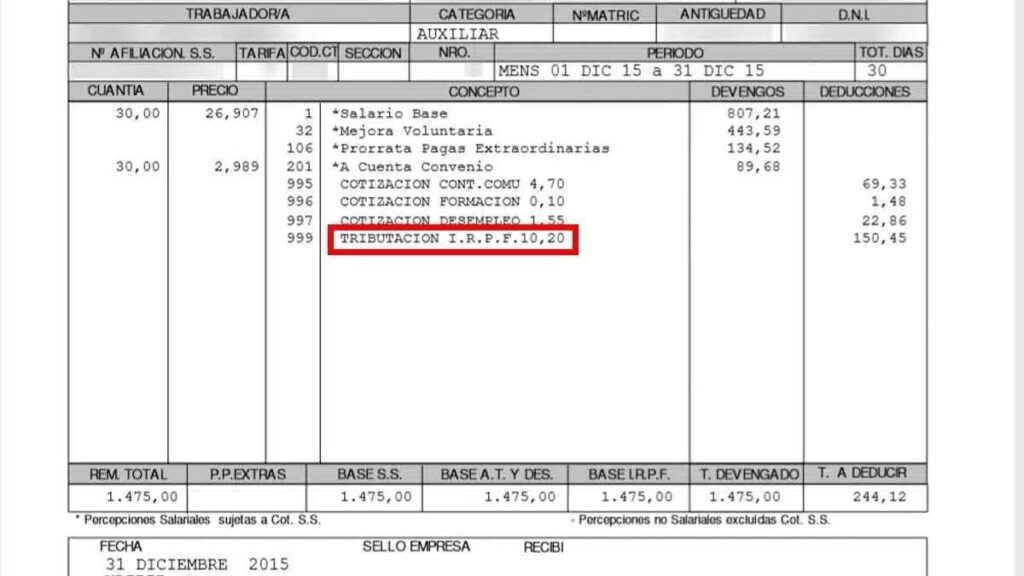
Social Security will once again raise the contributions of the Intergenerational Equity Mechanism (MEI) as of January 1, 2027, which will be applied to the payroll of all workers and whose contributions will not be used for their future retirement pension. This increase is included in Royal Decree-Law 2/2023, approved in this Official State Gazette (BOE)which was known as “the Escrivá reform” whose objective was to help fill the “pension piggy bank.”
This contribution is mandatory and applies to all workers, that is, both employed workers (salaried) and self-employed workers (self-employed), regardless of what they earn. The second thing to know is that its amount is a percentage, so the higher the salary, the greater the amount to be paid, until reaching a maximum limit.
In 2026, the amount paid was 0.90% where 0.75% was paid by the company and 0.15% by the worker. As of January 1, 2027, it will rise again to 1%, where companies will pay 0.83% and the worker 0.17%. Knowing this, only those with the highest salaries will pay the maximum, which will be around 104 euros (8.67 euros per month), if we take into account that the maximum contribution base for 2026 is about 61,214.40 euros per year, according to the Order PJC/297/2026. For most workers, the amount will be lower and strictly proportional to their salary.
In this table you can see how the MEI increases each year, according to RD 2/2023:
| Year | MEI Total Quote | Company Contribution | Worker Contribution |
|---|---|---|---|
| 2026 | 0.90% | 0.75% | 0.15% |
| 2027 | 1.00% | 0.83% | 0.17% |
| 2028 | 1.10% | 0.92% | 0.18% |
| 2029-2050 | 1.20% | 1.00% | 0.20% |
In the case of the self-employed worker, since he does not have that “company” figure, he will be the one who assumes the total of this contribution, so as of January 1 he will go from paying 0.90% to 1%.
Another thing to keep in mind is that, as the rule itself states, this contribution “will not be computed for benefit purposes,” which means that this additional contribution does not increase the amount of the worker’s future pension.
In this table you can see how the MEI affects the payroll as of 2027:
| Gross Monthly Salary | Total MEI Month (1.00%) | Company Month (0.83%) | Worker Month (0.17%) |
|---|---|---|---|
| €1,200 | €12.00 | €9.96 | €2.04 |
| €1,400 | €14.00 | €11.62 | €2.38 |
| €1,600 | €16.00 | €13.28 | €2.72 |
| €1,800 | €18.00 | €14.94 | €3.06 |
| €2,000 | €20.00 | €16.60 | €3.40 |
| €2,200 | €22.00 | €18.26 | €3.74 |
| €2,500 | €25.00 | €20.75 | €4.25 |
| €2,800 | €28.00 | €23.24 | €4.76 |
| €3,000 | €30.00 | €24.90 | €5.10 |
The MEI is automatically applied to the payroll starting in January, so both salaried and self-employed workers do not have to do anything. In other words, it is the General Treasury of Social Security that is in charge of applying this contribution automatically and it is the company that deducts it from the payroll each month.
Example to understand the MEI
A worker who receives the maximum contribution base (we will use the 2026 base, since the 2027 base does not yet exist), contributes for a maximum of 5,101.20 gross monthly euros. In this case, the withholding will be 0.17%, about 8.67 euros per month, which will be approximately 104 euros per year. In the case of being self-employed, you will pay 1%, so you will pay 51.01 euros each month and 612.14 euros per year.
Fedea proposes eliminating the MEI from payrolls and replacing it with a surcharge on personal income tax to finance pensions
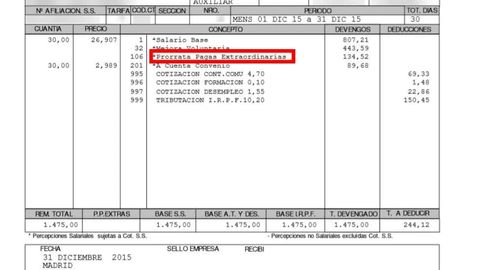
The workers will receive the extra Christmas pay without a Social Security discount, because they already contribute it every month, but the Treasury will withhold the personal income tax.
If we take as a reference an average salary of 2,386 euros per month gross, the 0.17% deduction will be about 4.06 euros per month, which is equivalent to about 49 euros per year.