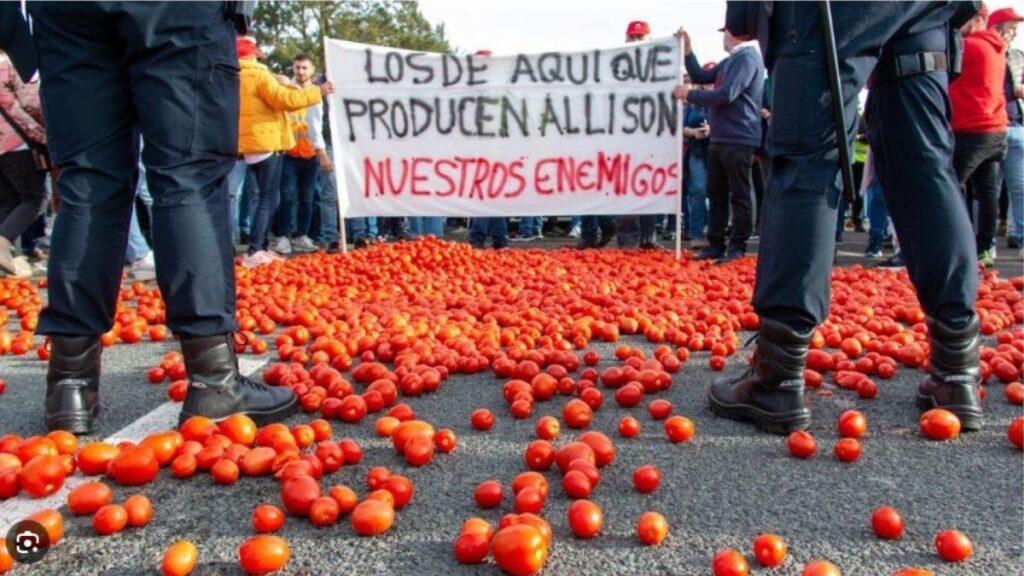
The agricultural organization ASAJA Almería has denounced the disappearance of official records on Moroccan tomato imports into the European Union and has asked the European Commission for immediate explanations. According to the entity, this lack of public data coincides with the detection of important differences between the exports declared by Morocco and the real volume circulating in European markets, a situation that, in its opinion, raises doubts about the control of agricultural trade.
ASAJA demands transparency
ASAJA has sent a formal request to the community institutions after verifying that the statistics that account for the entry of tomatoes from Morocco, including production originating in Western Sahara, have stopped being published. This absence of information occurs while the Directorate General of Agriculture of the European Commission investigates possible discrepancies in the trade of the product.
As explained by the organization, this community body has already requested clarifications from the customs services of the Member States after detecting serious discrepancies between the export figures declared by Morocco and the real volume of tomatoes present in the Union markets.
For ASAJA, having public and verifiable statistics is essential to guarantee balanced competition between European producers and third countries. Furthermore, it considers that without this data it is difficult to verify whether the trade agreement between the European Union and Morocco is correctly applied.
The organization also warns that statistical control makes it possible to verify the operation of the European entry price system, a mechanism designed to prevent imports from sinking tomato prices in the community market.
The European agricultural sector operates under social, environmental and phytosanitary standards considered among the most demanding in international trade. In this context, agricultural organizations insist that any trade agreement with third countries must be accompanied by control mechanisms that ensure similar conditions of competition.
According to ASAJA, the absence of official data makes it difficult to evaluate whether the quotas and entry prices established in the trade agreement are being applied correctly by European customs. Its president in Almería, Adoración Blanque, has criticized the situation and warned of its consequences for the European agricultural sector.
European agriculture cannot continue to compete in an environment marked by opacity and possible fraud.
Blanque also highlights that European producers comply with very strict social, environmental and health standards, which is why they demand that trade controls be applied with the same rigor in imports.
Faced with such a situation, ASAJA demands three immediate measures: the recovery of public statistics, a reinforcement of customs inspections and guarantees on compliance with the quota regime. Furthermore, the organization warns that, if it does not obtain answers in the coming days, it will take the case to the European Ombudsman and activate other institutional mechanisms to clarify what it describes as “statistical secrecy.”