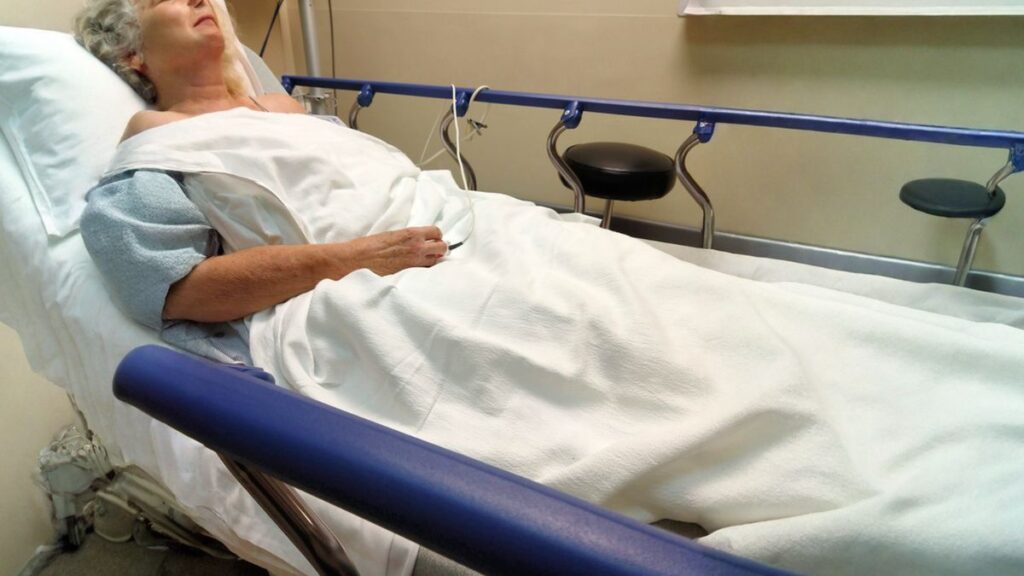
The Provincial Court of La Rioja has ruled in favor of the family of a woman who suffered a cardiorespiratory arrest in the Emergency Department of the San Pedro Hospital in Logroño and has ordered the insurer of the Rioja Health Service to compensate them with 153,464 euros. The court considers it proven that the patient was not treated within the time required by her emergency classification and that this delay violated the lex artis medical, that is, the basic standards of professional action.
According to the ruling of November 26, 2025, the woman went to the emergency room on February 22, 2020 with chest pain, intense sweating and difficulty breathing. She was classified in triage as level II, which implies priority medical attention in an approximate period of between 7 and 15 minutes. However, she was not evaluated by a doctor until 73 minutes after completing triage.
During that time, an electrocardiogram was performed, but no doctor reviewed it until after the patient suffered cardiac arrest. Furthermore, after initially remaining monitored in a box with a defibrillator, she was transferred to another without monitoring because the service was saturated and it was necessary to use the equipment with other patients.
At 3:10 p.m. she was found in cardiorespiratory arrest due to a serious alteration of the heart rhythm. Although she was resuscitated and urgent surgery was performed to open the blocked artery, the prolonged lack of oxygen caused irreversible brain damage. The patient remained in a state of minimal consciousness until her death in January 2022.
The Court of First Instance number 4 of Logroño initially dismissed the claim, considering that a direct relationship between the delay in care and the final damage had not been proven.
Delayed care as a violation of the lex artis
The Provincial Court of La Rioja, however, understood that the action in the Emergency Department did not comply with the standards required in a condition compatible with a serious heart problem. In this sense, the court recalled that, although the procedure was processed before the civil jurisdiction for direct action against the insurer (article 76 of the Insurance Contract Law), the substance of the matter had to be analyzed in accordance with the patrimonial liability rules of the Health Administration.
For this reason, the consolidated doctrine of the Supreme Court on patrimonial liability was applied, which requires that there be damage and that this be a consequence of the operation of the public service.
In this case, the violation of the lex artis ad hoc (the judgment and diligence that a doctor must apply in each situation), understanding that the symptoms presented by the patient required an immediate medical evaluation and continuous surveillance.
The ruling declared it proven that no doctor evaluated the patient within the time indicated by her classification in triage as level II, nor reviewed the electrocardiogram at the appropriate time, and that furthermore, monitoring was withdrawn without a clinical assessment to justify that decision. This action represented, in the opinion of the Chamber, an abnormal functioning of the public health service.
Likewise, it applied the doctrine of loss of opportunity, considering that the omission of care deprived the patient of a reasonable probability of avoiding or minimizing irreversible brain damage. It was not necessary to demonstrate with complete certainty that the outcome could have been avoided, but rather that there was a real possibility that the outcome would have been less serious with appropriate care.
For all this, the court declared the liability derived from the abnormal functioning of the health service and sentenced the insurer, under article 76 of the Insurance Contract Law, to pay 153,464 euros to the family.
However, the sentence was not final and an appeal could be filed against it before the Supreme Court.