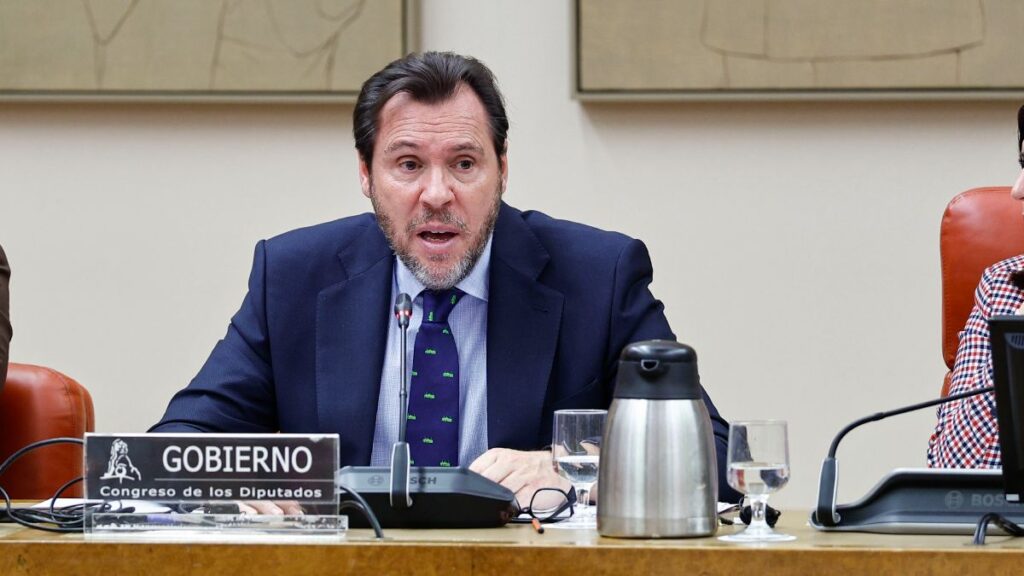
The Ministry of Transport, in the hands of Óscar Puente, has reached an agreement with the three main railway unions to call off the strike that began today, Monday, and which, in principle, was going to last until Wednesday. One of the measures of the signed agreement, which the union organizations described as “historic”, is to increase the workforce of the two main public railway companies, Adif and Renfe, by up to 3,600 additional positions.
This has been pointed out by Europa Press sources, who have reported that a specific replacement rate of 2,400 additional places will be processed in Adif between 2026 and 2030 (about 480 per year), with the commitment to raise the replacement rate above 115% in upcoming Budget laws and thus be able to internalize the workload and reinforce security. At the same time, it has been agreed that Renfe will incorporate 1,200 additional contracts in structure, driving, intervention, stations, management and maintenance centers, with the aim of reducing the burden associated with human error and improving staffing on medium and long distance trains.
Regarding investments, the agreement includes a shock plan with a reinforcement of investment in maintenance of the railway network between 2026 and 2030, both in the conventional and high-speed networks, with new financing agreements that include an additional expenditure of more than 1,000 million euros in those five years compared to what is currently budgeted. Thus, Adif’s spending on the maintenance of the conventional network will increase by 846 million euros compared to what is currently expected, and that of the high speed network by another 238 million euros.
Other measures of the agreement
In the agreement with the majority unions, according to the aforementioned news agency, the reinforcement of the State Railway Safety Agency (AESF) has been agreed with 50 new positions and more resources for supervision, training and coordination of risks, as well as new working groups on speed limitations, protocols for weather phenomena and safety culture throughout the sector.
The document also includes the progressive internalization of rolling stock maintenance at Renfe, starting with the 452, 453 and 104 series and extending to different workshops in León, Córdoba, Miranda, Tarragona, Sagunto, Escombreras, Vicálvaro, Portbou and Irún, as well as new freight wagons.
Likewise, Renfe is committed to ensuring that the new high-speed trains put out to tender are maintained entirely by its own personnel, and to carry out specific campaigns to improve air conditioning to reduce incidents and improve passenger comfort. Lastly, the agreement creates a joint monitoring commission that will meet in a month and provides for labor peace on the agreed matters, as long as the commitments are met, in exchange for the cancellation of the strikes scheduled for February 9, 10 and 11.
The strike will continue to be supported by other minority unions
The rest of the calling unions (CGT, SF-Intersindical and Alferro), which have not participated in the negotiations, have not yet called off the strike, so it continues, but will have much less support. Regarding the majority, the cancellation will have immediate effect, although the service will progressively return to normal.
Cancellations and delays in the first day of the strike
This morning, Renfe estimated at 11.6% the percentage of the workforce that was supporting the strike in all its operations, including all passenger and freight services, as well as the rest of the activities in workshops.
For its part, Semaf has estimated the monitoring of the railway strike at 100% and CCOO estimated that between 60 and 70% of the workers who do not have to cover any of the minimum services followed the strike.
Regarding the impact, with minimum services set by Transport of 73% in high speed and long distance; of 65%, on average, and 21%, in freight, hundreds of trains were cancelled, reducing the frequency of Cercanías circulations. Renfe alone has been forced to cancel 272 high-speed and long-distance trains, a figure that exceeds 330 including the private operators Ouigo and Iryo and 683 medium-distance trains.