


Add NewsWork in 
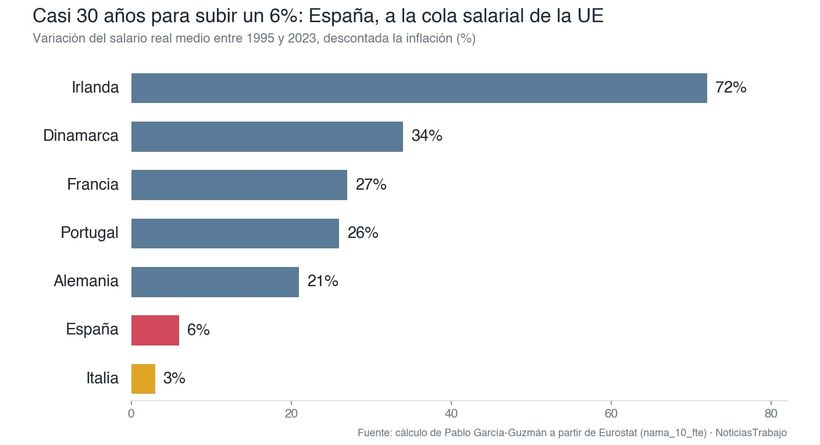
The salary of each average worker in Spain today buys almost the same as it did 30 years ago, although on the payroll it is higher in euros than then. Between 1995 and 2023, the average real salary only rose by 6%, a weak growth that barely distances itself from Italy, which remained above 3%, thus being the only country of the large EU economies that does worse, according to an analysis prepared by the economist Pablo García-Guzmán, head of the European Bank for Reconstruction and Development, based on data on the salaries of Eurostat.
If we remove inflation, Spain is far behind, for example, Ireland grew by 72% and Denmark by 34%, but even neighbors like France, Portugal or Germany improved between 21% and 27% while in Spain the salary barely moved.

Abdelilah, a self-employed Moroccan who works as a bricklayer in Spain: “You earn more in renovations, you can earn 10,000 euros a month”

I was appointed manager of an Intersport store at the age of 28, this is what I earn every month: “more than 3,000 euros gross”
Following these data, the economist Juan Luis Jiménez, professor of Applied Economics at the University of Las Palmas de Gran Canaria, points out the result as a “reminder about the wage (and productive) decline in Spain.” Putting productivity in parentheses was not a coincidence, because a salary that does not raise its head and an economy that yields little usually go hand in hand.
It must be explained that Eurostat measures the gross annual adjusted full-time salary, that is, what someone who works full-time would earn on average, and that series has existed since 1995. The 6%, however, is not published by Eurostat as is. It comes from deflating the series, that is, from taking away from the payroll the euros that come in just because everything is more expensive.
That is the problem, since there is no doubt that people now earn more salaries than 30 years ago, but the question is whether that money is enough to buy more things. This can be easily understood with the following question: Can you buy the same thing today with 100 euros as you did 30 years ago (although the peseta was available at that time)?
More euros and the same purchasing power
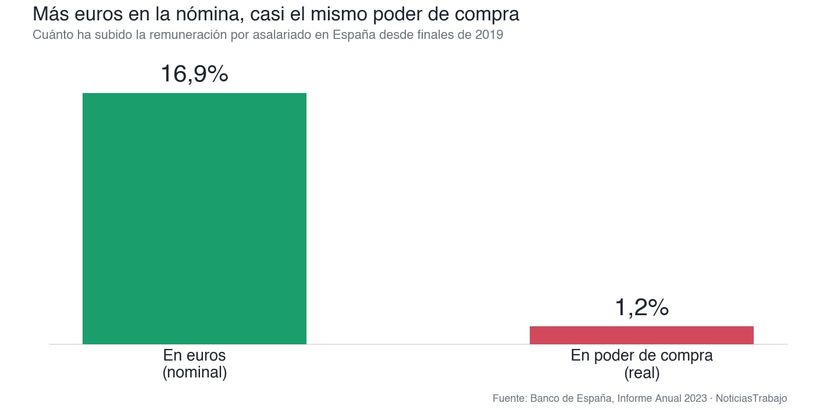
According to the Annual Report 2023 from the Bank of Spain explains that, since the end of 2019, compensation per employee has grown by 16.9% in nominal terms, and yet in real terms it remains at a poor 1.2%. In other words, almost 15 points have been eaten up by inflation, especially due to the price increase in 2022 and 2023.
But this situation is not from now. The OECD has been warning for years that the real salary in Spain has not moved from zero since the 90s, and that even in the 2010s it even fell, in such a way that there were about 10 years where many people lost purchasing power despite having a job.
The key is in productivity
According to the report Reviving Broadly Shared Productivity Growth in Spain The OECD report of June 2024 explains that productivity per hour worked grows in Spain by 0.5% annually on average, less than half of the 1.2% recorded by the organization as a whole. This slowdown began in the mid-90s where it came with more force in Spain than in almost any advanced economy.
The Bank of Spain and according to its accounts, between 2019 and 2023 the GDP per hour worked barely moved 0.8%, and productivity per employee even fell by 1.4%, and all of this in full employment record. The institution explains it almost as a physical law, because for an economy that has seen little improvement in productivity for years, it is incredibly difficult to raise salaries without prices skyrocketing.
The OECD explains that the burden is mainly against companies and regions that have been left behind, since the country’s leading companies follow the European pace and it is the rest that pull the group down. He Observatory of the BBVA Foundation and the Ivie Add to the list the small size of the typical Spanish company, the little invested per worker and wasted human capital, with graduates doing jobs that are too small for them.
The minimum wage paradox
The Minimum Interprofessional Wage has grown considerably in the last ten years, going from 735.90 euros in 2018 to 1,184 euros per month in 2025, an increase that the OECD, in its analysis of the Spanish economy in 2025rate at 30.2% in real terms, well above what inflation and productivity have risen. In other words, those who earn the least are the ones who have noticed it the most.
Since most salaries remain above the minimum and depend on agreements and the performance of each sector, real progress remains unchanged. The INE explains why the average annual salary remained at 28,049 euros in 2023, according to the Salary Structure Survey, while the most common salary, the one that most people earn, did not exceed 15,575 euros.
All in all, we can only say that living in Spain is cheaper than in northern Europe, since if we adjust salaries to what things cost (purchasing power), Spain improves a little on that list. Even so, we do not even reach the European average and we are still very far from countries like Ireland, Germany or Denmark.
Unions and companies signed an agreement to raise salaries (4% in 2023 and 3% in 2024 and 2025) to try to ensure that workers do not lose money due to rising prices. In 2024 it worked and salaries rose more than life, but in 2025 things became too expensive again. In the end, the little that had been gained is being lost again.