


The average price of electricity for this Sunday, May 24, 2026 is 26.32 euros per megawatt hour (MWh) in the wholesale market, according to data published by the Iberian Energy Market Operator (OMIE). This represents a decrease compared to the This Saturday’s price was 36.52 eurosmeaning that electricity is 27.91 cheaper (10.20 euros less).
It must be taken into account that the amount paid in the wholesale market differs from the cost that consumers have with a regulated or indexed rate in the free market. This price is usually higher because it includes other concepts and will be announced late in the afternoon.

The price of electricity today, Monday, May 25, in the PVPC skyrockets and leaves 3 sections above 200 euros

The price of electricity this Monday, May 25, rises although there will be 8 sections below 0 euros
When is electricity cheaper this Sunday?
The cheapest hour of electricity will be from 12:00 to 1:00 p.m., with a price of -2.10 euros/MWh, although there will be 9 sections below 0 euros.
When is electricity most expensive tomorrow, Sunday?
On the contrary, the maximum peak of electricity will be from 10:00 p.m. to 11:00 p.m. with a price of 89.80 euros/MWh, and the closest time slots such as the sides of the day should be avoided.
Price of electricity by hour, Sunday, May 24
It must be taken into account that despite the decrease, the difference between the different sections is considerable. For this reason, it is advisable to review the price of electricity hour by hour shown in the following list.
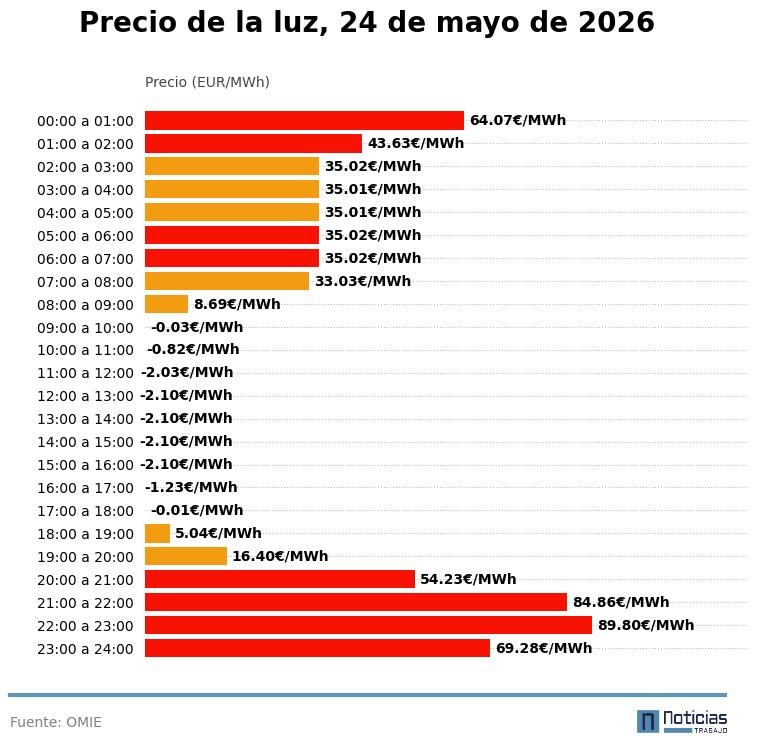
| Hour | Price (euros/MWh) |
|---|---|
| 00:00 – 01:00 | 64.07 |
| 01:00 – 02:00 | 43.63 |
| 02:00 – 03:00 | 35.02 |
| 03:00 – 04:00 | 35.01 |
| 04:00 – 05:00 | 35.01 |
| 05:00 – 06:00 | 35.02 |
| 06:00 – 07:00 | 35.02 |
| 07:00 – 08:00 | 33.03 |
| 08:00 – 09:00 | 8.69 |
| 09:00 – 10:00 | -0.03 |
| 10:00 – 11:00 | -0.82 |
| 11:00 – 12:00 | -2.03 |
| 12:00 – 13:00 | -2.10 |
| 13:00 – 14:00 | -2.10 |
| 14:00 – 15:00 | -2.10 |
| 15:00 – 16:00 | -2.10 |
| 16:00 – 17:00 | -1.23 |
| 17:00 – 18:00 | -0.01 |
| 18:00 – 19:00 | 5.04 |
| 19:00 – 20:00 | 16.40 |
| 20:00 – 21:00 | 54.23 |
| 21:00 – 22:00 | 84.86 |
| 22:00 – 23:00 | 89.80 |
| 23:00 – 24:00 | 69.28 |
Evolution of the price of electricity in these 24 days of May
The average price during these first 24 days of May has been 52.25 euros/MWh, which means that electricity is now 34.67 euros more expensive compared to a year ago, when the average price was €17.58/MWh.
If you compare today’s day with that of just a year ago, you can see an xxxx of 265.56%. It is so because the On May 24, 2025, the price of electricity stood at €7.20/MWhwhile the price today stands at €26.32/MWh, which represents an increase of €19.12 compared to the same date last year.
| Date | 2025 | 2026 | Difference in euros/MWh |
|---|---|---|---|
| May 1 | 13.29 | 57.87 | 44.58 |
| May 2 | 10.94 | 43.64 | 32.70 |
| May 3 | 16,17 | 48.13 | 31.96 |
| May 4 | 11 | 69.71 | 58.71 |
| May 5 | 10.89 | 64.34 | 53.45 |
| May 6 | 10.24 | 78.02 | 67.78 |
| May 7 | 19.01 | 86.90 | 67.89 |
| May 8 | 16.76 | 64.69 | 47.92 |
| May 9 | 18.24 | 33.80 | 15.56 |
| May 10 | 9.08 | 20.84 | 11.76 |
| May 11 | 96.94 | 50.66 | -46.28 |
| May 12 | 21.69 | 69.23 | 47.54 |
| May 13 | 41.42 | 48.26 | 6.84 |
| May 14 | 30.55 | 53.34 | -22.79 |
| May 15 | 11.62 | 37.73 | 26.11 |
| May 16 | 4.68 | 41.78 | 37.10 |
| May 17 | 10.64 | 45.82 | 35.18 |
| May 18 | 6.76 | 60.72 | 53.96 |
| May 19 | 12.85 | 45.85 | 33 |
| May 20 | 13.41 | 56.03 | 42.62 |
| May 21 | 20.19 | 57.75 | 37.56 |
| May 22 | 3.35 | 56.14 | 52.79 |
| May 23 | 5.11 | 36.52 | 31.41 |
| May 24 | 7.20 | 26.32 | 19.12 |
How storms and extreme events affect the electricity supply
The increase in extreme weather events is putting power grids to the test in many countries, including Spain. Intense storms, floods or strong gusts of wind can cause damage to electrical infrastructure and power outages in certain areas.
When incidents occur on the network, electricity companies must activate backup systems and carry out urgent repair work to guarantee supply. These additional costs can end up having an indirect impact on the electrical system and the price of energy.
In addition, extreme weather events also affect renewable production. The lack of wind, droughts or heat waves reduce the performance of some technologies, forcing the use of more expensive energies such as natural gas to meet demand.