

The average price of electricity for this Saturday, May 23, 2026, plummets by 40.82%, settling at 82.73 euros per megawatt hour (euros/MWh) according to data published by Red Eléctrica for consumers with a regulated or indexed rate in the free market. This, to your pocket, means paying 57.06 euros less if you take into account the price of electricity this Friday, May 22, when it cost 139.79 euros.
This price is known as the Voluntary Price for Small Consumers (PVPC) and is different from the one published by the Iberian Energy Market Operator (OMIE) at midday. The latter is usually cheaper because it does not have tolls or taxes, which do appear in the PVPC.

The price of electricity today, Monday, May 25, in the PVPC skyrockets and leaves 3 sections above 200 euros

The price of electricity this Monday, May 25, rises although there will be 8 sections below 0 euros
What time is electricity cheaper today, Saturday, May 23?
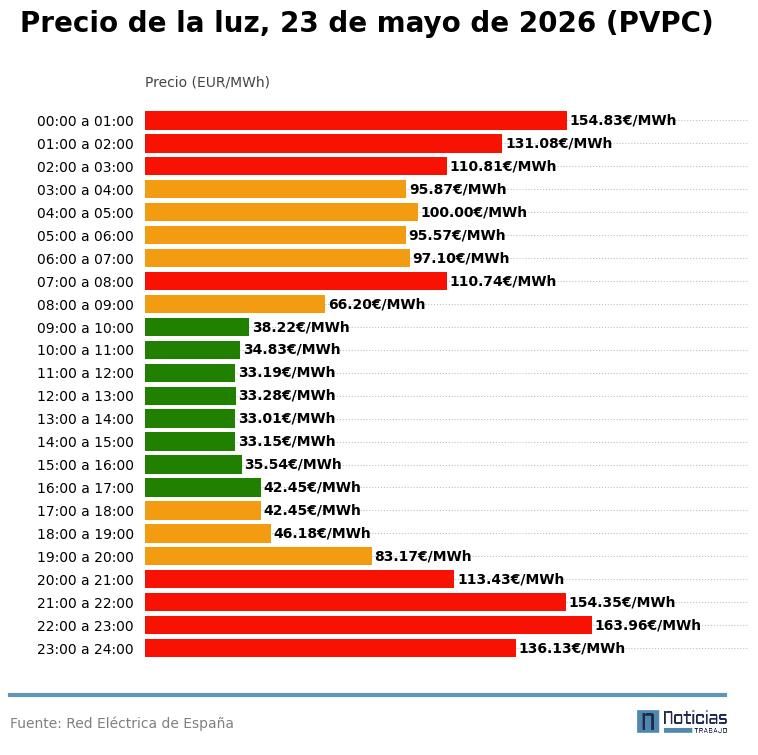
The cheapest hour will be from 1:00 p.m. to 2:00 p.m., with a price of 33.01 euros/MWh with other cheap periods from nine in the morning to four in the afternoon.
When is electricity most expensive today, Saturday, May 23
The most expensive hour will be from 10:00 p.m. to 11:00 p.m. with a price of 163.96 euros/MWh. It is advisable to avoid the late hours of the night and early morning to avoid surprises on your electricity bill since that is when the highest peaks are recorded.
Price of electricity per hour Saturday, May 23
The electricity plummets during the first day of the weekend, with prices that do not reach 40 euros during the cheapest periods. On the other hand, we must avoid those moments in which the light shoots above 100 euros, starting at 8:00 p.m.
To know exactly the price of electricity hour by hour during the 24 days of the day and program consumption, you can consult the following graph and list prepared with official data from Red Eléctrica Española.
- 00:00 to 01:00: 154.83 euros/MWh
- 01:00 to 02:00: 131.08 euros/MWh
- 02:00 to 03:00: 110.81 euros/MWh
- 03:00 to 04:00: 95.87 euros/MWh
- 04:00 to 05:00: 100.00 euros/MWh
- 05:00 to 06:00: 95.57 euros/MWh
- 06:00 to 07:00: 97.10 euros/MWh
- 07:00 to 08:00: 110.74 euros/MWh
- 08:00 to 09:00: 66.20 euros/MWh
- 09:00 to 10:00: 38.22 euros/MWh
- 10:00 to 11:00: 34.83 euros/MWh
- 11:00 to 12:00: 33.19 euros/MWh
- 12:00 to 13:00: 33.28 euros/MWh
- 1:00 p.m. to 2:00 p.m.: 33.01 euros/MWh
- 2:00 p.m. to 3:00 p.m.: 33.15 euros/MWh
- 15:00 to 16:00: 35.54 euros/MWh
- 16:00 to 17:00: 42.45 euros/MWh
- 17:00 to 18:00: 42.45 euros/MWh
- 18:00 to 19:00: 46.18 euros/MWh
- 19:00 to 20:00: 83.17 euros/MWh
- 20:00 to 21:00: 113.43 euros/MWh
- 21:00 to 22:00: 154.35 euros/MWh
- 22:00 to 23:00: 163.96 euros/MWh
- 23:00 to 24:00: 136.13 euros/MWh
The Government awards 512 million in aid to modernize wind farms and hydroelectric plants
The Ministry for the Ecological Transition, through the IDAE, has provisionally awarded 512 million euros in aid for wind and hydroelectric repowering within the Circular Repowering 2 program. In total, 149 projects in 16 autonomous communities will benefit, distributed among 80 wind turbine modernization initiatives and 69 actions in hydroelectric plants of up to 50 MW. This aid comes from the NextGenEU funds of the Recovery Plan and expands the momentum started in the first call, in which 186 million were already granted.
Most of the aid is allocated to wind projects, with 462 million euros, while hydroelectric modernization will have 50 million. Galicia heads the provisional list with 35 files, followed by Andalusia and Castilla y León, with 24 projects each. Altogether, the actions will involve 2 GWh of new storage capacity, 3.3 GW of additional power and will mobilize an investment of more than 3.7 billion euros.
The projects must be executed before June 30, 2030, although the deadline could be extended until December 31, 2030. The objective is to replace old facilities with more efficient equipment, with less environmental impact and greater capacity to support the electrical system. In the case of wind power, repowering will allow reducing the number of wind turbines, reducing the landscape impact and maintaining economic activity in rural areas.