


Add NewsWork in 
The Tourist Use Housing (VUT) sector in Spain has entered a phase of strict regulation that grants unprecedented power to neighboring communities. Currently, the transformation of a residential home into a holiday accommodation no longer depends solely on the will of the owner, but is subject to the majorities established in the owners’ meeting.
According to current regulations, the rest of the neighbors have direct legal tools to limit or prohibit this activity in their building, thus ending years of uncontrolled growth in housing blocks.

A millennial who grew up in the 1990s: “what boomers don’t understand about us is that we work three times as hard for a third of what they did at our age”

Marketing experts are not shy about Zapatero’s daughters: “it’s the first time I’ve seen it”
The end of ‘anything goes’
This change in cycle is clearly reflected in official data. According to the National Institute of Statistics (INE), in February 2026 alone, there was a 12.4% reduction in the number of active tourist apartments compared to the previous year.
Currently, there are some 329,764 homes of this type throughout the country, which represents just 1.24% of the total real estate stock. Cities like Madrid have led this decline with the application of the Reside Plan, which has caused the loss of more than 3,000 licenses during the last year alone.
Regulatory pressure has transformed what was previously considered “easy money” into an activity with high administrative demands. Among the new obligations, the Information Model 2026 (Order VAU/1560/2025) stands out, which requires owners to detail each stay and guest before the Treasury. In addition, the market has been limited by physical restrictions: since March, no home with a surface area of less than 25 m² can legally operate as a tourist apartment in high-pressure regions such as Madrid.
What does article 17.12 say?
The definitive legal tool for residents is found in Article 17.12 of the Horizontal Property Law (LPH). This legal precept is what empowers the owners’ associations to veto the opening of new tourist accommodation in their property.
For this prohibition to be effective, the law no longer requires the unanimity of all the owners, but rather the favorable vote of three-fifths (3/5) of the neighbors who, in turn, represent three-fifths of the participation fees, is sufficient. But the capacity for neighborhood intervention does not end with the veto. That same article 17.12 allows the community to agree to a surcharge on the receipt of the common fees for these properties.
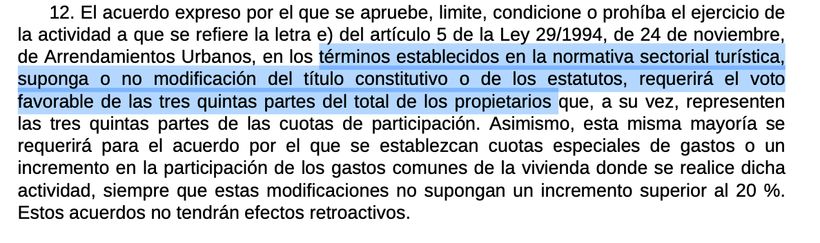
Given that passenger traffic generates more intensive use of elevators, doorways and landings, residents can vote, also by a 3/5 majority, for an increase of up to 20% in community expenses for the tourist apartment. It is a way to compensate for the extra wear and tear and inconvenience resulting from commercial activity in a residential environment.
Fiscal asphyxiation
In addition to the surveillance of neighbors, relentless digital control is added. Platforms such as Airbnb or Booking are prohibited by law from showing advertisements that do not have the Unique Rental Registration Number (NRUA).
Without this identifier, the apartment is invisible and its exploitation is illegal. Furthermore, in destinations like Barcelona, the tourist tax has risen to 5 euros per night, a cost that seeks to discourage the VUT model in favor of traditional hotels or long-term rentals.
Finally, tax equalization is finally tightening the fence on the owner’s net profit. The mandatory application of 10% VAT to all short-stay rentals is being processed, eliminating its competitive advantage.
Faced with this scenario of tax control, constant inspections and the right to veto of the owners’ boards, the small investor is progressively returning to traditional rentals, seeking the stability of a long-term tenant in the face of the growing complications of the vacation market.