
The amount of the retirement pension depends on the contribution bases and the total number of years worked, so the unemployment rate or the sector where contributions are made will have an influence. In fact, if we look at the latest data from the Ministry of Inclusion, Social Security and Migration and the National Institute of Statistics (INE); Vizcaya is at the head of the entire country, where a total of 200,213 retirees receive an average benefit of 1,933.39 euros per month. This figure far exceeds the national retirement average, which stands at 1,566.81 euros. Vizcaya is also one of the provinces in Spain with the lowest unemployment rate in the country.
The data show that provinces with a more powerful industry and historically higher salaries end up concentrating the most generous pensions in the public system. Between the maximum in Vizcaya and the minimum in Ourense (€1,131.24) there is a difference of 802.15 euros per month, which represents almost 71% more pension for Biscayan retirees compared to Galician retirees. At the level of autonomous communities, the disparity is even greater in percentage terms, although with more contained absolute figures: the Basque Country (€1,901.08) exceeds Extremadura (€1,337.44) by 563.64 euros, revealing structural inequalities in the work history and contributions of each region.
Other regions with high figures are the Principality of Asturias, with an average of 1,834.99 euros, and the Community of Madrid, which reaches an average of 1,790.49 euros for its more than 880,000 pensioners. Navarra (€1,749.23) and Cantabria (€1,653.99) complete the top-5while the communities with the lowest pensions are Extremadura, Galicia and Castilla-La Mancha, where the average retirement pension does not reach 1,480 euros per month.
The provinces with the highest unemployment rate and where the retirement pension reaches the limit
At the other end of the scale, areas that suffer a higher unemployment rate generally have retirement pensions that are much lower than the national average. Andalusian provinces such as Granada and Cádiz lead the negative employment figures with unemployment of 21.34% and 20.82% respectively. However, their reality in retirement is different, because while the people of Cádiz maintain a pension of 1,611.15 euros thanks to the old contributions from their naval industry, the people of Granada barely reach 1,350.33 euros, remaining well below the state average.
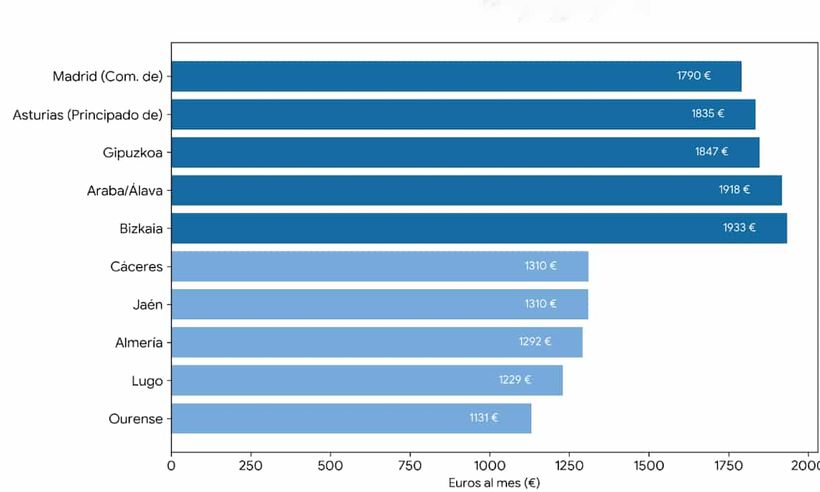
Where structural unemployment and job insecurity are most noticeable is in Jaén and Badajoz. With unemployment rates of 18.95% and 17.59%, these territories historically dependent on the agricultural sector see their retirement benefits fall to 1,309.66 and 1,358.41 euros per month. These figures show that prolonged periods of work inactivity or temporary employment end up definitively weighing down the contribution bases at the time of retirement.
Now, current unemployment is not the only factor that affects the checkbook of retirees. Areas such as Orense and Lugo present apparent stability with unemployment rates of 9.77% and 7.35%, but they occupy the last place in Spain in the amount of their pensions. Their bare 1,131.24 and 1,229.49 monthly retirement pensions reveal that the quality of past employment and the historical weight of the rural minimum bases are factors as determining as having a contract in force.
Comparisons between the unemployment rate and permanent disability and widowhood
This economic gap is not exclusive to retirements, but pensions for permanent disability and widowhood reflect this same pattern of territorial inequality. At the national level, the average disability benefit stands at 1,253.57 euros, while widowhood benefits remain at a tight 972.78 euros. However, provinces with strong productive fabrics and low unemployment, as is the case of Vizcaya and Álava, manage to protect these benefits with substantially higher amounts.
The data perfectly illustrates this distance. In Vizcaya, where unemployment is almost negligible compared to other provinces, the average pension for permanent disability amounts to 1,567 euros per month, and the pension for widowhood reaches 1,186.89 euros. If we compare these amounts with those of a province heavily affected by unemployment like Jaén, the drop is drastic. In the territory of Jaen, disability stagnates at 1,098 euros and widows receive an insufficient 866 euros, bordering in many cases the threshold of risk of poverty.
However, Social Security figures show that the health of the labor market determines the economic protection of the entire family unit. In the less favored territories, such as Orense, the widow’s pension marks the bottom of the country with a mere 715.77 euros. The benefits map demonstrates unequivocally that temporary employment, low salaries and chronic unemployment today are the mathematical guarantee of precarious pensions in the future.